Study finds link between Parkinson's disease genes and manganese poisoning
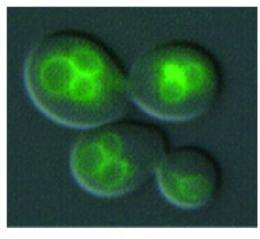
A connection between genetic and environmental causes of Parkinson's disease has been discovered by a research team led by Aaron D. Gitler, PhD, Assistant Professor in the Department of Cell and Developmental Biology at the University of Pennsylvania School of Medicine. Gitler and colleagues found a genetic interaction between two Parkinson's disease genes (alpha-synuclein and PARK9) and determined that the PARK9 protein can protect cells from manganese poisoning, which is an environmental risk factor for a Parkinson's disease-like syndrome. The findings appear online this week in Nature Genetics.
Manganism, or manganese poisoning, is prevalent in such occupations as mining, welding, and steel manufacturing. It is caused by exposure to excessive levels of the metal manganese, which attacks the central nervous system, producing motor and dementia symptoms that resemble Parkinson's disease.
In Parkinson's patients, the alpha-synuclein protein normally found in the brain misfolds, forming clumps. Yeast cells, the model system in which Gitler studies disease proteins, also form clumps and die when this protein is expressed at high levels. These are the same yeast cells that bakers and brewers use to make bread, beer, and wine.
As a postdoctoral fellow at the Whitehead Institute in Cambridge, Massachusetts, Gitler and colleagues started looking for genes that could prevent the cell death caused by mis-folded alpha-synuclein in yeast. Eventually they found a few genes to test in animal models and some were able to protect neurons from the toxic effects of alpha-synuclein. "One of the genes that we found was a previously uncharacterized yeast gene called YOR291W. No one knew what it did back in 2006," he recalls.
In the meantime, researchers in Europe published studies about a family that had an early-onset form of a type of Parkinson's disease caused by mutations in the PARK9 gene. "When I read about this study, I wondered what the closest yeast gene was to the human PARK9 gene and it turned out to be YOR291W," explains Gitler. "It was one of the genes that could rescue alpha-synuclein toxicity from our yeast screen. That was the big Eureka! and completely unexpected. It suggested that Parkinson's disease genes could interact with each other in previously unexpected ways."
Because of its similarity to the human PARK9 gene, Gitler and colleagues renamed the yeast gene to YPK9 (which stands for Yeast PARK9). Researchers at Purdue University and The University of Alabama teamed up with Gitler and his colleagues to show that the PARK9 gene could also protect neurons from alpha-synuclein's toxic effects.
Next, the team set out to find the function of YPK9. Study co-first author, postdoctoral fellow Alessandra Chesi, PhD, discovered that YPK9 encodes a metal transporter protein. "Its sequence looks like other proteins that we know transport metals," says Chesi.
She deleted the YPK9 gene from yeast and the cells were fine. Then she exposed YPK9-deficient yeast cells to an excess of different metals -- zinc, copper, manganese, iron, etc. -- to determine which metal it might transport. Of all the metals Chesi tested, she found that in the presence of manganese, the YPK9-deficient yeast did not grow as well. They were hypersensitive to manganese.
"This was astonishing, because it was known for years that welders and miners that inhale manganese get a Parkinson's-like disease called manganese poisoning," says Chesi. "The specific neurons that are lost in the miners are from the globus pallidus, a brain motor center. The European parkinsonism patients with the PARK9 mutation also lose neurons in this region."
Gitler then found that the protein made by YPK9, the yeast gene equivalent of PARK9, is localized to the vacuole membrane in the yeast cell. Vacuoles are inner cell components that wall off toxic substances for later disposal. "Our hypothesis is that the vacuole, a bag in the cell that captures toxins, is sitting there and taking in manganese and sequestering it for detoxification, keeping it away from other cell organelles," explains Gitler. "But, having a mutation in the PARK9 gene causes problems for this process in yeast and possibly in humans".
"It's an interesting story that we've discovered in yeast and it will be important to see if it holds up in people. What's new is the connection between genetic and environmental causes of Parkinson's. How does PARK9 protect against alpha-synuclein toxicity and how does PARK9 help prevent manganese poisoning? This is what we will be investigating next."
Source: University of Pennsylvania


