New technique images tumor vessel leakiness to predict breast cancer chemotherapy outcome
Chemotherapy is an integral part of modern cancer treatment, but it's not always effective. Successful chemotherapy depends on the ability of anticancer drugs to escape from the bloodstream through the leaky blood vessels that often surround tumors.
Predicting chemotherapy's efficacy could save thousands of individuals from unnecessary toxicity and the often difficult side effects of the treatments.
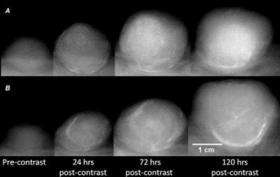
In a study published in the February issue of the journal Radiology, researchers describe a technique for determining the "leakiness" of tumor blood vessels using a simple digital mammography unit. The researchers designed nanometer-sized capsules containing a contrast agent that could only leak into tumors with blood vessels that were growing and therefore leaky. The digital mammography-based quantification of "leakiness" is closely correlated to the ability of a clinically approved chemotherapy agent to enter the tumor, allowing the researchers to predict the agent's therapeutic efficacy.
"We developed a quantitative way to measure the leakiness of the blood vessels, which is directly linked to the amount of drug that gets to the cancer and in turn determines effectiveness," said Ravi Bellamkonda, a professor in the Wallace H. Coulter Department of Biomedical Engineering at Georgia Tech and Emory University. "By simply measuring how much contrast agent reaches the tumor, we can predict how much of a clinically approved chemotherapeutic will reach the tumor, allowing physicians to personalize the dose and predict effectiveness."
In some cases, one chemotherapy drug may not be effective in treating the tumor, but this new technique allows oncologists to investigate other drugs sooner since they know the drug is reaching the tumor. Studies are currently underway to determine if mammography can predict the optimal dose of a wide range of breast cancer chemotherapeutics.
Bellamkonda and Coulter Department postdoctoral fellow Efstathios Karathanasis collaborated on this study with Ioannis Sechopoulos, an assistant professor in radiology at Emory University; Andrew Karellas, a former professor in the Emory University Winship Cancer Institute currently at the University of Massachusetts Medical School; and Ananth Annapragada, an associate professor of health information sciences at the University of Texas, Houston. The project was funded by the National Science Foundation and Georgia Cancer Coalition.
For the study, a long-circulating nanometer-scale liposomal capsule filled with iodinated contrast agent was injected into rats with six-day-old breast cancer tumors. For the next three days, the researchers collected digital mammography images of the animals and compared the pre- and post-injection grayscale intensity values to study the dynamics of how the contrast agent accumulated in the tumor over time.
"During the three-day time course, some tumors exhibited a rapid and significant increase in image brightness, meaning the contrast agent was accumulating in the tumor, whereas other tumors showed a slow and low increase," said Bellamkonda, who is also a Georgia Cancer Coalition Distinguished Scholar.
While the brightness of the tumors in the images changed significantly, no variations were observed in non-tumor areas or in the tumors of animals that did not receive the contrast agent. Immediately after the imaging was completed and the leakiness of each individual cancer vessel was quantified, the animals were intravenously injected with a clinically approved chemotherapy drug, liposomal doxorubicin.
Results showed that the chemotherapeutic drug slowed the progress of the tumor. The variability in uptake of the contrast agent by the tumors, as measured during the three-day imaging sessions, provided an accurate prognosis of the effect of liposomal doxorubicin on tumor growth rate.
"When we plotted the post-treatment tumor growth rate versus the intensity of leakiness, there was a significant and strong correlation," noted Bellamkonda. "The tumors in which the nanocarrier leaked out and accumulated the most in the tumors during the initial three-day test were the ones that responded best to the treatment."
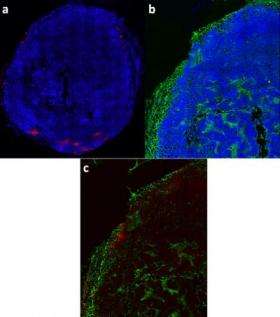
To verify that the intensity changes in the images were caused by the nanocarrier and not endogenous changes in the tumor tissue, liposomal probes tagged with a fluorescent dye were injected into the animals. By looking at histological tumor sections, the researchers showed that the location of the increased image brightness and the fluorescent dye were the same.
"This study showed that higher uptake of the probe by the tumor related to leakier vasculature and suggested a better therapeutic outcome of liposomal doxorubicin," said Bellamkonda. "Imaging the integrity of the tumor vasculature like this may allow cancer treatment to be more patient-specific and potentially spare patients from chemotherapy if it is not going to be effective."
While the goal of the study reported in the journal was not to induce tumor regression, the researchers plan to investigate whether the liposomal probes can be used for this purpose in the future. To further develop and commercialize these multifunctional probes, Bellamkonda and Annapragada founded a start-up company called Marval Biosciences, Inc.
The researchers also want to investigate whether the leakiness of tumor vasculature represents a parameter that is useful for clinical diagnosis or tumor characterization.
"We want to study the molecular basis for blood vessel leakiness," said Bellamkonda. "We want to understand why there is variation in leakiness and chemotherapy effectiveness among individuals with tumors of the same type, size and stage."
Source: Georgia Institute of Technology


