Slow Down -- Those Lines On The Road Are Longer Than You Think
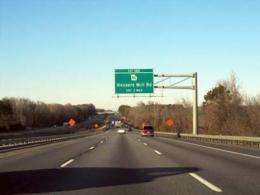
Take a guess -- how long are the dashed lines that are painted down the middle of a road? If you're like most people, you answered, "Two feet."
The real answer is 10 feet. That's the federal guideline for every street, highway, and rural road in the United States, where dashed lines separate traffic lanes or indicate where passing is allowed.
A new study has found that people grossly underestimate the length of these lines -- a finding which implies that we're all misjudging distances as we drive, and are driving too fast as a result.
Dennis Shaffer, assistant professor of psychology at Ohio State University's Mansfield campus, led the study, which appeared in the journal Perception & Psychophysics.
Shaffer and his colleagues tested more than 400 college students in three experiments. When asked to guess the length of the lines from memory, most answered two feet. Even when the students were standing some distance away from actual 10-foot lines or riding by them in a car, they judged the size to be the same: two feet.
"We were surprised, first, that people's estimates were so far off, and second, that there was so little variability," Shaffer said.
The finding holds implications for traffic safety. Each dashed line measures 10 feet, and the empty spaces in-between measure 30 feet. So every time a car passes a new dashed line, the car has traveled 40 feet. But in this study, people consistently judged the lines and the empty spaces to be the same size, claiming that both were two feet.
"This means that to most people, 40 feet looks like a lot less than 40 feet when they're on the road," Shaffer said. "People cover more ground than they think in a given period of time, so they are probably underestimating their speed."
He acknowledges that the study will come as no surprise to transportation engineers, some of whom his team consulted with during the study. But this is the first study to quantify Americans' misperceptions of the lines.
Shaffer began this research when he was a graduate student at Kent State University in 1995, and continued it while he was on the faculty of Arizona State University's West Campus, and now at Ohio State. At each university, he and his colleagues measured lines on a variety of roads in the area.
Over those years, the federal guideline for line size has shrunk from 15 feet to 10 feet. Wherever the researchers went, they found all lines to be close to the federal guidelines of the time. In Arizona in 2000, for instance, some lines were 16 feet long instead of the expected 15.
But even back then -- when the federal guideline was 15 feet -- people still thought of lines as measuring only two feet.
"It was ridiculous," Shaffer said. "We talked to different people in different states, over different years, and whether the lines were 15 feet or 10 feet, people still estimated them to be two feet."
One possible explanation: as we drive, we look out far ahead the car for safety reasons, so the only lines we really see are faraway lines that look small.
Even though lines appear to expand as a car passes by, drivers can't safely notice that effect. Rather, the first line we can comfortably look at while driving safely is some 120 feet ahead -- the fourth line ahead on the road. So perhaps we think that all lines are as small in reality as that one faraway line appears to be.
Some researchers have proposed the idea of "size constancy" to explain our perceptions -- meaning that we see an object as being the same size, no matter how close or far away it is, Shaffer said.
"That seems to be the case for lines on the road, because even if you know how long they are, they still look two feet," he added. "To have a correct perception of the size of an object, you have to be familiar with the object in advance. And that's the clincher. Very few people are familiar with the size of a line on the road in advance."
In the first experiment, researchers gave participants a written test in which they were asked how long they believed the lines and the spaces in-between to be. In the second experiment, the researchers took a piece of paper that was the exact size and shape of a dashed line and taped it to the ground. Participants stood either 60 or 120 feet from the line, and looked at it at an angle close to their line of sight, as they would see it if they were driving down a road. In the third experiment, participants sat in the front or rear passenger seat of a car, and were asked to study the lines and spaces while a researcher drove down an actual road at either 25 or 60 miles per hour.
As to why everyone's estimates were consistent in every experiment, Shaffer suspects that the answer has something to do with how our brains perceive geometry. Engineers design roads, buildings, and public spaces using Euclidian geometry -- the system of lines and angles first described by the ancient Greek mathematician Euclid. But this study and previous ones suggest that our brains perceive objects in a non-Euclidian way.
In the future, Shaffer will examine how people perceive the size of lines that are oriented at different angles -- as if seen by a driver approaching a bend in a road -- and how our perceptions affect our ability to judge the steepness of hills.
Source: Ohio State University


