NASA and Google Launch Virtual Exploration of Mars
February 2, 2009 Mars

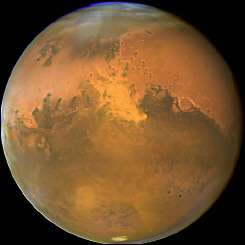
This NASA Hubble Space Telescope image shows Mars in 2005.

(PhysOrg.com) -- NASA and Google announced Monday the release of a new Mars mode in Google Earth that brings to everyone's desktop a high-resolution, three-dimensional view of the Red Planet.

Besides providing a rich, immersive 3D view of Mars that will aid public understanding of Mars science, the new mode, Google Mars 3D, also gives researchers a platform for sharing data similar to what Google Earth provides for Earth scientists.

The mode enables users to fly virtually through enormous canyons and scale huge mountains on Mars that are much larger than any found on Earth. Users also can explore the Red Planet through the eyes of the Mars rovers and other Mars missions, providing a unique perspective of the entire planet.

Users can see some of the latest satellite imagery from NASA's Mars Reconnaissance Orbiter and other probes orbiting the Red Planet. Viewers can learn about new discoveries and explore indexes of available Mars imagery. The new Mars mode also allows users to add their own 3D content to the Mars map to share with the world.

Today's announcement is the latest benefit from a Space Act Agreement NASA's Ames Research Center in Moffett Field, Calif., signed with Google in November 2006. Under its terms, NASA and Google agreed to collaborate to make NASA's data sets available to the world.

NASA Ames, along with its partners at Google, Carnegie Mellon University, SETI, and other institutions, helped produce the data to make this possible.

Google's innovative search technologies connect millions of people around the world with information every day. Google is headquartered close to Ames in Silicon Valley with offices throughout the Americas, Europe and Asia.

Provided by NASA


print this article email this article download pdf blog this article bookmark this article     Stumble it Digg this share on Facebook retweet share on Reddit add to delicious
Rate this story - 4.7 /5 (3 votes)


February 2, 2009 all stories

Comments: 0

4.7 /5 (3 votes)
  • Stumble this up

  • Digg this

  • share this

  • hide
  • Related Stories

  • A Mars Rover Named 'Curiosity'
    created Oct 30, 2009 | popularity not rated yet | comments 0
  • New concept may enhance Earth-Mars communication
    created Oct 16, 2009 | popularity not rated yet | comments 0
  • Lava flows in Daedalia Planum
    created Oct 09, 2009 | popularity not rated yet | comments 0
  • Seeking Life's Shadow
    created Oct 01, 2009 | popularity not rated yet | comments 0
  • Biosphere 2 Opens Phoenix Mars Lander Exhibit
    created Sep 18, 2009 | popularity not rated yet | comments 0


  • hide
  • Relevant PhysicsForums posts

  • The shape of our solar system's orbits.
    created Nov 07, 2009
  • Above or Below the Line of Nodes
    created Nov 07, 2009
  • Supernova vs. Nova?
    created Nov 07, 2009
  • Supernova's Gamma Rays and Comets
    created Nov 06, 2009
  • More from Physics Forums - General Astronomy

Other News

Deep creep means milder, more frequent earthquakes along Southern California's San Jacinto fault

Deep creep means milder, more frequent earthquakes along Southern California's San Jacinto fault

Space & Earth / Earth Sciences

created 16 hours ago | popularity 4.5 / 5 (4) | comments 0

With an average of four mini-earthquakes per day, Southern California's San Jacinto fault constantly adjusts to make it a less likely candidate for a major earthquake than its quiet neighbor to the east, the ...


Success in 'space elevator' competition (AP)

Success in 'space elevator' competition (Update 3)

Space & Earth / Space Exploration

created Nov 05, 2009 | popularity 4.3 / 5 (33) | comments 50

(AP) -- A robot powered by a ground-based laser beam climbed a long cable dangling from a helicopter on Wednesday to qualify for prize money in a $2 million competition to test the potential reality of the ...


In a Galaxy Far, Far Away...

In a Galaxy Far, Far Away...

Space & Earth / Astronomy

created Nov 06, 2009 | popularity 4.8 / 5 (5) | comments 17

(PhysOrg.com) -- Astronomers have published the discovery of the farthest known object in the cosmos: a star that exploded when the universe was only 630 million years old -- only 4.6% of its current age. ...


'Dropouts' pinpoint earliest galaxies

'Dropouts' pinpoint earliest galaxies

Space & Earth / Astronomy

created Nov 06, 2009 | popularity 4.2 / 5 (10) | comments 13

Astronomers, conducting the broadest survey to date of galaxies from about 800 million years after the Big Bang, have found 22 early galaxies and confirmed the age of one by its characteristic hydrogen signature ...


Space hotel taking bookings for 2012 opening

Space hotel taking bookings for 2012 opening

Space & Earth / Space Exploration

created Nov 05, 2009 | popularity 4.4 / 5 (21) | comments 11

(PhysOrg.com) -- The first orbiting space hotel is on track to open for its first customers in 2012, but hurry, as bookings are filling fast.