New control of nanoscale 'magnetic tornadoes' holds promise for data storage
February 2, 2009
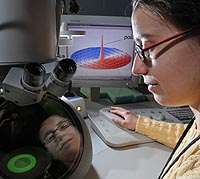
Argonne materials scientist Mihaela Tanase observes a small magnetic disk with a transmission electron microscope. Tanase discovered a new method to control the way the atoms in the magnetic disk orient themselves to form "nanoscale vortices," which are illustrated on the computer screen.
(PhysOrg.com) -- At the human scale, the tightly wrapped spinning columns of air in a tornado contain terrifying destructive power that ravages communities. At the nanoscale, however, closely coiled magnetic vortices hold the promise of a new generation of computers.
Researchers at the U.S. Department of Energy's Argonne National Laboratory have discovered a new way to control the rotation - or chirality - of these infinitesimal "magnetic tornadoes."
A vortex forms spontaneously — one vortex per disk — in a small magnetic disk when the disk's diameter falls below a certain limit. Although the vortex does not whirl about like a meteorological tornado, the atoms in the material do orient themselves so that their magnetic states, or "moments," point either clockwise or counterclockwise around the disk's surface. At the center of the disk, the density of this rotation causes the polarity of the vortex core to point either up out of the disk or down like a tornado's funnel.
Conventional computer memories store data in "bits" that consist of two magnetic elements that record data in binary form. When these elements are magnetized in the same direction, the computer reads the bit as a "0"; when magnetized in opposite directions, the bit represents a "1".
Because the vortices that form on the disks contain two independently controllable and accessible magnetic parameters, they could form the basis for quaternary bits that would contain data written as a 0, 1, 2, or 3. "This technology could change the way we look at how to store data electronically," said Argonne materials scientist Mihaela Tanase.
While prior research had shown the way to create the "tornadoes" and control their polarity, scientists had until recently not found an effective way to prevent the chirality from switching randomly between its alternate states. "The hardest part is finding out how to reverse the chirality in a reproducible way,” Tanase said.
Previous studies that stabilized the vortices' chirality relied on asymmetries in the shape of the disk or in the magnetic fields that researchers applied to it. However, asymmetries in the shape of the disk and the applied magnetic fields can cause the accidental switching of neighboring bits.
Tanase and senior materials scientist Amanda Petford-Long tried to create a reliable way of controlling the vortices' chiralities by annealing the magnetic layer in the disk to an antiferromagnetic one, which allowed them to control the magnetic orientation of the atoms in the disk.
By bringing together this interaction, called exchange bias, and the vortex field, researchers would no longer have to rely on asymmetries to manipulate the chirality of the vortices. In the future, this could enable the writing and reading of digital information with greater sensitivity, reliability and efficiency, Tanase said.
A paper based on this research appeared in the January 27 issue of Physical Review B. An abstract can be found online at http://link.aps.or … /v79/e014436 .
Provided by Argonne National Laboratory
-
Synchronized dynamic duos: Controlling how magnetic vortices gyrate together
Aug 26, 2011 |
5 / 5 (4) |
0
-
Mini disks for data storage: Slanted edges favor tiny magnetic vortices
Mar 14, 2011 |
5 / 5 (2) |
0
-
Research elucidates the effect of disorder on magnetic vortex gyration
Mar 01, 2011 |
not rated yet |
0
-
Cassini Shows Saturnian Roller Derby, Strange Weather
Mar 18, 2010 |
5 / 5 (7) |
0
-
Storing data on atomic roundabouts
Oct 10, 2007 |
4.6 / 5 (14) |
1
-
Engineers build first sub-10-nm carbon nanotube transistor
Feb 01, 2012 |
4.9 / 5 (31) |
30
-
Something old, something new: Evolution and the structural divergence of duplicate genes
Jan 31, 2012 |
4.6 / 5 (7) |
1
-
The hidden nanoworld of ice crystals: Revealing the dynamic behavior of quasi-liquid layers
Jan 30, 2012 |
5 / 5 (3) |
1
-
Stock market network reveals investor clustering
Jan 27, 2012 |
3.9 / 5 (23) |
8
-
Of microchemistry and molecules: Electronic microfluidic device synthesizes biocompatible probes
Jan 26, 2012 |
5 / 5 (1) |
0
-
What would happen when a jet travelling at Mach 10 experiences engine failure
2 hours ago
-
Rust from my microwave ruined a nice bowl of soup and also my day
4 hours ago
-
gas leaks in space
8 hours ago
-
Weight required to balance a boom stand?
9 hours ago
-
Questions about Equivalence principle & Einstein Elevator?
11 hours ago
-
Kinetic energy of gas
12 hours ago
- More from Physics Forums - General Physics
More news stories
Explained: Sigma
It's a question that arises with virtually every major new finding in science or medicine: What makes a result reliable enough to be taken seriously? The answer has to do with statistical significance -- but ...
Feb 09, 2012 |
5 / 5 (19) |
76
Quantum physicist explains $100K offer for proof scaled-up quantum computing is impossible
(PhysOrg.com) -- MIT researcher Scott Aaronson has certainly riled the physics community with his offer this past Friday, of $100,000 to anyone who can prove that scaled-up quantum computing is impossible. ...
Diamond light, brighter than the sun
Its the size of five football pitches and generates light 10 billion times brighter than the sun. As the Diamond Light Source celebrates its tenth anniversary this year, Penny Bailey visits one of the ...
Feb 07, 2012 |
4.3 / 5 (7) |
18
|
Physicists 'record' magnetic breakthrough
An international team of scientists has demonstrated a revolutionary new way of magnetic recording which will allow information to be processed hundreds of times faster than by current hard drive technology.
Feb 07, 2012 |
4.5 / 5 (41) |
14
|
Hints of the Higgs - papers are submitted
Back in December 2011, the ATLAS and CMS experiments at CERN presented some exciting results that provided tantalising hints of the Higgs boson.
Feb 08, 2012 |
4.1 / 5 (7) |
10
Injured boomers beware: Know when to see doctor
(AP) -- It happened to nurse Jane Byron years after an in-line skating fall, business owner Haralee Weintraub while doing "men's" push-ups, and avid cyclist Gene Wilberg while lifting a heavy box.
Google might launch Drive for cloud storage soon
(PhysOrg.com) -- Google's next big move, according to the Wall Street Journal, is a cloud storage service called Drive. Hardly first to the plate, Google is simply catching up to introducing its cloud reposi ...
Latin America mining boom clashes with conservation
Latin America is experiencing a mining boom as prices rise fuelled by a hike in global demand, but the region is also being hit by a wave of violent protests, strikes and rallies by environmentalists.
Love a click away in Indonesia's Twitter Republic
He was a geeky kid from Yogyakarta, she a glamorous city girl in Jakarta. In a country with one of the world's most vibrant social networking scenes they fell in love on Twitter.
Europeans protest controversial Internet pact
Tens of thousands of people marched in protests in more than a dozen European cities Saturday against a controversial anti-online piracy pact that critics say could curtail Internet freedom.
Walney offshore wind farm is world's biggest (for now)
(PhysOrg.com) -- The Walney wind farm on the Irish Sea--characterized by high tides, waves and windy weather--officially opened this week. The farm is treated in the press as a very big deal as the Walney ...
Feb 03, 2009
Rank: not rated yet
Feb 12, 2009
Rank: not rated yet