Astronomers Discover Link Between Supermassive Black Holes and Galaxy Formation
February 2, 2009
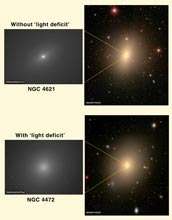
Two giant elliptical galaxies, NGC 4621 and NGC 4472, look similar from a distance, as seen on the right in images from the Sloan Digital Sky Survey. But zooming into these galaxies' cores with Hubble Space Telescope reveals their differences (left, black and white images). NGC 4621 shows a bright core, while NGC 4472 is much dimmer. The core of this galaxy is populated with fewer stars. Many stars have been slung out of the core when the galaxy collided and merged with another. Their two supermassive black holes orbited each other, and their great gravity sent stars careening out of the galaxy's core. Credit: NASA/AURA/STScI and WikiSky/SDSS
(PhysOrg.com) -- A pair of astronomers from Texas and Germany have used a telescope at The University of Texas at Austin's McDonald Observatory together with Hubble Space Telescope and many other telescopes around the world to uncover new evidence that the largest, most massive galaxies in the universe and the supermassive black holes at their hearts grew together over time.
"They evolved in lockstep," said The University of Texas at Austin's John Kormendy, who co-authored the research with Ralf Bender of Germany's Max-Planck-Institute for Extraterrestrial Physics and Ludwig Maximilians University Observatory. The results are puiblished in this week's issue of Astrophysical Journal Letters.
Astronomers know that galaxies, those vast cities of millions or billions of stars, grow larger through collisions and mergers. Kormendy and Bender's work involves the biggest galaxies in the universe--"elliptical galaxies" that are shaped roughly like footballs and that can be made of as many as a thousand billion stars. Virtually all of these galaxies contain a black hole at their centers, that is, an infinitely dense region that contains the mass of millions or billions of Suns and from which no light can escape.
A current leading theory says that when galaxies collide, their black holes end up revolving around each other. Together, the two black holes act like an egg beater: They violently stir up the galaxy center with their incredibly strong gravity, and they fling stars out of the central regions. As the black hole pair sinks to the center of the new merger remnant, this supergalaxy's core is depleted of the stars that were flung away. Kormendy and Bender measured the resulting dimming of such galaxies' cores, their so-called "light deficits."
Light deficits in galaxy cores are surprising in view of decades of work by many astronomers, including Kormendy and Bender, which showed that the biggest elliptical galaxies contain the most massive black holes at their centers. These are monsters "weighing in" at a billion or more times the mass of our Sun. They attract the stars around them with ferociously strong gravity. Astronomers expected that such big black hole would yank the galaxy's stars into a tiny, dense cluster at the center. But observations in the 1980s with ground-based telescopes and much better observations in the 1990s with Hubble Space Telescope revealed the opposite. The biggest galaxies have big, fluffy, low-density centers. Why are giant black holes not surrounded by dense cluster of stars? Where did the missing stars go?
The theory that black hole binaries gravitationally slingshot the stars out of galactic centers has been the popular but unproved explanation. No telescope observations provided compelling evidence--until now.
"Our new observations are a strong and direct link between black holes and galaxy central properties," Kormendy says. "They are a 'smoking gun' that connects black holes with the formation of the surprisingly fluffy centers of giant elliptical galaxies."
Kormendy and Bender made detailed studies of 11 such galaxies in the Virgo Cluster. To get a comprehensive overall picture of each galaxy, they used the wide field of view of the Prime Focus Camera on McDonald Observatory's 0.8-meter Telescope. They used Hubble Space Telescope to study these same galaxies' cores in great detail. Many other telescopes were used to connect the central data from Hubble with the outer data from the McDonald telescope. The results on 27 elliptical galaxies in the Virgo Cluster measured by Kormendy, Bender, and their University of Texas colleagues David Fisher and Mark Cornell, and supported by the National Science Foundation, are scheduled for publication in a forthcoming issue of the Astrophysical Journal Supplement Series.
Their precision measurements of the brightnesses--that is, the number of stars--at various distances from the centers of elliptical galaxies allowed them to calculate much more accurately than previously the masses of stars that are "missing" in the centers of the biggest ellipticals. This revealed more surprises: The missing mass increases in lockstep with the measured masses of the central black holes. It was known that the two quantities are related, but it was not known that the correlation is so tight as to be within the margin of error. That is, the correlation is virtually perfect.
The missing mass also increases in lockstep with another galaxy property that is known to be tied directly to black holes, namely the speeds at which stars move far out in the galaxy where they cannot feel the black hole's gravity.
"Astronomers love tight correlations," Bender says. "They tell us what is connected with what. The new observations give us much stronger evidence that black holes control galaxy formation, at least at their centers."
According to Linda Sparke, NSF program director for astronomical sciences, "This valuable research shows how black holes grow along with the galaxy. This is big news. We've long accepted that black holes are not scattered randomly in galaxies. The most luminous galaxies harbor the most massive black holes. But we haven't known just how the black hole and the galaxy influence each other. Kormendy and Bender have seen the footprint of merging pairs of black holes in the centers of huge elliptical galaxies, revealing evidence that the largest black holes form after smaller galaxies collide to produce one larger system."
Kormendy finally adds, "We have long believed that black holes power quasars in galactic nuclei--they are the brightest objects in the universe. And we have come to suspect that putting giant black holes at the centers of young galaxies and shining so much quasar light on them affects galaxy formation. In other words, we suspect that the study of quasars and the study of galaxies are really one subject. We can't understand one without understanding the other.
"We think we have helped to merge these subjects by connecting black holes directly to galaxy structure." he said. "John Muir famously said that everything is hitched to everything else in the world. As we find that different subjects are hitched together, we build a theory of galaxy formation that we confidently believe."
Provided by National Science Foundation
-
Engineers build first sub-10-nm carbon nanotube transistor
Feb 01, 2012 |
4.9 / 5 (31) |
30
-
Something old, something new: Evolution and the structural divergence of duplicate genes
Jan 31, 2012 |
4.6 / 5 (7) |
1
-
The hidden nanoworld of ice crystals: Revealing the dynamic behavior of quasi-liquid layers
Jan 30, 2012 |
5 / 5 (3) |
1
-
Stock market network reveals investor clustering
Jan 27, 2012 |
3.9 / 5 (23) |
8
-
Of microchemistry and molecules: Electronic microfluidic device synthesizes biocompatible probes
Jan 26, 2012 |
5 / 5 (1) |
0
-
Titan's lack of impact craters
Feb 09, 2012
-
Real pictures of black hole eating a star?
Feb 08, 2012
-
Hypothetical way to travel faster than light, but not technically exceed lightspeed
Feb 06, 2012
-
How do scientists monitor the Sun's activity?
Feb 05, 2012
-
Search patterns in observational studies
Feb 05, 2012
-
Derivation of Pogson's law
Feb 03, 2012
- More from Physics Forums - General Astronomy
More news stories
Humans may have helped the decline of African rainforests 3000 years ago
(PhysOrg.com) -- Large areas of rainforests in Central Africa mysteriously disappeared over three thousand years ago, to be replaced by savannas. The prevailing theory has been that the cause was a change ...
Could Venus be shifting gear?
(PhysOrg.com) -- ESAs Venus Express spacecraft has discovered that our cloud-covered neighbour spins a little slower than previously measured. Peering through the dense atmosphere in the infrared, the ...
Space & Earth / Space Exploration
5 hours ago |
5 / 5 (5) |
7
|
Mars Science Laboratory computer issue resolved
(PhysOrg.com) -- Engineers have found the root cause of a computer reset that occurred two months ago on NASA's Mars Science Laboratory and have determined how to correct it.
Space & Earth / Space Exploration
6 hours ago |
5 / 5 (5) |
3
|
Clam fields found at deep, low-temperature Mariana vents
(PhysOrg.com) -- Scientists have marveled at the unusual life forms thriving at high temperature hydrothermal vents of the deep ocean.
Space & Earth / Earth Sciences
6 hours ago |
not rated yet |
0
|
Two new moons for Jupiter
Advances in technology have lead to the discovery of new planets outside of our Solar System, and now even new moons in our own backyard.
Space & Earth / Space Exploration
5 hours ago |
not rated yet |
2
Human cognitive performance suffers following natural disasters, researchers find
Not surprisingly, victims of a natural disaster can experience stress and anxiety, but a new study indicates that it might also cause them to make more errors - some serious - in their daily lives. In their upcoming Human Fa ...
"Twisted Metal" gamers get shot at real gunplay
Fans of "Twisted Metal" will get to welcome a long-awaited sequel of the car-battle videogame with a real-world bang by blasting an ice cream truck to bits with a machine gun.
Putting the squeeze on planets outside our solar system
(PhysOrg.com) -- Using high-powered lasers, scientists at Lawrence Livermore National Laboratory and collaborators discovered that molten magnesium silicate undergoes a phase change in the liquid state, abruptly ...
The power of estrogen -- male snakes attract other males
A new study has shown that boosting the estrogen levels of male garter snakes causes them to secrete the same pheromones that females use to attract suitors, and turned the males into just about the sexiest ...
Both maternal and paternal age linked to autism
Older maternal and paternal age are jointly associated with having a child with autism, according to a recently published study led by researchers at The University of Texas Health Science Center at Houston (UTHealth).
New error-correcting codes guarantee the fastest possible rate of data transmission
Error-correcting codes are one of the triumphs of the digital age. Theyre a way of encoding information so that it can be transmitted across a communication channel such as an optical fiber o ...
Feb 02, 2009
Rank: 1.8 / 5 (5)
Oh wait, astronomy stopped requiring proof for it's religious ideas a long time ago.
Experimental/observational data? Who needs it.
Feb 02, 2009
Rank: 4.5 / 5 (2)
denying their existence is simply idotic, on an extreme scale, but we need more data to figure out what they actually are.
how many black holes need to be seen and measured before stupid comments like the above go away??
Feb 02, 2009
Rank: 4 / 5 (3)
That will hopefully change when the LHC is fixed and running again, since it has the potential to generate black holes that we could directly measure.
All of this aside, I DO take considerable objection to you saying that astronomy is "religious". Very insulting notion - you're probably the religious one.
Feb 03, 2009
Rank: 3 / 5 (2)
And check this article for more info about the need and the actuality of the black holes. http://www.arxiv....901.4365
Feb 03, 2009
Rank: 4 / 5 (1)
Feb 03, 2009
Rank: not rated yet
Feb 04, 2009
Rank: 1 / 5 (1)
To the best of my knowledge, the only evidence available is matter or stars whipping wildly around a dark central point.
Is there even any gravity lensing evidence?
Even more perplexing to the whole situation is that "black holes" produce bipolar jets (sometimes happy, sometimes angry...)
Direct from NASA, they have no idea what's going on...
http://imagine.gs...23a.html
"thought to generate tangled-up magnetic field, which is probably what collimates the jets. However, astrophysicists are still working out the details of how material is lifted up from the accretion disk in the first place, and how exactly it is that the accelerating force (probably radiation pressure) can overcome the gravity of the central object."
Wowza!
Feb 04, 2009
Rank: not rated yet
The actual proof of a black hole would involve observing an event horizon (or events that point to the existence of event horizon). Since all we see is accretion, then the existence of BH isn't proved. What's more, the data from the GRB shows a great inconsistency with the idea of BH as their progenitors. Which puts even bigger question on the existence of BH at all.
As fun as it is to solve differential equations, mathematics isn't physics. There might be black hole solutions, but how stable they are, how much they last and if they are what we observe in the galactic centres is another question. As for the moment, the only thing we know is that there is extremely heavy object in the centre. Only that.
Feb 05, 2009
Rank: 1 / 5 (1)
http://www.holosc...tyybhrr8
http://www.holosc...qwk0u6cc
Feb 05, 2009
Rank: not rated yet
there is no gravity lensing evidence that I know of for two reasons. 1) stellar black holes are ery small, so if they are in a binary system the lensing effects will basically be invisible and 2) Outside of a binary system, the star, black hole, and earth must all be aligned so perfectly that the odds of us actualy catching the effects are astronomical(haha, pun).
The first observations were in binary systems using a combination of x-ray observations and using the velocity of the visible star to calculate the mass of the smaller of the pair. If the x-rays and mass match prediction, we have a stellar black hole. Yay! Not infallible, but hey, nothing is.
There was a bunch more after the first discoveries to make certain, but i have no idea as to exactly what. Everything I've ever read just indicates that there was a good decade of calculations, expiriments, observations, ect. Also, I know they brought in a bunch more data when they started observing "radio galaxies." Later on they found massive black holes at the center of galaxies, yadda yadda, everyone knows the story. I don't know all the data, but I'm confident that thirty years of observation, calculation, and ensuing expiriments on earth have brought some modicum of certainty to the existence of black holes.
Feb 05, 2009
Rank: 1 / 5 (1)
And it's great, I get away with my ignorance and nay-saying because there is literally NO EVIDENCE to the contrary... Besides shit whipping wildly around a "central point."
Everything is inferred from Cavendish's experiment, "the universal gravitational constant."
A couple facts of which...
"The gravitational constant is perhaps the most difficult physical constant to measure."
"Another authoritative _estimate_"
"The accuracy of the measured value of G has increased only modestly since the original experiment of Cavendish."
"gravity has no established relation to other fundamental forces, so it does not appear possible to measure it indirectly."
"published values of G have varied rather broadly, and some recent measurements of high precision are, in fact, mutually exclusive."
Is that level of uncertainty about something so intricate really enough to say "this is the absolute truth of the situation?" Oh well ya know earls, it's 211 years old so I mean how could there be any doubt?!
Feb 09, 2009
Rank: not rated yet
Feb 09, 2009
Rank: 1 / 5 (1)
Feb 12, 2009
Rank: not rated yet
Also, there is absolutely no counter theory to explain what we have seen. Black holes are the best we've got and no substansive holes have been poked in the theory. The math is all there to support them. I know denijane said earlier that "math is not physics" but that's not entirely right. Physics is just applied mathematics with expirimentation. Everything that has been done so far has screamed black hole in our faces.
If you have an alternative theory that is more complete, observable, and supported by mathematics, I would love to take a looksie.
Feb 15, 2009
Rank: not rated yet
it could turn out to be completely incorrect, of course, but there are valid scientific theories for it out there...and who knows, maybe your bubble there is the fantasy.
to beat a dead horse here, my little idea there was just to give a simply example of how soemthing could be flowing out of a black hole and escape the gravitational pull potentially....
Feb 15, 2009
Rank: 1 / 5 (1)
Feb 18, 2009
Rank: not rated yet
You can calculated a radius and mass at which gravity can overcome this pressure. When gravity is greater than pressure, collapse occurs. This is thought to be the cause of supernovae.
Now theory steps in and says the resultant object is a black hole, something super-dense, and quite small. Most other claims are conjecture.
Theory is needed to direct experiments. Experiments then prove a theory likely to be true, or false.
So we have a theory. That's a good thing. Only a theory? Well let's get to designing some experiments.
Feb 22, 2009
Rank: 1 / 5 (2)
http://www.holosc...6bcdajsb
Jun 05, 2009
Rank: 1 / 5 (1)
But once I started putting my argument down here I came to realise that there is a possabilty for a black hole to exist. That does not mean they do however, just that they may be possible even with the true picture of the universe.
Forget Big Bang hokus pokus and forget MOND and forget antigravity and space foam and forget gravity being an independent property of mass. Think of gravity being caused by a lack of pressure on one side rather than a mysterious force sucking you towards it.
Gravity does not come from matter but is impinged on matter by photons of lengthy wavelength and where these wavelengths penetrate matter and get absorbed by matter over a wide area, secondary objects in the shadow of this photon stream will be pushed towards the primary object.
Think of two objects having force applied equally from all directions. Then bring those two objects closer together - what happens? Simple the outside pressure is reduced in the direction of the other object and they are "forced" together. Magic? no that is gravity at work.
Now take a black hole which absorbs all wavelengths and emits none. You have the theoretical maximum of gravity here. What happens when matter enters this event horizon? - assuming that it can get in. The event horizon would have to increase in size and the black hole would absorb a little more radiation and thus appear to gain mass.
Is there a balancing force that would resist this? don't know but at least in the real stable universe in which we exist it is nice to know that I don't know of anything - yet - that will stop a theoretical black hole from becoming a real black hole.
It is funny but gravity is more closely akin to objects at ground level on Earth being pressed upon on all sides by the atmosphere. If you can block the atmospheric pressure on one side you will be pushed that way not pulled that way.
Jun 05, 2009
Rank: not rated yet
Which I guess means that gravity or rather the shadow of background radiation that permeates the universe at 2.7 degrees Kelvin. would have to be pretty insignificant compared to the incandescence of electricity and magnetic forces at work.
Recently NASA published an article about the magnetic whirlwinds rising 1,000's of kilometers above the Earths surface and whirling at thousands of Kilometers per hour. Pretty impressive size and velocity yet satellites do travel straight through these vortexes with minimal problems.
Do the strong and weak nuclear forces and electrical/magnetic forces have enough strength to overcome the measurable strength of the photons - themselves electromagnetic in nature - generated by the entire universe?
Too much of what is currently built out of the standard Big Bang and the number of stretched and manipulated figures and fudge factors added have clouded the waters so much that I and many others are not fully sure what is mud and what is fish.