Discovery fleshes out metabolism of key environmental and energy bacteria
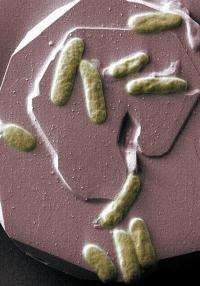
An international collaboration of researchers has discovered a new enzyme in a species of bacteria with potential environmental cleanup and energy roles. This is the first multi-protein enzyme of its kind. Although many microbes use a single-protein version to consume certain food, the new study suggests that dozens of bacteria use only the multi-protein one instead. This advance in understanding of the microbe's metabolism will help researchers use the bugs to clean up toxic or radioactive pollutants.
The team of researchers reported their results the week of Feb. 2 in the Proceedings of the National Academy of Sciences Early Edition online. Led by microbiologist Alex Beliaev of the Department of Energy's Pacific Northwest National Laboratory, the international group hailed from PNNL, the Burnham Institute for Medical Research in La Jolla, Calif., and five other institutions in four countries.
"It surprised a lot of us," said Beliaev. "Since this is the first multi-protein lactate dehydrogenase found in bacteria, we had to prove that all three proteins worked together."
Metalhead Bug
Lactate is a food and energy source. Some bacteria that consume lactate chemically modify metals while doing so. Researchers want to use such microbes to slow the movement of toxic or radioactive metals in contaminated ground, or to create biologically inspired fuel cells. The researchers studied how Shewanella consumes lactate because these bacteria have a particular fondness for a wide variety of metals.
But the scientists had trouble finding the gene they wanted to study using conventional methods. Like comparing a picture to faces in a crowd, researchers had been comparing lactate utilization genes in another species to the crowd of Shewanella genes. And nothing looked familiar.
"It was surprising to see lactate utilization but no machinery. There should be something there," said Beliaev.
Enzyme Incognito
The mystery suggested the team would find machinery that was unlike that seen in other bacteria. So the researchers took a different tack to find the genes. Rather than comparing genes side by side, they used a method called "genome context analysis" to expand the search for genes that might be more remotely involved in lactate consumption.
This yielded them a candidate that looked like it might have the job of bringing lactate into the cell. That led them to a handful of genes that kept cropping up nearby in species after species. Like fingering a thief because he's the guy standing outside a broken window with a sack of jewelry, the team thought these genes deserved some scrutiny.
"It was guilt by association," said Beliaev.
Various genetic and biochemical tests revealed that the three proteins made by the genes worked together to oxidize lactate. Deleting any one of them, for example, got rid of Shewanella's ability to grow. Together, the three proteins make up an enzyme called L-lactate dehydrogenase. Until this discovery, researchers had only found examples of L-lactate dehydrogenase made up of one protein, setting Shewanella's enzyme apart.
But preliminary work uncovered similar genes in unrelated bacteria. So the researchers wanted to know how prevalent it was.
To get a bird's eye view of the enzyme's pervasiveness, the team searched for the corresponding genes in the DNA of 400 other bacterial species. In more than 80 species, the three-protein version of L-lactate dehydrogenase was the only L-lactate dehydrogenase in the DNA. Included in these 80 was the well-studied bacterium known as Bacillus subtilis. Another 40 species had both versions, but circumstantial evidence suggested only one version was used in each of the 40 species.
Stress Reducer?
Beliaev speculated why some bacteria might be using the three-protein version instead of the one-protein enzyme. When the bacteria's environment is high in oxygen, the single-protein enzyme creates a toxic situation called oxidative stress.
Preliminary experiments suggest that a high oxygen environment cranks up production of the multi-component lactate dehydrogenase in bacteria with both. In addition, the larger enzyme's construction suggests it might produce less oxidative stress. Together, these preliminary data suggests the multi-component L-lactate dehydrogenase offers an advantage, allowing these bacteria to live in environments that would kill others.
Ongoing research will explore that speculation. In any event, Beliaev and his colleagues said that finding this multi-faceted enzyme in so many species indicated researchers have much to learn about metabolism in the diverse bacterial universe.
Reference: G.E. Pinchuk, D.A. Rodionov, C. Yang, X. Li, A.L. Osterman, E. Dervyn, O.V. Geydebrekht, S.B. Reed, M.F. Romine, F.R. Collart, J.H. Scott, J.K. Fredrickson, A.S. Beliaev, Genomic reconstruction of Shewanella oneidensis MR-1 metabolism reveals a novel machinery for lactate utilization, Proc Natl Acad Sci U S A Early Edition week of February 2, 2009, DOI www.pnas.org/cgi/doi/10.1073/pnas.0806798106 .
Source: DOE/Pacific Northwest National Laboratory


