Genetic change prevents cell death in mouse model of Parkinson's disease
February 2, 2009
Genetic change prevents cell death in mouse model of Parkinson's disease

Enlarge

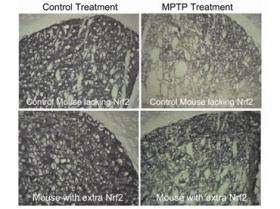
Jeffrey Johnson, professor of pharmaceutical sciences at the University of Wisconsin-Madison, has developed a method to completely shield mice in a laboratory model from a toxic chemical that would otherwise cause Parkinson's disease. In the top two images, the pale color of normal mouse brains injected with the toxic MPTP reveals severe loss of nerve cells connecting to the substantia nigra, a major symptom of Parkinson's disease. In the bottom images, the brains of mice producing higher levels of the protein Nrf-2 were completely unharmed by MPTP. Photo: courtesy Jeffrey Johnson

(PhysOrg.com) -- By shifting a normal protective mechanism into overdrive, a University of Wisconsin-Madison scientist has completely shielded mice from a toxic chemical that would otherwise cause Parkinson's disease.

Parkinson's disease is a disabling and sometimes fatal disease that afflicts 1.5 million Americans, with about 60,000 new cases annually. Its major symptoms, including tremors and sluggish movement, have been traced to death of small numbers of nerve cells in the substantia nigra, a brain region that helps regulate movement.

Adding extra copies of a gene that makes a normal, protective protein neutralized a toxic chemical that would normally devastate the substantia nigra. "This complete abolition of toxicity was far greater than we expected," says Jeffrey Johnson, a UW-Madison professor of pharmacy. "It was striking. We thought we would see a 20 or 30 or 40 percent reduction in cell death."

The protective mechanism is initiated by a protein called Nrf-2, which is present in people and in mice, says Johnson. Nrf-2 (transcription factor NF-E2-related factor) is made by astrocytes, brain cells that play a supportive role to the neurons, which are the cells that actually carry nerve signals.

In recent years, researchers looking at a range of neurodegenerative diseases, including Alzheimer's and Lou Gehrig's diseases as well as Parkinson's, have focused on the astrocytes in their quest to help the brain protect itself from stressful conditions that are deadly to neurons. "Astrocytes way outnumber neurons and are found throughout the central nervous system," says Johnson. "Neurons have always gotten the Academy Awards, but astrocyte dysfunction is becoming a central theme in neurodegenerative disease. If we can figure out how to fix a sick astrocyte, or even prevent it from getting sick, that could offer profound protection against almost all neurodegenerative diseases."

Because neurons are impossible to replace, the present research focus in neurodegenerative disease is on preventing their death in the first place. Parkinson's disease can be treated for a time by replacing dopamine, the brain chemical made by the substantia nigra, but the treatment loses its efficacy over time.

In a study funded by the National Institute of Environmental Health Sciences and published in today's Proceedings of the National Academy of Sciences, Johnson and UW-Madison colleagues Pei-Chun Chen, Marcelo Vargas and Delinda Johnson studied mice with extra Nrf-2 genes. The astrocytes in these mice produced about twice the normal level of Nrf-2 protein.

The researchers then dosed the mice with MPTP, a chemical that kills neurons in the substantia nigra and has become the major mechanism for studying Parkinson's disease in mice. The toxicity of MPTP was discovered in 1982, when young drug users in California developed the classic symptoms of Parkinson's disease, a disease that usually strikes those over age 60. Researchers found that the synthetic heroin these people had used was contaminated with MPTP, and further studies showed that MPTP is highly toxic to nerve cells in the substantia nigra.

When astrocytes make Nrf-2, the protein attaches to their DNA, kick-starting activity in hundreds of genes that release chemicals that can protect nearby neurons from oxidation - a series of chemical reactions that can injure or kill cells. "The astrocytes are also probably sucking up the bad stuff, thereby reducing the oxidative environment and stress on the neurons," says Johnson, adding that his laboratory is trying to identify those specific protective chemicals.

Nobody can predict when a manipulation of Nrf-2 could reach clinical trials, which Johnson says are at the very least two years in the future. While these experiments altered the mouse cells with genetic engineering, human trials would probably use drugs to boost Nrf-2 production in astrocytes. Several labs, including Johnson's, are already searching for candidate drugs.

The stakes are high, Johnson says, because Nrf-2 also protects brain cells in models of such fatal brain diseases as Alzheimer's, ALS, and Huntington's disease.

Normally, neurons die in these neurodegenerative diseases to "commit suicide" through a process called programmed cell death. "Nrf-2 seems to rebalance the system," Johnson says, "in favor of what we call programmed cell life."

Provided by University of Wisconsin-Madison


Rank 5 /5 (1 vote)
Relevant PhysicsForums posts
  • Is Everyday Technology Killing Us?
    createdFeb 08, 2012
  • Exercise and weight loss
    createdFeb 08, 2012
  • Why do we have head aches? Our brains can't feel anything.
    createdFeb 07, 2012
  • "The end of diseases" by David Agus, interview from Daily Show with Jon Stewart
    createdFeb 04, 2012
  • Oncolytic adenovirus
    createdFeb 04, 2012
  • Nutrition label stuffs and diets
    createdFeb 02, 2012
  • More from Physics Forums - Medical Sciences

More news stories

Researchers make breakthrough in stem cell research

(Medical Xpress) -- University of Queensland scientists have developed a world-first method for producing adult stem cells that will substantially impact patients who have a range of serious diseases.

Medicine & Health / Research

created 20 minutes ago | popularity 5 / 5 (1) | comments 0 | with audio podcast

Georgia Tech develops software for the rapid analysis of foodborne pathogens

2011 brought two of the deadliest bacterial outbreaks the world has seen during the last 25 years. The two epidemics accounted for more than 4,200 cases of infectious disease and 80 deaths. Software developed at Georgia Tech ...

Medicine & Health / Diseases

created 12 minutes ago | popularity not rated yet | comments 0

Social psychologist: Lust makes you smarter and evidence that seven deadly sins are good for you

(Medical Xpress) -- Good news for lovers on Valentine’s Day - the seven deadly sins, including Lust, are good for you. University of Melbourne social psychologist Dr Simon Laham uses modern research to make a compelling ...

Medicine & Health / Psychology & Psychiatry

created 42 minutes ago | popularity 4 / 5 (1) | comments 0

Couples in the same place emotionally stay together, study says

(Medical Xpress) -- Despite life’s ups and downs, couples whose feelings are in sync consistently over time are more likely to stay together, says a University of California, Davis, study.

Medicine & Health / Psychology & Psychiatry

created 7 minutes ago | popularity not rated yet | comments 0 | with audio podcast

Low levels of amplitude-modulated electromagnetic fields elicit therapeutic responses cancer patients

Ryne Ramaker, a senior UALR Donaghey Scholar and University Science Scholar with a double major in biology and chemistry, is a co-author of a cancer research paper creating excitement among other researchers. The article ...

Medicine & Health / Cancer

created 29 minutes ago | popularity not rated yet | comments 0


New molecule has potential to help treat genetic diseases and HIV

(PhysOrg.com) -- Chemists at The University of Texas at Austin have created a molecule that's so good at tangling itself inside the double helix of a DNA sequence that it can stay there for up to 16 days before ...

With climate change, today's '100-year floods' may happen every three to 20 years: research

Last August, Hurricane Irene spun through the Caribbean and parts of the eastern United States, leaving widespread wreckage in its wake. The Category 3 storm whipped up water levels, generating storm surges ...

The joy of cheques

An electronic cheque which eliminates the need for costly processing by banks but preserves the simplicity and ease of a traditional cheque book has been designed by a team of academics in the UK.

Research shows promise in converting camelina oil into jet fuel

(PhysOrg.com) -- Researchers at Montana State University-Northern have developed a process to convert camelina oil to jet fuel and other high-value chemicals. MSU has applied for a U.S. patent and research is ongoing.

Omega-3 fatty acid on trial: Study to evaluate long-term effects on intelligence, behavior

University of Kansas researchers John Colombo and Susan Carlson have been awarded $2.5 million for the next five years of a 10-year, double-blind randomized controlled trial to determine whether prenatal nutritional supplementation ...

Research finds injuries to professional athletes from routine play or practice often reported as 'freak accidents' in me

(Medical Xpress) -- A new report from the Johns Hopkins Center for Injury Research and Policy finds injuries to professional athletes from routine play or practice are often characterized as “freak accidents” in ...