New evidence from excavations supports theory of the 'Birth of Zeus'
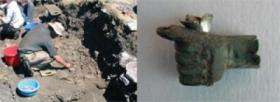
In the third century BCE, the Greek poet Callimachus wrote a 'Hymn to Zeus' asking the ancient, and most powerful, Greek god whether he was born in Arcadia on Mt. Lykaion or in Crete on Mt. Ida.
A Greek and American team of archaeologists working on the Mt. Lykaion Excavation and Survey Project believe they have at least a partial answer to the poet's query. New excavation evidence indicates that Zeus' worship was established on Mt. Lykaion as early as the Late Helladic period, if not before, more than 3,200 years ago. According to Dr. David Gilman Romano, Senior Research Scientist, Mediterranean Section, University of Pennsylvania Museum, and one of the project's co-directors, it is likely that a memory of the cult's great antiquity survived there, leading to the claim that Zeus was born in Arcadia.
Dr. Romano will present his team's new discoveries—and their implications for our understanding of the beginnings of ancient Greek religion—at a free public lecture, The Search for Zeus: The Mt. Lykaion Excavation and Survey Project, Tuesday, January 27 in the Rainey Auditorium of the University of Pennsylvania Museum.
New evidence to support the ancient myth that Zeus was born on Mt. Lykaion in Arcadia has come from a small trench from the southern peak of the mountain, known from the historical period as the ash altar of Zeus Lykaios. Over fifty Mycenaean drinking vessels, or kylikes, were found on the bedrock at the bottom of the trench along with fragments of human and animal figurines and a miniature double headed axe. Also found were burned animal bones, mostly of goats and sheep, another indication consistent with Mycenaean cult activity.
"This new evidence strongly suggests that there were drinking (and perhaps feasting) parties taking place on the top of the mountain in the Late Helladic period, around 3,300 or 3,400 years ago," said Dr. Romano.
In mainland Greece there are very few if any Mycenaean mountain-top altars or shrines. This time period — 14th-13th centuries BC — is approximately the same time that documents inscribed with a syllabic script called Linear B (an archaic form of the Greek language) first mention Zeus as a deity receiving votive offerings. Linear B also provides a word for an 'open fire altar' that might describe this altar on Mt. Lykaion as well as a word for a sacred area, temenos, a term known from later historical sources. The shrine on Mt. Lykaion is characterized by simple arrangements: an open air altar and a nearby sacred area, or temenos, which appears to have had no temple or other architectural feature at any time at this site.
Evidence from subsequent periods in the same trench indicate that cult activity at the altar seems to have continued uninterrupted from the Mycenaean period down through the Hellenistic period (4th - 2nd centuries BCE), something that has been documented at very few sites in the Greek world. Miniature bronze tripods, silver coins, and other dedications to Zeus including a bronze hand of Zeus holding a silver lightning bolt, have been found in later levels in the same trench. Zeus as the god of thunder and lightning is often depicted with a lightning bolt in his hand.
Also found in the altar trench was a sample of fulgurite or petrified lightning. This is a glass-like substance formed when lightning strikes sandy soil. It is not clear if the fulgurite was formed on the mountain-top or if it was brought to the site as a dedication to Zeus. Evidence for earlier activity at the site of the altar, from the Final Neolithic and the Early and Middle Helladic periods, continues to be found.
More info: corinth.sas.upenn.edu/lykaion/lykaion.html
Source: University of Pennsylvania


