Don't go changing: New chemical keeps stem cells young
February 3, 2009 Don't go changing: New chemical keeps stem cells young

Enlarge

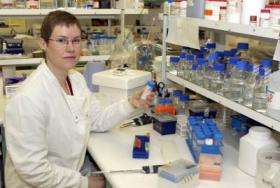
Professor Melanie Welham led the research at Bath, a collaboration with colleagues at the University of Leeds. Credit: Nic Delves-Broughton, University of Bath

Scientists at the Universities of Bath and Leeds have discovered a chemical that stops stem cells from turning into other cell types, allowing researchers to use these cells to develop new medical treatments more easily.

Stem cells have the ability to develop into many other cell types in the body, and scientists believe they have huge potential to treat diseases or injuries that don't currently have a cure.

Professor Melanie Welham's team at the University of Bath's Department of Pharmacy & Pharmacology, collaborating with Professor Adam Nelson at the University of Leeds, have discovered a chemical that can be added to embryonic stem cells grown in the lab, allowing them to multiply without changing into other cell types.

This breakthrough will help scientists produce large stocks of cells that are needed for developing new medical therapies.

Professor Welham, who is co-director of the University of Bath's Centre for Regenerative Medicine, explained: "Stem cells have great potential for treating spinal injuries and diseases like type I diabetes because they can change into a range of specialised cell types including nerve or pancreatic cells, which could be used to repair damaged tissues.

"Unfortunately, when you grow stem cells in the lab, they can spontaneously develop into specialised cells, making it difficult to grow large enough stocks to use for medical research.

"We've identified a chemical that will put this process on hold for several weeks so that we can grow large numbers of them in their unspecialised state. This is reversible, so when you take it away from the cells, they still have the ability to change into specialised cells."

Professor Adam Nelson's team, at the Astbury Centre for Structural Molecular Biology, made more than 50 chemical compounds that were tested for activity in the stem cells.The researchers found that the chemicals worked by blocking an enzyme, called GSK3, that can control when the stem cell switches to a more specialised cell type.

Professor Nelson, who is Director of the Astbury Centre at the University of Leeds, said: "This research is a great example of how small molecules can be used as tools to understand biological mechanisms."

The research, supported by funding from the Biotechnology & Biological Sciences Research Council, is published in the prestigious peer-reviewed Cell Press journal, Chemistry & Biology.

Source: University of Bath


print this article email this article download pdf blog this article bookmark this article     Stumble it Digg this share on Facebook retweet share on Reddit add to delicious
Rate this story - 5 /5 (2 votes)


February 3, 2009 all stories

Comments: 0

5 /5 (2 votes)
  • Stumble this up

  • Digg this

  • share this

  • hide
  • Related Stories


Other News

Golden Oldie: Key Role for Ancient Protein in Algae Photosynthesis

Golden Oldie: Key Role for Ancient Protein in Algae Photosynthesis

Biology / Biotechnology

created 5 hours ago | popularity not rated yet | comments 1

The discovery that an ancient light harvesting protein plays a pivotal role in the photosynthesis of green algae should help the effort to develop algae as a biofuels feedstock. Researchers with the Lawrence ...


Hammerhead shark

Wide heads give hammerheads exceptional stereo view

Biology / Plants & Animals

created 14 hours ago | popularity 4.4 / 5 (5) | comments 4

Hammerhead sharks are some of the Ocean's most distinctive residents. 'Everyone wants to understand why they have this strange head shape,' says Michelle McComb from Florida Atlantic University. One possible ...


Indonesia rejects Bali plan for turtle sacrifices (AP)

Indonesia rejects Bali plan for turtle sacrifices

Biology / Ecology

created 12 hours ago | popularity not rated yet | comments 0

(AP) -- Indonesia has rejected a push by the resort island of Bali for rare turtles to be legally slain in Hindu ceremonies, siding with conservationists of the protected reptiles against religious advocates, ...


Tough yet stiff deer antler is materials scientist's dream

Biology / Plants & Animals

created 14 hours ago | popularity 3 / 5 (1) | comments 2

Prized for their impressive antlers, red deer have been caught in the hunters' sights for generations. But a deer's antlers are much more than decorative. They are lethal weapons that stags crash together when duelling. John ...


Ecologists sound out new solution for monitoring cryptic species

Biology / Ecology

created 14 hours ago | popularity not rated yet | comments 0

Ecologists have at last worked out a way of using recordings of birdsong to accurately measure the size of bird populations. This is the first time sound recordings from a microphone array have been translated into accurate ...