Team finds smallest transiting extrasolar planet ever
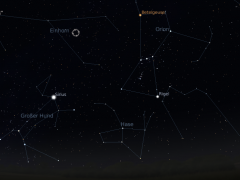
February 3, 2009 CoRoT-Exo-7b

Enlarge

The CoRoT satellite has discovered a planet only twice as large as the Earth orbiting a star slightly smaller than the Sun. It is the smallest extrasolar planet (planet outside our solar system) whose radius has ever been measured. The planet's composition is not yet certain, but it is probably made predominantly of rock and water. It orbits its host star in 20 hours, which is the shortest orbital period of all exoplanets found so far. Astronomers infer its temperature must be so high (over 1000 degrees C) that it should be covered in lava or superheated water vapour.

Most of the 330 or so exoplanets discovered so far are giant planets, primarily composed of gas, like Jupiter and Neptune. This new object, named CoRoT-Exo-7b, is very different. "Finding such a small planet wasn't a complete surprise", says Dr Daniel Rouan, from LESIA in Paris, who announced the discovery today at a conference in Paris. Dr Alain Leger from the Institut d'Astrophysique de Marseille, leader of the discovery paper, explains: "It could be an example of a so-called ocean planet, whose existence was predicted some years ago: a Neptune-like planet, made of ice around a rocky core, drifts so close to its star, the ice the melting to form a fluid envelope."

Such a small planets such as this one is extremely difficult to detect. CoRoT-Exo-7b was found because it passes in front of its host star, causing the star to dim very slightly once per orbit - a so-called transit, which in this case is only 0.03% deep. "We were able to see it with CoRoT because it is in space, with no atmosphere to disturb the measurements or daylight to interrupt them." explains Dr Roi Alonso, from the Laboratoire d'Astrophysique de Marseille.

The team then had to make sure they were not seeing one of many other kinds of objects that can mimic planetary transits, using complementary observations from the ground. This is particularly challenging in the case of such a small planet, as Dr Aigrain from the University of Exeter explains "We ruled out every mimic except for a very improbable, almost perfect chance alignment of three stars. All our data so far is consistent with the transits being caused by a planet of a few Earth masses, though more data are needed for a precise mass estimate."

The discovery of CoRoT-Exo-7b is being announced today at the CoRoT Symposium 2009 in Paris and will be the published in a forthcoming special issue of the journal Astronomy and Astrophysics dedicated to results from CoRoT.

CoRoT - which stands for Convection, Rotation and planetary Transits - was developed by the French Space Agency CNES, with important contributions from Austria, Belgium, Brazil, the European Space Agency, Germany, and Spain. It was designed to detect tiny variations in the luminosity of stars, with two scientific goals: searching for planets orbiting stars other than the Sun, and studying the internal structure of seismology.

This discovery is based on data from the CoRoT satellite and complementary observations made from the European Southern Observatory at Paranal and La Silla (Chile), the 80-cm telescope at the Canary Islands Astrophysics Institute, and the Canada-France-Hawaii Telescope on Mauna Kea, Hawaii (operated by CNRS, CNRC, and University of Hawaii).

Source: University of Exeter


print this article email this article download pdf blog this article bookmark this article     Stumble it Digg this share on Facebook retweet share on Reddit add to delicious
Rate this story - 5 /5 (7 votes)

Rank Filter

Move the slider to adjust rank threshold, so that you can hide some of the comments.


Display comments: newest first

  • Modernmystic - Feb 03, 2009
    • Rank: 5 / 5 (2)
    Can we get a little more meat here please?

    What's the eccentricity, estimated diameter, what's the metalicity of the star it orbits, is it in the goldilocks zone??

    ON EDIT: Nevermind, found my own info. For anyone else intrested...

    http://exoplanet....oT-Exo-7&p2=b

February 3, 2009 all stories

Comments: 1

5 /5 (7 votes)
  • Stumble this up

  • Digg this

  • share this

  • hide
  • Related Stories

  • The CoRoT space mission: Early results
    created Oct 22, 2009 | popularity not rated yet | comments 0
  • Astronomers do it Again: Find Organic Molecules Around Gas Planet (w/ Video)
    created Oct 20, 2009 | popularity not rated yet | comments 0
  • 32 New Exoplanets Found (w/ Video)
    created Oct 19, 2009 | popularity not rated yet | comments 0
  • Researcher hunts for new planets, seeking clues on solar system's origin
    created Oct 13, 2009 | popularity not rated yet | comments 0
  • The GalileoMobile starts its South American voyage
    created Oct 05, 2009 | popularity not rated yet | comments 0


  • hide
  • Relevant PhysicsForums posts

  • The shape of our solar system's orbits.
    created Nov 07, 2009
  • Above or Below the Line of Nodes
    created Nov 07, 2009
  • Supernova vs. Nova?
    created Nov 07, 2009
  • Supernova's Gamma Rays and Comets
    created Nov 06, 2009
  • More from Physics Forums - General Astronomy

Other News

Deep creep means milder, more frequent earthquakes along Southern California's San Jacinto fault

Deep creep means milder, more frequent earthquakes along Southern California's San Jacinto fault

Space & Earth / Earth Sciences

created 15 hours ago | popularity 4.5 / 5 (4) | comments 0

With an average of four mini-earthquakes per day, Southern California's San Jacinto fault constantly adjusts to make it a less likely candidate for a major earthquake than its quiet neighbor to the east, the ...


Success in 'space elevator' competition (AP)

Success in 'space elevator' competition (Update 3)

Space & Earth / Space Exploration

created Nov 05, 2009 | popularity 4.3 / 5 (33) | comments 50

(AP) -- A robot powered by a ground-based laser beam climbed a long cable dangling from a helicopter on Wednesday to qualify for prize money in a $2 million competition to test the potential reality of the ...


In a Galaxy Far, Far Away...

In a Galaxy Far, Far Away...

Space & Earth / Astronomy

created Nov 06, 2009 | popularity 4.8 / 5 (5) | comments 17

(PhysOrg.com) -- Astronomers have published the discovery of the farthest known object in the cosmos: a star that exploded when the universe was only 630 million years old -- only 4.6% of its current age. ...


'Dropouts' pinpoint earliest galaxies

'Dropouts' pinpoint earliest galaxies

Space & Earth / Astronomy

created Nov 06, 2009 | popularity 4.2 / 5 (10) | comments 13

Astronomers, conducting the broadest survey to date of galaxies from about 800 million years after the Big Bang, have found 22 early galaxies and confirmed the age of one by its characteristic hydrogen signature ...


Space hotel taking bookings for 2012 opening

Space hotel taking bookings for 2012 opening

Space & Earth / Space Exploration

created Nov 05, 2009 | popularity 4.4 / 5 (21) | comments 11

(PhysOrg.com) -- The first orbiting space hotel is on track to open for its first customers in 2012, but hurry, as bookings are filling fast.