Long-term recovery of reefs from bleaching requires local action to increase resilience
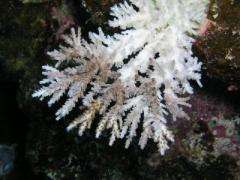
February 3, 2009 Bleached Coral

Enlarge

Coral bleaching -- in which corals expel their symbiotic algal partners and turn pale or white -- is one of the most visible impacts of climate change on marine ecosystems. Typically caused by higher-than-normal ocean temperatures, it can lead to widespread death of corals and is a major contributor to the rapid decline of coral reef ecosystems worldwide. Credit: Andrew C. Baker

In the journal Estuarine, Coastal and Shelf Science, University of Miami Rosenstiel School of Marine and Atmospheric Science Professor Dr. Peter Glynn, and 2008 Pew Fellow for Marine Conservation and Assistant Professor Dr. Andrew Baker, assess more than 25 years of data on reef ecosystems recovery from climate change-related episodes of coral bleaching. Coral bleaching - in which corals expel their symbiotic algal partners and turn pale or white - is one of the most visible impacts of climate change on marine ecosystems. Typically caused by higher-than-normal ocean temperatures, it can lead to widespread death of corals and is a major contributor to the rapid decline of coral reef ecosystems worldwide.

The paper, co-authored by Dr. Bernhard Riegl, associate director of the National Coral Reef Institute, represents the first comprehensive review of long-term global patterns in reef recovery following bleaching events. Bringing together the results of dozens of bleaching studies, the article reports that bleaching episodes set the stage for diverse secondary impacts on reef health, including coral disease, the breakdown of reef framework, and the loss of critical habitat for reef fishes and other important marine animals.

"Bleaching has resulted in catastrophic loss of coral cover in some locations, and has changed the coral community structure in many others," said Glynn. "These dramatic fluctuations have critical impacts on the maintenance of biodiversity in the marine tropics, which is essential to the survival of many tropical and sub-tropical economies."

However, the paper also shows that, while bleaching episodes have resulted in dramatic loss of coral cover in certain locations, reefs vary dramatically in their ability to bounce back from these disturbances. It also evaluates factors explaining why some species of coral recover better than others, as well as why some reef regions are recovering while others are not.

The study finds that reefs in the Indian Ocean are recovering relatively well from a single devastating bleaching event in 1998. In contrast, western Atlantic (Caribbean) reefs have generally failed to recover from multiple smaller bleaching events and a diverse set of chronic additional stressors such as diseases, overfishing and nutrient pollution. No clear trends were found in the eastern Pacific, the central-southern-western Pacific or the Arabian Gulf, where some reefs are recovering and others are not.

"These findings illustrate how coral reefs, under the right conditions, can demonstrate resilience and recover from bleaching, even when it initially appears catastrophic", said Baker. "What prevents them from doing so is the lethal prescription of combined, additional stressors that prevent them from recovering in-between recurrent bleaching events. If we can remove or reduce these stressors we might give reefs a fighting chance of surviving climate change".

The paper entitled "Climate change and coral reef bleaching: An ecological assessment of long-term impacts, recovery trends and future outlook" also discusses potential mitigation and intervention strategies that might maximize coral reef survival in the coming years. It concludes that bleaching disturbances are likely to become a chronic stress in many reef areas in the coming decades, and coral communities, if they cannot recover quickly enough, are likely to be reduced to their most hardy or adaptable constituents. Unless significant reductions in greenhouse gas emissions can be achieved within the next two to three decades, maximizing coral survivorship during this time may be critical to ensuring healthy reefs can recover in the long term.

Source: University of Miami Rosenstiel School of Marine & Atmospheric Science


print this article email this article download pdf blog this article bookmark this article     Stumble it Digg this share on Facebook retweet share on Reddit add to delicious
Rate this story - 3 /5 (4 votes)

Rank Filter

Move the slider to adjust rank threshold, so that you can hide some of the comments.


Display comments: newest first

  • Big_Oil_Sockpuppet - Feb 03, 2009
    • Rank: 2.6 / 5 (5)
    Bleached corals look better.
  • theophys - Feb 03, 2009
    • Rank: 2.8 / 5 (6)
    We could always just color in the coral with crayons and pretend there's nothing wrong.
  • GrayMouser - Feb 03, 2009
    • Rank: 2.3 / 5 (6)
    "Typically caused by higher-than-normal ocean temperatures"

    Which has not happened so they need to find another politically correct cause.
  • Velanarris - Feb 04, 2009
    • Rank: 2.6 / 5 (5)
    "Typically caused by higher-than-normal ocean temperatures"

    Which has not happened so they need to find another politically correct cause.
    Truth is they don't knwo why coral bleaching occurs. There are multiple reasons, on the table including coral disease pandemics. After all, humans aren't the only species to undergo wide spread disease outbreaks.

February 3, 2009 all stories

Comments: 4

3 /5 (4 votes)
  • Stumble this up

  • Digg this

  • share this

  • hide
  • Related Stories

  • Australian scientists call for urgent 'global cooling' to save coral reefs
    created 4 hours ago | popularity not rated yet | comments 0
  • Caribbean, Gulf spared widespread coral damage
    created Nov 06, 2009 | popularity not rated yet | comments 0
  • The White Stuff: Marine Lab Team Seeks to Understand Coral Bleaching
    created Oct 20, 2009 | popularity not rated yet | comments 0
  • Corals 'could starve in high CO2'
    created Oct 05, 2009 | popularity not rated yet | comments 0
  • Coral bleaching increases chances of coral disease
    created Oct 01, 2009 | popularity not rated yet | comments 0


  • hide
  • Relevant PhysicsForums posts

  • cycles
    created Nov 08, 2009
  • The Origin of the term 'fossil' fuels
    created Nov 05, 2009
  • co2
    created Nov 03, 2009
  • Early Earths Sulfidic Ocean Conditions
    created Oct 30, 2009
  • More from Physics Forums - Earth

Other News

Planetary Society plans new 'solar sail'

Space & Earth / Space Exploration

created 3 hours ago | popularity 5 / 5 (1) | comments 0

(AP) -- Four years after its first solar sail ended up in the ocean instead of orbit, The Planetary Society announced Monday that by the end of 2010 it will try again to launch a spacecraft that will be propelled by the ...


L-R: Chiwetel Ejiofor, Amanda Peet and John Cusack at the premiere of "2012"

NASA on crusade to debunk 2012 apocalypse myths

Space & Earth / Space Exploration

created 8 hours ago | popularity 4 / 5 (1) | comments 1

The world is not coming to an end on December 21, 2012, the US space agency insisted Monday in a rare campaign to dispel widespread rumors fueled by the Internet and a new Hollywood movie.


Australian scientists call for urgent 'global cooling' to save coral reefs

Space & Earth / Environment

created 4 hours ago | popularity 3 / 5 (2) | comments 0

(PhysOrg.com) -- Australian marine scientists have issued an urgent call for massive and rapid worldwide cuts in carbon emissions, deep enough to prevent atmospheric CO2 levels rising to 450 parts per million (ppm).


Antarctica glacier retreat creates new carbon dioxide store

Antarctica glacier retreat creates new carbon dioxide store

Space & Earth / Earth Sciences

created 13 hours ago | popularity 3.5 / 5 (4) | comments 0

Large blooms of tiny marine plants called phytoplankton are flourishing in areas of open water left exposed by the recent and rapid melting of ice shelves and glaciers around the Antarctic Peninsula. This ...


NASA satellites see Ida spreading out before landfall

NASA satellites see Ida spreading out before landfall

Space & Earth / Earth Sciences

created 4 hours ago | popularity not rated yet | comments 0

NASA's Aqua and Terra satellites are keeping a close eye on Tropical Storm Ida, and both have instruments aboard that show her clouds and rains are already widespread inland over the U.S. Gulf coast states. ...