Research Lab Combines Psychology with Technology
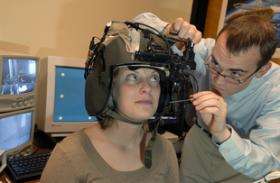
A unique laboratory has been established at The University of Alabama in Huntsville that combines psychology with technology to focus on the interaction between humans and complex systems.
Dr. Anthony Morris, a psychology professor in the College of Liberal Arts and a research scientist in the Center for Modeling, Simulation & Analysis (CMSA), has established the Human Factors and Ergonomics Laboratory to investigate such issues.
This unique lab combines psychology and technology, and focuses its research on work performed by human factors engineers. Experimentation and research projects include human operator interaction with complex systems such as aircraft and designing work stations that are logical and user friendly, prevent injuries and trauma disorders; and creating manufacturing systems that maximize quality and productivity, while considering human limitations.
Morris and UAHuntsville graduate student Sage Jessee have been collaborating with Dr. Thomas Davis, chief of the Aviation and Missile Command Field Element of the Human Research and Engineering Directorate of the Army Research Lab at Redstone Arsenal, evaluating head and eye movement in the cockpit of Black Hawk helicopters.
The project “Building a Better Helicopter” recently aired on The Military Channel’s Science of War Videos.
Jessee worked as the eye-tracking specialist on a video game style simulator that monitored the pilot’s point of gaze and head position during flight scenarios.
“The purpose was two-fold: first, to build an ‘attentional landscape’ that characterized the general gaze of the pilot in terms of outside the window as opposed to inside the window viewing times; second, was to identify specific eye measures that correlate with mental workload,” Jessee said.
The new ergonomically designed cockpit used in the Black Hawk helicopter upgrade ensured researchers had good head and eye movement. More importantly, it enabled test pilots the ability to spend 90 percent of their time looking outside windows, rather than continuously staring at the instrument panel in the cockpit. This allowed test pilots more time to concentration on reconnaissance. The user-friendly cockpit also gives researchers more opportunity to learn more about pilot behavior, ultimately reducing pilot error and saving lives.
Jessee, a home-schooled student from North Alabama, decided to transfer to UAHuntsville because of its focus on student needs and top of the line research.
“Combining psychology and technology was a natural progression for me as a budding human factors psychologist,” he said. “All I had to do was marry my appreciation of people and individual differences to my enjoyment of technology. It turned out that Huntsville is an excellent place for career opportunities of someone with my interests.”
Jessee will graduate this spring and is preparing to move into a position with the Army Research Lab and continue his research. He is also a member of the Tennessee Valley Human Factors and Ergonomics Society, which has allowed students to gain experience in presenting. Last fall, Jessee presented an overview of Delmia’s digital human modeling system used during the product life cycle management process.
Delmia is software distributed by Dassault Systems. According to Morris, Delmia has the largest robotics simulation capacity of any product lifecycle management software on the market.
Morris is working on placing other UAHuntsville students enrolled in the Human Factors and Ergonomics Laboratory in prime research posts at manufacturing companies and virtual reality labs located at NASA (Marshall Space Flight Center), Army AMCOM, Boeing and Dassault Systems. Students are also encouraged to get involved in research at CMSA at UAHuntsville.
Morris said the SCEP contract, awarded to students through CMSA, provides valuable training and learning experience for students. “The SCEP contract is typically a 12-month program that allows students to enter into a government work environment with competitive wages while still focusing primarily on their academic curriculum,” he explained.
Morris likened human factors engineering as a bridge to student success in the workplace, as well as establishing an advantageous partnership between area businesses and UAHuntsville.
Source: University of Alabama Huntsville


