'Chameleon Guitar' blends old-world and high-tech

(PhysOrg.com) -- Natural wood, with its unique grain patterns, is what gives traditional acoustic instruments warm and distinctive sounds, while the power of modern electronic processing provides an unlimited degree of control to manipulate the characteristics of an instrument's sound. Now, a guitar built by a student at MIT's Media Lab promises to provide the best of both worlds.
The Chameleon Guitar -- so named for its ability to mimic different instruments -- is an electric guitar whose body has a separate central section that is removable. This inserted section, the soundboard, can be switched with one made of a different kind of wood, or with a different structural support system, or with one made of a different material altogether. Then, the sound generated by the electronic pickups on that board can be manipulated by a computer to produce the effect of a different size or shape of the resonating chamber.
Its creator, Media Lab master's student Amit Zoran, explains that each piece of wood is unique and will behave in a different way when it is part of an instrument and begins to vibrate in response to the strings attached to it. Computers can't model all the details of that unique responsiveness, he says. So, as he began experimenting with the design of this new instrument, he wondered "what would happen if you could plug in acoustic information, like we do with digital information on a memory stick?"
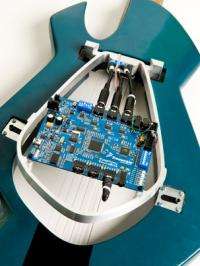
Under the direction of Media Lab Associate Professor Pattie Maes, and with help from experienced instrument builder Marco Coppiardi, he built the first proof of concept version last summer, with a variety of removable wooden inserts. The concept worked, so he went on to build a more polished version with an easier quick-change mechanism for switching the inserts, so that a musician could easily change the sound of the instrument during the course of a concert -- providing a variety of sound characteristics, but always leaving the same body, neck and frets so that the instrument always feels the same.
Join PhysOrg.com on Facebook
With Coppiardi's help, he selected spruce and cedar for the initial soundboard inserts. This January, he demonstrated the new instrument at the annual Consumer Electronics Show in Las Vegas, where it received an enthusiastic response. He also demonstrated the earlier version at two electronics conferences last year.
The five electronic pickups on the soundboard provide detailed information about the wood's acoustic response to the vibration of the strings. This information is then processed by the computer to simulate different shapes and sizes of the resonating chamber. "The original signal is not synthetic, it's acoustic," Zoran says. "Then we can simulate different shapes, or a bigger instrument." The guitar can even be made to simulate shapes that would be impossible to build physically. "We can make a guitar the size of a mountain," he says. Or the size of a mouse.
Because the actual soundboard is small and inexpensive, compared to the larger size and intricate craftsmanship required to build a whole acoustic instrument, it will allow for a lot of freedom to experiment, he says. "It's small, it's cheap, you can take risks," he says. For example, he has a piece of spruce from an old bridge in Vermont, more than 150 years old, that he plans to use to make another soundboard. The wooden beam is too narrow to use to make a whole guitar, but big enough to try out for the Chameleon Guitar.
The individual characteristics of a given piece of wood -- what Zoran refers to as the "romantic value" of the material, "is very important for the player," he says, and helps to give an individual instrument a particular, unique sound. Digital processing provides an infinite range of variety. "Now," he says, "it's possible to have the advantages of both."
For now, Zoran is concentrating on developing the guitar as a thesis project for his master's degree, and hopes to continue working on it as his doctoral thesis project. After that, he says, he hopes it will develop into a commercial product.
Provided by MIT


