Preventing prostate cancer the complex way
February 3, 2009 Lauren Bertin
Preventing prostate cancer the complex way

Enlarge

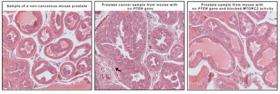
The image on the left shows a sample from a normal prostate, with organized cells lining the O-shaped ductules. Mice without the PTEN gene had developed cancer, which is characterized by enlarged glands and disorganized cells clogging the ductules (middle image). When mTORC2 activity is blocked in mice lacking the PTEN gene, the prostate ductules resemble the appearance of normal prostate samples, with organized cells along the ductules (right image). Image courtesy / Sabatini and Cell Press (Feb. 3, 2009)

(PhysOrg.com) -- Blocking a specific protein complex prevents the formation of tumors in mice genetically predisposed to develop prostate cancer, researchers at the Whitehead Institute for Biomedical Research have found. Interestingly, inhibiting this protein complex in non-cancer cells appears to have no impact, suggesting that the protein complex may represent a promising target for drug development.

Prostate cancer, the second-most common cancer among men in the United States, can be caused by mutation of a known tumor suppressor gene that restrains abnormal cell growth. Studies have shown that an estimated 70 percent of men with prostate cancer have a deletion of this gene, known as PTEN.

"PTEN is probably the second-most common tumor suppressor loss that causes cancer -- after p53 -- so it's a 'big deal' tumor suppressor," says Whitehead Member David Sabatini.

In prostate cells where PTEN is absent, no mechanism exists to prevent the cells from dividing and growing uncontrollably. In a new study appearing in the Feb. 3 edition of Cancer Cell, researchers in Sabatini's lab found that prostate cells also require the mTORC2 protein complex to form tumors.

In a mouse model of human prostate cancer, the PTEN gene is deleted, causing prostate tumors to form. By switching off a protein known as RICTOR, one of the proteins comprising the mTORC2 protein complex, Whitehead researchers found that tumor formation could be blocked and prostate cancer development inhibited in study mice -- despite the PTEN deletion.

To test how a RICTOR-blocking drug might affect healthy cells, Sabatini's lab worked with normal cells where RICTOR was inhibited and found that regular cellular activity is unaffected. This suggests that RICTOR inhibition may offer a novel therapeutic target.

According to David Guertin, a postdoctoral researcher in Sabatini's lab and lead author of this paper, "if you want to make a drug, this protein complex is an appealing target because that drug may not have a big impact on normal cells, but it will have a detrimental effect on cancer cells. It's really a major finding."

Finding a protein that's an acceptable target poses a substantial challenge, explains Sabatini, who is also a Howard Hughes Medical Institute Investigator and professor of biology at MIT. "Evolution has reused proteins in many, many roles, and often proteins important in cancer are also important in other processes. Therefore, when you inhibit them you get more toxicities than you would want."

And while this study specifically focused on mTORC2's role in prostate cancer, inhibiting mTORC2 could lead to therapies for a wide range of cancers, in particular brain and ovarian cancer. Sabatini notes, "We have evidence that in other cancers where PTEN is lost, the same kind of paradigm may operate."

Even if the loss of PTEN functions similarly in other cancers, the researchers are far from developing an inhibitor. Scientists still need to better understand the mTORC2 protein complex structure and to investigate how fully developed malignant tumors react to blocking RICTOR.

Possibly the greatest hurdle will be to find a drug that actually works. "It's really hard to design an inhibitor. And because it's so challenging to do this pharmacologically, we wanted to make a genetic model first showing that we could inhibit this," says Guertin. "This study obviously has big implications, and that could generate interest now to move forward."

Provided by MIT


Rank 5 /5 (1 vote)
Related Stories
Relevant PhysicsForums posts
  • Is Everyday Technology Killing Us?
    createdFeb 08, 2012
  • Exercise and weight loss
    createdFeb 08, 2012
  • Why do we have head aches? Our brains can't feel anything.
    createdFeb 07, 2012
  • "The end of diseases" by David Agus, interview from Daily Show with Jon Stewart
    createdFeb 04, 2012
  • Oncolytic adenovirus
    createdFeb 04, 2012
  • Nutrition label stuffs and diets
    createdFeb 02, 2012
  • More from Physics Forums - Medical Sciences

More news stories

New ability to regrow blood vessels holds promise for treatment of heart disease

(Medical Xpress) -- University of Texas at Austin researchers have demonstrated a new and more effective method for regrowing blood vessels in the heart and limbs — a research advancement that could have ...

Medicine & Health / Research

created 27 minutes ago | popularity 5 / 5 (3) | comments 0 | with audio podcast

New tumor suppressor gene identified

A recent study published in Clinical Cancer Research suggests that the protein hVps37A suppresses tumor growth in ovarian cancer. The work, which was funded by the Austrian Science Fund FWF, shows, for th ...

Medicine & Health / Cancer

created 1 hour ago | popularity 4.7 / 5 (3) | comments 0

Motivation to exercise affects behavior

(Medical Xpress) -- For many people, the motivation to exercise fluctuates from week to week, and these fluctuations predict whether they will be physically active, according to researchers at Penn State. In an effort to ...

Medicine & Health / Health

created 17 minutes ago | popularity not rated yet | comments 0 | with audio podcast

'It's not nutritious until it's eaten'

As part of her "Let's Move! Initiative," First Lady Michelle Obama unveiled a new web resource highlighting new changes in the Chefs Move to Schools, during a CMST gathering in Dallas, TX today. CMTS advocates ...

Medicine & Health / Health

created 4 minutes ago | popularity not rated yet | comments 0

Packard Children's has smallest child yet to get pacemaker

Jaya Maharaj was 15 minutes old when she was sent to surgery at Lucile Packard Children’s Hospital and given a pacemaker that saved her life. The tiny girl — born nine weeks early, weighing 3.5 pounds, ...

Medicine & Health / Cardiology

created 56 minutes ago | popularity not rated yet | comments 0


Fast photon control brings quantum photonic technologies closer

(PhysOrg.com) -- Using photons instead of electrons to transmit information could lead to faster and more secure ways to communicate, among other advantages. Now a team of physicists has taken another step toward realizing ...

Transforming galaxies

(PhysOrg.com) -- Many of the Universe's galaxies are like our own, displaying beautiful spiral arms wrapping around a bright nucleus. Examples in this stunning image, taken with the Wide Field Camera 3 on ...

'Smart' microcapsules in a single step

(PhysOrg.com) -- A new, single-step method of fabricating microcapsules, which have potential commercial applications in industries including medicine, agriculture and diagnostics, has been developed by researchers ...

A continent ablaze in auroral and manmade light

The North American continent is literally set ablaze in a confluence of Auroral and Manmade light captured in spectacular new videos snapped by the astronauts serving aboard the International Space Station ...

Nanostructured electrodes for rechargeable sodium-Ion batteries

Highly efficient 3V cathodes for rechargeable sodium-ion batteries have been developed by users from Argonne National Laboratory's Materials Science, Chemical Sciences & Engineering, and X-ray Sciences Divisions, ...

A lost world? How zooarchaeology can inform biodiversity conservation

A new study of tropical forests will provide a 50,000-year perspective on how animal biodiversity has changed, explored through an archaeological investigation of animal bones.