Refining the search for new planets
February 3, 2009
Refining the search for new planets

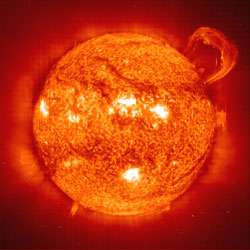
Turbulent activity on the Sun, the kind of stellar activity studied by SF State student Howard Isaacson. Credit: SOHO-EIT Consortium, ESA, NASA

(PhysOrg.com) -- SF State's planet hunting team is trying new avenues of investigation in the quest to discover planets beyond our solar system. At the American Astronomical Society (AAS) meeting in January, graduate students presented novel approaches being used by the Exoplanet Group to search for earth-like planets.

While the search for planets has typically focused on solar-type stars, the Exoplanet Group has begun a new project observing red dwarf stars. Astronomy student Kelsey Clubb shared a poster presentation at the AAS meeting explaining why these cool, low-mass red dwarfs make promising targets.

"We believe that focusing on low-mass stars will lead to the detection of more smaller-mass planets similar to the Earth, and planets with liquid water and temperatures that could sustain life," Clubb said.

Red dwarfs are so faint that they are invisible to the naked eye. However, they are highly suitable for indirect observations because planets orbiting red dwarfs produce a bigger wobble in the host star. Astronomers can detect planets by measuring the gravitational tug that planets exert on their host star, producing a wobble in the star's rotation.

Previous studies of low mass, red dwarf stars show that they are more likely to be accompanied by low mass planets. Since the project began last September the team has identified five red dwarf stars that are prime candidates for further investigation.

Astronomy student Howard Isaacson shared a presentation at the AAS meeting, explaining how his work on stellar activity is aiding planet search efforts. "There can be all kinds of activity in a star's atmosphere such as explosions, flares and solar winds," Isaacson said. "This 'activity' can cause changes in a star's luminosity which could be mistakenly interpreted to indicate the presence of an orbiting planet."

"Howard's work is fundamental to our search for exoplanets because stars that have high activity levels are too 'noisy' for planet searches," said Assistant Professor of Astronomy Debra Fischer, who leads SF State's Exoplanet Group.

At a professional booth hosted by NASA and the Jet Propulsion Laboratory at the AAS meeting, SF State researchers were invited to present a demo version of their planet detection software along with a newly-designed graphical user interface. The graphical user interface (GUI) allows users to analyze data collected from observations of stars to model multiple planet systems.

"Users can enter parameters about their planet search data such as mass and orbital period and they can then see a simple visual simulation of the multiple planet system on the screen," said Julien Spronck, a postdoctoral fellow who worked on the GUI with astronomy students John Brewer and Matt Giguere. "This is a convenient way for people to model multiple planet systems without having to think about the complicated mathematical equations behind the model," Spronck said. The software can manipulate radial velocity data, which measures changes in the star's speed, as well as astrometric data which measures changes in the position of the star.

"The process of fitting data and detecting planets has often been in the hands of a few people in the world," Fischer said. "This software is exciting because it makes it possible for other people to quickly understand the process."

Provided by San Francisco State University

4.6 /5 (5 votes)  

Filter


Move the slider to adjust rank threshold, so that you can hide some of the comments.


Display comments: newest first

LuckyBrandon
Feb 03, 2009

Rank: not rated yet
correct me if im wrong, but a star doesnt hit red dwarf stage unless its mass was too small to ever hit a red giant stage. also, from my understanding, red dwarf stars supposedly would be older than the universe itself...so how could we identify these as true red dwarfs, and if what I stated is the case, I would think any form of planet we are looking for would be long gone....eliminating the purpose for the search. The "rock" might still be there, but I'd think the compnents we want to look for are gone, in other words.
theophys
Feb 04, 2009

Rank: not rated yet
I really don't get the whole method of "let's llook around until we see something cool!" We have models for how planets form, we have models for all the forces that act between planets and their mother star, and we have really spiffy calculators. We should be making predictions as to where planets will be and at what size, then look to see how accurate the models are. Just scanning the universe with a telescope seems a little inefficient to me.

a star doesnt hit red dwarf stage unless its mass was too small to ever hit a red giant stage. also, from my understanding, red dwarf stars supposedly would be older than the universe itself

Nope. Red giants are unrelated to the formation of red dwarves. Also, red dwarf stars would actualy have shorter life spans than other stars due to their lack of fuel.
lomed
Feb 04, 2009

Rank: not rated yet
I really don't get the whole method of "let's llook around until we see something cool!" We have models for how planets form, we have models for all the forces that act between planets and their mother star, and we have really spiffy calculators. We should be making predictions as to where planets will be and at what size, then look to see how accurate the models are. Just scanning the universe with a telescope seems a little inefficient to me.

a star doesnt hit red dwarf stage unless its mass was too small to ever hit a red giant stage. also, from my understanding, red dwarf stars supposedly would be older than the universe itself

Nope. Red giants are unrelated to the formation of red dwarves. Also, red dwarf stars would actualy have shorter life spans than other stars due to their lack of fuel.

Actually, the lifespan of red dwarfs is longer than that of larger stars since the larger the star is, the faster it burns its fuel. If I remember correctly, the lifespan of an average red dwarf is several tens of billions of years (versus ~10 billion for the sun.) However, red dwarfs are among the most common types of stars. Just because red dwarfs have long lifespans does not mean they are older than the universe. Red dwarfs are made just like any other star; thus, one would expect to find red dwarfs of many different ages (some perhaps nearly as old as the universe, and some "born" yesterday.)

Unfortunately, though we have models for planet formation, most of them are almost entirely without evidence from beyond our solar system. Also, in order to find planets that way, we would have to know what conditions were like near the star(s) when it was forming, perhaps billions of years ago. Additionally, planetary systems are chaotic, a small variation in initial conditions can drastically change the results of a simulation. Thus, it would be computationally prohibitive, at this point, and not strongly predictive (in most cases) to attempt to "find" planets via simulation. Simulations are good for checking current theories of planetary formation, but the difference between checking theories and producing predictions is great.
theophys
Feb 05, 2009

Rank: not rated yet
Unfortunately, though we have models for planet formation, most of them are almost entirely without evidence from beyond our solar system. Also, in order to find planets that way, we would have to know what conditions were like near the star(s) when it was forming, perhaps billions of years ago. Additionally, planetary systems are chaotic, a small variation in initial conditions can drastically change the results of a simulation. Thus, it would be computationally prohibitive, at this point, and not strongly predictive (in most cases) to attempt to "find" planets via simulation. Simulations are good for checking current theories of planetary formation, but the difference between checking theories and producing predictions is great.

Consider it a learning oppurtunity. We can keep pointing telescopes at lights, but we should keep working on our models until we find effective methods of prediction. That's what science is all about. Finding the best way to explain the universe and make accurate predictions. All we're doing now is catalouging and hoping somebody can think of a way to use the data.
LuckyBrandon
Feb 09, 2009

Rank: not rated yet
if the average lifesspan of a red dwarf is tens of billions of years, the would make them potentially older than the universe...if it were 10 billion years, ok sure, but being as the universe is ~13 billion years old, the stars must have either formed immediately after the "big bang" and are still persisting to this day, or else they were here first. of course i would tend to think they were formed right around the time of the big bang and are still persisting....
thanks guys :)
theophys
Feb 10, 2009

Rank: not rated yet
It doesn't matter what the lifespans of red dwarves are, they aren't going to be older than the universe. Saying that they last tenss of billion of years isn't saying that they've been around for tens of billions of years. It just means that they'll be around for a long time to come.
LuckyBrandon
Feb 15, 2009

Rank: not rated yet
well thats kind of what i ended with...the assumption they formed soon after and still persist...but my real point in all of that was, why are we looking around such ancient stars for planets....it owuld make way more sense to stick with what we know the symptoms of, that being 1 solarm ass suns (maybe .5-2.5 solar mass range)...there are enough of those to keep us looking eternally im sure....and we can better, or at least quicker, breakdown the composition of those solar systems.
Rank 4.6 /5 (5 votes)
Related Stories
Relevant PhysicsForums posts
  • Is Venus Slowing Down?
    created1 hour ago
  • Never ending outer space.....
    createdFeb 11, 2012
  • Neutron Star fragments?
    createdFeb 11, 2012
  • stationary or not?
    createdFeb 11, 2012
  • Scale of the Universe
    createdFeb 10, 2012
  • Titan's lack of impact craters
    createdFeb 09, 2012
  • More from Physics Forums - General Astronomy

More news stories

Transforming galaxies

(PhysOrg.com) -- Many of the Universe's galaxies are like our own, displaying beautiful spiral arms wrapping around a bright nucleus. Examples in this stunning image, taken with the Wide Field Camera 3 on ...

Space & Earth / Astronomy

created 48 minutes ago | popularity 5 / 5 (1) | comments 0 | with audio podcast

A continent ablaze in auroral and manmade light

The North American continent is literally set ablaze in a confluence of Auroral and Manmade light captured in spectacular new videos snapped by the astronauts serving aboard the International Space Station ...

Space & Earth / Space Exploration

created 41 minutes ago | popularity not rated yet | comments 0

A better picture of clouds

Some of us look at clouds and see animal shapes. Scientists are looking beyond. For the first time, a team of scientists led by Pacific Northwest National Laboratory used actual measurements of clouds and ...

Space & Earth / Earth Sciences

created 43 minutes ago | popularity not rated yet | comments 0

Scientists drill two miles down to ancient Lake Vostok

(PhysOrg.com) -- Russian scientists last week finished penetrating more than two miles through the Antarctic ice sheet to Lake Vostok, a huge freshwater lake that has been buried under the ice for millions ...

Space & Earth / Earth Sciences

created 32 minutes ago | popularity 5 / 5 (1) | comments 0

Earth-facing sunspot doubles in size

The latest sunspot region to traverse the face of the Sun has nearly doubled in size as it aims Earthward, as seen in the animation above from NASA’s Solar Dynamics Observatory. (Click image to play the ...

Space & Earth / Space Exploration

created 1 hour ago | popularity not rated yet | comments 0


'Smart' microcapsules in a single step

(PhysOrg.com) -- A new, single-step method of fabricating microcapsules, which have potential commercial applications in industries including medicine, agriculture and diagnostics, has been developed by researchers ...

New ability to regrow blood vessels holds promise for treatment of heart disease

(Medical Xpress) -- University of Texas at Austin researchers have demonstrated a new and more effective method for regrowing blood vessels in the heart and limbs — a research advancement that could have ...

Ethanol mandate not the best option

Many people are willing to pay a premium for ethanol, but not enough to justify the government mandate for the corn-based fuel, a Michigan State University economist argues.

Nanostructured electrodes for rechargeable sodium-Ion batteries

Highly efficient 3V cathodes for rechargeable sodium-ion batteries have been developed by users from Argonne National Laboratory's Materials Science, Chemical Sciences & Engineering, and X-ray Sciences Divisions, ...

New tumor suppressor gene identified

A recent study published in Clinical Cancer Research suggests that the protein hVps37A suppresses tumor growth in ovarian cancer. The work, which was funded by the Austrian Science Fund FWF, shows, for th ...

A lost world? How zooarchaeology can inform biodiversity conservation

A new study of tropical forests will provide a 50,000-year perspective on how animal biodiversity has changed, explored through an archaeological investigation of animal bones.