Surgeons Use Microwaves to Destroy Tumors
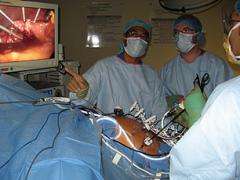
A new minimally-invasive option for treating liver tumors, called microwave ablation, is now available at UC San Diego Medical Center and Moores UCSD Cancer Center, the only hospitals in the region to offer this technology to patients.
“A liver tumor can be removed in many ways,” said Marquis Hart, MD, transplant surgeon at UC San Diego Medical Center. “Now, patients at UC San Diego have a new option called ‘microwave ablation.’ Simply put, we zap and destroy liver tumors with heat derived from microwave energy. This is an important alternative, especially since the majority of liver cancers cannot be partially removed and not all patients are transplant candidates.”
Liver cancer is on the rise in the United States, linked closely with the epidemic of hepatitis and other conditions causing cirrhosis, a degenerative disease of the liver. Current treatment options for liver cancer include transplantation, partial surgical removal of the liver, chemotherapy, radiation, or ablation—the destruction of abnormal tissue with heat from radiofrequency waves, high frequency ultrasound, freezing, or alcohol injection. Now, microwave technology, offered by Covidien, removes the tumor with intense heat.
To perform the procedure, Hart accesses the tumor through the skin, or through a small laparoscopic port or open incision. With ultrasound guidance or a computed tomography (CT) scan, the tumor is located and then pierced with a thin antenna which emits microwaves. This energy spins the water molecules in the tumor producing friction which causes heat. Temperatures above 60 degrees Celsius (140 degrees Fahrenheit) cause cellular death, usually within 10 minutes.
“Microwave ablation causes the tumor to be quickly and precisely removed. If necessary, multiple tumors can be treated at the same time,” said Hart. “This method appears to be more efficient than other ablation techniques which translates to better tumor destruction and less time for the patient under general anesthesia.”
In addition to liver disease, microwave ablation has promising potential in the treatment of lung, kidney, and bone cancer.
“The incidence of liver cancer in the United States has more than doubled in the last 20 years,” said Hart. “Conditions that cause chronic liver damage increase the risk of liver cancer. Fortunately the treatment options at UC San Diego Medical Center and Moores UCSD Cancer Center are numerous. No where else in the region will you find a multidisciplinary team of surgeons, hepatologists, radiologists, and oncologists offering the latest in cancer care. With a team dedicated specifically to the liver, our patients receive cutting-edge care from a diverse team of experts.”
According to the National Cancer Institute, primary liver and bile duct cancers are the fifth most common cause of cancer death in men and the ninth most common cause of cancer death in women. More than 90 percent of all cases occur in men and women age 45 or older. Liver cancer is closely associated with hepatitis virus infections. The incidence and mortality rates for these cancers have increased in all races and both sexes in the past two decades.
Established in 1965, the Department of Surgery at UC San Diego Medical Center represents more than 80 leading surgeons with specialties in open, minimally invasive, and scarless surgery techniques. The Department is committed to advancing surgical education by teaching and training the next generation of innovators; researching, testing and developing groundbreaking surgical techniques; providing superior patient care and service; and attracting a world-class faculty.
Every year surgeons at UC San Diego Medical Center and Moores UCSD Cancer Center are recognized locally as San Diego’s Top Doctors and nationally as the physician-scientists who are developing emerging surgical techniques.
The Moores UCSD Cancer Center is one of the nation’s 41 National Cancer Institute-designated Comprehensive Cancer Centers, combining research, clinical care and community outreach to advance the prevention, treatment and cure of cancer.
Provided by University of California, San Diego


