Scientists discover how deadly fungus protects itself
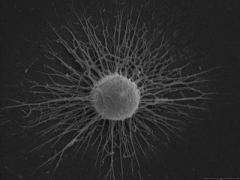
Researchers at Albert Einstein College of Medicine of Yeshiva University have discovered how a deadly microbe evades the human immune system and causes disease.
The study, published in the journal Proceedings of the National Academy of Sciences (PNAS), may help scientists develop new therapies or vaccines against infections caused by Cryptococcus neoformans. These fungal infections occur most commonly in those with compromised immune systems ─ especially AIDS patients and transplant patients who must take lifelong immunosuppressive therapy. The fungus causes an estimated one million deaths each year worldwide, including some 600,000 in sub-Saharan Africa. The lead author of the study was Susana Frases-Carvajal, Ph.D., a postdoctoral fellow in microbiology & immunology at Einstein.
C. neoformans typically enters the body through the lungs and can spread throughout the body, including the brain. The resulting infection, called cryptococcosis, can cause chest pain, dry cough, abdominal swelling, headache, blurred vision, or confusion. The infection can be fatal, especially if not treated with antifungal medications.
"It's a horrendous disease, and even with therapy, you often can't get rid of it," says the paper's senior author, Arturo Casadevall, M.D., Ph.D., professor and chair of microbiology & immunology.
Scientists have known that the capsule surrounding C. neoformans is essential to its ability to cause disease. When the fungus enters a host, the capsule begins to enlarge. "As the capsule grows larger, it reaches a point where immune system scavenger cells, known as macrophages, can't swallow it," says Dr. Casadevall. "But we didn't understand the mechanism responsible for capsule growth."
The protective capsule of C. neoformans is composed of polysaccharides, which are long chains of sugar molecules, or saccharides. Using a technique called dynamic light scattering, Dr. Frases and her colleagues found that the capsule grows by linking more and more saccharides together at the outer edge of the capsule, forming giant molecules pointing in an outward, or axial, direction.
The findings point to potential new targets for drug intervention and reveal a new area of investigation into basic polysaccharide biology. Polysaccharides are poorly understood, partly because of the difficulty of working with them. "Also, scientists have tended to view polysaccharides as boring molecules that simply grow to a specified length," says Dr. Casadevall.
"But this study raises huge questions about polysaccharides," he adds. "For example, how does the organism assemble these molecules, and how does it know how to make molecules that are roughly the same length? We don't know. There appears to be a whole dimension of cellular machinery that we never knew existed."
More information: The study, "Capsule of Cryptococcus neoformans grows by enlargement of polysaccharide molecules," appears in the January 27 issue of PNAS. www.pnas.org/content/106/4/1228.abstract
Source: Albert Einstein College of Medicine


