Powerful New Technique to Measure Asteroids' Sizes and Shapes
February 4, 2009
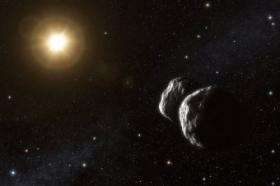
Artist’s impression of the asteroid (234) Barbara. Thanks to a unique method that uses ESO’s Very Large Telescope Interferometer, astronomers have been able to measure sizes of small asteroids in the main belt for the first time. Their observations also suggest that Barbara has a complex concave shape, best modelled as two bodies that may possibly be in contact. Credit: ESO/L. Calçada
A team of French and Italian astronomers have devised a new method for measuring the size and shape of asteroids that are too small or too far away for traditional techniques, increasing the number of asteroids that can be measured by a factor of several hundred. This method takes advantage of the unique capabilities of ESO's Very Large Telescope Interferometer (VLTI).
"Knowledge of the sizes and shapes of asteroids is crucial to understanding how, in the early days of our Solar System, dust and pebbles collected together to form larger bodies and how collisions and re-accumulation have since modified them," says Marco Delbo from the Observatoire de la Côte d'Azur, France, who led the study.
Direct imaging with adaptive optics on the largest ground-based telescopes such as the Very Large Telescope (VLT) in Chile, and space telescopes, or radar measurements are the currently favoured methods of asteroid measurement. However, direct imaging, even with adaptive optics, is generally limited to the one hundred largest asteroids of the main belt, while radar measurements are mostly constrained to observations of near-Earth asteroids that experience close encounters with our planet.
Delbo and his colleagues have devised a new method that uses interferometry to resolve asteroids as small as about 15 km in diameter located in the main asteroid belt, 200 million kilometres away. This is equivalent to being able to measure the size of a tennis ball a distance of a thousand kilometres. This technique will not only increase the number of objects that can be measured dramatically, but, more importantly, bring small asteroids that are physically very different from the well studied larger ones into reach.
The interferometric technique combines the light from two or more telescopes. Astronomers proved their method using ESO's VLTI, combining the light of two of the VLT's 8.2-metre Unit Telescopes. "This is equivalent to having vision as sharp as that of a telescope with a diameter equal to the separation between the two VLT Unit Telescopes used, in this case, 47 metres," says co-author Sebastiano Ligori, from INAF-Torino, Italy. The researchers applied their technique to the main belt asteroid (234) Barbara, which was earlier found, by co-author Alberto Cellino, to have rather unusual properties. Although it is so far away, the VLTI observations also revealed that this object has a peculiar shape. The best fit model is composed of two bodies each the size of a major city - with diameters of 37 and 21 km - separated by at least 24 km. "The two parts appear to overlap," says Delbo, "so the object could be shaped like a gigantic peanut or, it could be two separate bodies orbiting each other."
If Barbara proves to be a double asteroid, this is even more significant: by combining the diameter measurements with the parameters of the orbits, astronomers can then compute the density of these objects. "Barbara is clearly a high priority target for further observations," concludes Ligori.
Having proven the validity of their new and powerful technique, the team can now start a large observing campaign to study small asteroids.
These observations are presented in a paper by Delbo M. et al., First VLTI-MIDI direct determinations of asteroid sizes, in press in the Astrophysical Journal.
Provided by ESO
-
Lowell Observatory astronomers chase Pluto's shadow across the Pacific ocean
Jul 21, 2011 |
not rated yet |
4
-
Ground-based images of asteroid Lutetia complement spacecraft flyby
Oct 07, 2010 |
5 / 5 (1) |
0
-
Zooming in on an infant solar system
Jun 11, 2010 |
5 / 5 (10) |
2
-
Spitzer Telescope Warms Up to New Career
May 06, 2009 |
5 / 5 (6) |
2
-
Looking for New Light
Jun 19, 2008 |
4.8 / 5 (8) |
0
-
Engineers build first sub-10-nm carbon nanotube transistor
Feb 01, 2012 |
4.9 / 5 (31) |
30
-
Something old, something new: Evolution and the structural divergence of duplicate genes
Jan 31, 2012 |
4.6 / 5 (7) |
1
-
The hidden nanoworld of ice crystals: Revealing the dynamic behavior of quasi-liquid layers
Jan 30, 2012 |
5 / 5 (3) |
1
-
Stock market network reveals investor clustering
Jan 27, 2012 |
3.9 / 5 (23) |
8
-
Of microchemistry and molecules: Electronic microfluidic device synthesizes biocompatible probes
Jan 26, 2012 |
5 / 5 (1) |
0
-
Scale of the Universe
14 hours ago
-
Titan's lack of impact craters
Feb 09, 2012
-
Real pictures of black hole eating a star?
Feb 08, 2012
-
Hypothetical way to travel faster than light, but not technically exceed lightspeed
Feb 06, 2012
-
How do scientists monitor the Sun's activity?
Feb 05, 2012
-
Search patterns in observational studies
Feb 05, 2012
- More from Physics Forums - General Astronomy
More news stories
Could Venus be shifting gear?
(PhysOrg.com) -- ESAs Venus Express spacecraft has discovered that our cloud-covered neighbour spins a little slower than previously measured. Peering through the dense atmosphere in the infrared, the ...
Space & Earth / Space Exploration
21 hours ago |
5 / 5 (7) |
8
|
Mars Science Laboratory computer issue resolved
(PhysOrg.com) -- Engineers have found the root cause of a computer reset that occurred two months ago on NASA's Mars Science Laboratory and have determined how to correct it.
Space & Earth / Space Exploration
22 hours ago |
4.7 / 5 (6) |
4
|
Two new moons for Jupiter
Advances in technology have lead to the discovery of new planets outside of our Solar System, and now even new moons in our own backyard.
Space & Earth / Space Exploration
21 hours ago |
4 / 5 (1) |
7
NASA sees wide-eyed cyclone Jasmine
Cyclone Jasmine's eye has opened wider on NASA satellite imagery, as it moves through the Southern Pacific Ocean.
Space & Earth / Earth Sciences
13 hours ago |
3.5 / 5 (2) |
2
Clam fields found at deep, low-temperature Mariana vents
(PhysOrg.com) -- Scientists have marveled at the unusual life forms thriving at high temperature hydrothermal vents of the deep ocean.
Space & Earth / Earth Sciences
21 hours ago |
4.3 / 5 (3) |
0
|
Anonymous knocks CIA website offline (Update)
The website of the Central Intelligence Agency was inaccessible on Friday after the hacker group Anonymous claimed to have knocked it offline.
New error-correcting codes guarantee the fastest possible rate of data transmission
Error-correcting codes are one of the triumphs of the digital age. Theyre a way of encoding information so that it can be transmitted across a communication channel such as an optical fiber o ...
Small modular reactor design could be a 'SUPERSTAR'
(PhysOrg.com) -- Though most of today's nuclear reactors are cooled by water, we've long known that there are alternatives; in fact, the world's first nuclear-powered electricity in 1951 came from a reactor ...
New power source discovered
(PhysOrg.com) -- Researchers at the Massachusetts Institute of Technology (MIT) and RMIT University have made a breakthrough in energy storage and power generation.
The power of estrogen -- male snakes attract other males
A new study has shown that boosting the estrogen levels of male garter snakes causes them to secrete the same pheromones that females use to attract suitors, and turned the males into just about the sexiest ...
Advanced power-grid model finds low-cost, low-carbon future in West
(PhysOrg.com) -- The least expensive way for the Western U.S. to reduce greenhouse gas emissions enough to help prevent the worst consequences of global warming is to replace coal with renewable and other ...
Feb 04, 2009
Rank: 3 / 5 (2)
Feb 04, 2009
Rank: not rated yet
Feb 04, 2009
Rank: not rated yet