Largest prehistoric snake on record discovered in Colombia (Video)
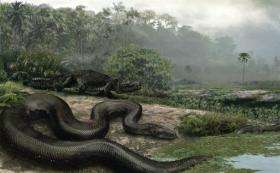
February 4, 2009 Titanoboa cerrejonensis

Enlarge

Titanoboa cerrejonensis (© Jason Bourque, University of Florida)

Scientists have recovered fossils of a 60-million-year-old South American snake whose length and weight might make today's anacondas and reticulated pythons seem a bit cuter and more cuddly.

Named Titanoboa cerrejonensis by its discoverers, the size of the snake's vertebrae suggest it weighed 1140 kg (2,500 pounds) and measured 13 metres (42.7 feet) nose to tail tip. A report describing the find appears in this week's Nature.

Drs Jason Head and David Polly carried out much of the quantitative work behind the discovery whilst working in the School of Biological and Chemical Sciences at Queen Mary, University of London; they identified the position of the fossil vertebrae which made a size estimate possible. Now based at the University of Indiana, Polly explains: "At its greatest width, the snake would have come up to about your hips. The size is pretty amazing. But our team went a step further and asked, how warm would the Earth have to be to support a body of this size?"

You need Flash installed to watch this ideo

Largest prehistoric snake on record discovered in Colombia

Crews led by the Smithsonian Tropical Research Institute and the University of Florida's Florida Museum of Natural History discovered the fossils in the Cerrejon Coal Mine in northern Colombia, and together with lead-author Jason Head now of the University of Toronto-Mississauga, used its size to make an estimate of Earth's temperature 58 to 60 million years ago in tropical South America.

Paleontologists have long known of a rough correlation between an age's temperature and the size of its poikilotherms (cold-blooded creatures). Over geological time, as ages get warmer, so does the upper size limit on poikilotherms.

"There are many ways the anatomy of a species is correlated with its environment on broad scales," Polly said. "If we understand these correlations better, we will know more about how climate and climate change affect species, as well as how we can infer things about past climates from the morphology of the species that lived back then."

Assuming the Earth today is not particularly unusual, Head and Dr Jonathan Bloch, Assistant Curator of Vertebrate Paleontology at the Florida Museum of Natural History, estimated a snake of Titanoboa's size would have required an average annual temperature of 30 to 34°C (86 to 93 F) to survive. By comparison, the average yearly temperature of today's Cartagena, a Colombian coastal city, is about 28°C.

"Tropical ecosystems of South America were surprisingly different 60 million years ago," said Bloch. "It was a rainforest, like today, but it was even hotter and the cold-blooded reptiles were all substantially larger. The result was, among other things, the largest snakes the world has ever seen... and hopefully ever will."

"The temperature estimation shows that a tropical rainforest, like Cerrejon, lived at a temperature of 32°C, five degrees above the upper limit of temperature for tropical rainforest in modern times," said Carlos Jaramillo, a palaeobotanist ad the Smithsonian Topical Research Institute. "These data challenge the view that tropical vegetation lives near its climatic optimum and it has profound implications in understanding the effect of current global warming on tropical plants."

The scientists classify Titanoboa as a boine snake, a type of non-venomous constrictor that includes anacondas and boas. Head and Polly extrapolated the placement of Titanoboa fossil vertebrae by comparing the fossils' structure to the vertebrae of today's boine snakes. Snake vertebrae get bigger near a snake's midsection, but they are also structured differently than vertebrae closer to a snake's head or tail. Using a computer model he wrote, Polly estimated the fossil vertebrae originate near Titanoboa's middle. That means that if Polly's model is incorrect about the bone's placement, the snake could have been even bigger.

Evolution has produced a wide variety of gigantic animals over the last several hundred million years -- dinosaurs, ancient dragonflies, and today's blue whale, to name a few; but why some species lineages produce monsters remains a matter of debate among evolutionary biologists and ecologists.

Reference: Jason J. Head, Jonathan I. Bloch, Alexander K. Hastings, Jason R. Bourke, Edwin A. Cadena, Fabiany A. Herrera, P. David Polly, and Carlos A. Jaramillo. 2008. Giant boid snake from the paleocene neotropics reveals hotter past equatorial temperatures. Nature. February 5, 2009

Estimated Titanoboa size: 42 feet (13 meters); 1140 kilograms. According to the Guinness Book of World Records, the longest snake ever measured was 10 meters (33 feet) in length. The heaviest snake, a python, weighed 183 kilograms (403 pounds).

Source: Queen Mary, University of London

Follow PhysOrg.com stories on Twitter: http://twitter.com/physorg_com


Rate this story - 4.2 /5 (24 votes)

Rank Filter

Move the slider to adjust rank threshold, so that you can hide some of the comments.


Display comments: newest first

  • gopher65 - Feb 04, 2009
    • Rank: 5 / 5 (1)
    True, the temperature may have been hotter, but keep in mind that if the oxygen content in the atmosphere was higher, that would reduce the need to increase the temperature.
  • Modernmystic - Feb 04, 2009
    • Rank: not rated yet
    Makes sense, right around the time of the PETM...

    Impressive animal as well. I wonder how fast it could have moved...
  • Velanarris - Feb 04, 2009
    • Rank: not rated yet
    Makes sense, right around the time of the PETM...

    Impressive animal as well. I wonder how fast it could have moved...

    Considering modern snakes are a big mass of quick twitch muscles, probably incredibly fast. Almost frightening when you think about it.
  • defunctdiety - Feb 04, 2009
    • Rank: not rated yet
    True, the temperature may have been hotter, but keep in mind that if the oxygen content in the atmosphere was higher, that would reduce the need to increase the temperature.


    But if the oxygen content of the atmosphere was higher when it was alive, it's likely also a time period with higher mean global temperatures, no?, so I'm not sure what your point is.
  • Sophos - Feb 04, 2009
    • Rank: 5 / 5 (1)
    Another article on this found in Google news used a statement from a climate scientist disputing the validity of extrapolating reptile size and average temperature. Thanks Physorg for editing that silliness out !!!!
  • Valentiinro - Feb 04, 2009
    • Rank: 4 / 5 (1)

    Considering modern snakes are a big mass of quick twitch muscles, probably incredibly fast. Almost frightening when you think about it.


    You call a 40 foot long snake able to move at high speeds ALMOST frightening?

    I do think this is a shame: "The result was, among other things, the largest snakes the world has ever seen... and hopefully ever will."
    Scientists aren't supposed to want creatures to not exist.
  • Velanarris - Feb 04, 2009
    • Rank: 5 / 5 (2)
    Another article on this found in Google news used a statement from a climate scientist disputing the validity of extrapolating reptile size and average temperature. Thanks Physorg for editing that silliness out !!!!
    I'm surprised he didn't call it a temperature proxy and demand grant money.
  • Modernmystic - Feb 04, 2009
    • Rank: 5 / 5 (1)
    I'm surprised he didn't call it a temperature proxy and demand grant money.


    Who says he won't ;)

    Seriously though the PETM is well established scientifically. As I recall the average temperature of the Earth was roughly 12 degrees F hotter than it is today....

    *cough* and they didn't have power plants or cars *cough*
  • Mercury_01 - Feb 04, 2009
    • Rank: 4 / 5 (1)
    thats a big fukkin snake mang!
  • Otto - Feb 04, 2009
    • Rank: not rated yet
    That'd be a mindblowing sight.
  • RAL - Feb 05, 2009
    • Rank: 5 / 5 (2)
    Does this mean that Al Gore will be adding "Giant Snakes" as another danger of AGW?
  • RFC - Feb 05, 2009
    • Rank: 5 / 5 (1)
    I see the movie now.... "Snakes the Size of a Plane!"

  • lengould100 - Feb 05, 2009
    • Rank: 1 / 5 (1)
    You denier genius guys are real jokers (eg. worth laughing at). As if any scientist doesn't already know that there have been periods in past when global temperatures were higher than present.
  • gopher65 - Feb 05, 2009
    • Rank: 5 / 5 (1)
    Uh, yes? But contrary to what they say in this article, temperature increase DOES NOT correspond to a directly proportional increase in reptile size. That's just stupid. There were many factors whose combined effect led to bigger animals.
  • ctpappas - Feb 05, 2009
    • Rank: not rated yet
    Please find a few more of them that size before telling us what the average temp was at that time....

    Just one isn't a good sample size, is it?
  • Doug_Huffman - Feb 05, 2009
    • Rank: not rated yet
    Wanna be scared? Think T. Rex as you watch a crow hunt.
  • Modernmystic - Feb 05, 2009
    • Rank: 5 / 5 (1)
    You denier genius guys are real jokers (eg. worth laughing at). As if any scientist doesn't already know that there have been periods in past when global temperatures were higher than present.


    Does this mean you believers are worth laughing at when you KNOW that the Earth has been 12 degrees hotter than it is today without a single car or factory to blame, yet can't concieve how it could possibly be a natural variation now?

    Oh never mind. I forgot I made a promise to myself to at least try not to beat my head against brick walls anymore.

    20 years time will do more to clear up the issue than all the argument in the world...
  • Velanarris - Feb 05, 2009
    • Rank: 5 / 5 (1)
    You denier genius guys are real jokers (eg. worth laughing at). As if any scientist doesn't already know that there have been periods in past when global temperatures were higher than present.


    Does this mean you believers are worth laughing at when you KNOW that the Earth has been 12 degrees hotter than it is today without a single car or factory to blame, yet can't concieve how it could possibly be a natural variation now?

    Oh never mind. I forgot I made a promise to myself to at least try not to beat my head against brick walls anymore.

    20 years time will do more to clear up the issue than all the argument in the world...

    5 actually.
  • DrZsbl - Feb 06, 2009
    • Rank: not rated yet
    49-foot python captured in Indonesia. With video.

    http://www.msnbc....3845750/


February 4, 2009 all stories

Comments: 19

4.2 /5 (24 votes)

  • hide
  • Related Stories

  • World's first skeletal mount of Paluxysaurus jonesi reveals new biology
    created Dec 15, 2009 | popularity not rated yet | comments 0
  • Fossils shake dinosaur family tree
    created Dec 10, 2009 | popularity not rated yet | comments 0
  • Scientists find fossil bones of smallest dinosaur
    created Oct 21, 2009 | popularity not rated yet | comments 0
  • Robots with fins, tails demonstrate evolution
    created May 29, 2009 | popularity not rated yet | comments 0
  • Preserved shark fossil adds evidence to great white's origins
    created Mar 12, 2009 | popularity not rated yet | comments 0


  • hide
  • Relevant PhysicsForums posts

  • Do we lose weight by respiration ? (Losing carbons)
    created 3 hours ago
  • Sleeping habits and the risk of cancer
    created Feb 08, 2010
  • Pressure in chambers of the heart
    created Feb 07, 2010
  • Primordial soup canned?
    created Feb 07, 2010
  • Where on the r/K selection theory scale do social insects like ants and bees fall?
    created Feb 06, 2010
  • Testosterone levels and Fighting
    created Feb 05, 2010
  • More from Physics Forums - Biology

Other News

Study challenges bird-from-dinosaur theory of evolution - was it the other way around?

Study challenges bird-from-dinosaur theory of evolution - was it the other way around?

Other Sciences / Archaeology & Fossils

created 16 hours ago | popularity 3.7 / 5 (11) | comments 4 | with audio podcast

(PhysOrg.com) -- A new study just published in the Proceedings of the National Academy of Sciences provides yet more evidence that birds did not descend from ground-dwelling theropod dinosaurs, experts say, a ...


TED takes on 'What the world needs now'

Other Sciences / Other

created 4 hours ago | popularity not rated yet | comments 0

Let the mind-bending begin! A TED conference that attracts brilliant minds and challenges them to solve humanity's ills got underway Tuesday in the southern California city of Long Beach.


New research reveals burglars have changed their 'shopping list'

Other Sciences / Social Sciences

created 4 hours ago | popularity 3.5 / 5 (2) | comments 3

Globalisation, and particularly cheaper electronic goods from China and the Far East, has altered behaviour among Britain's burglars according research in progress at the University of Leicester.


'Counterfactual' thinkers are more motivated and analytical, study suggests

Other Sciences / Social Sciences

created 19 hours ago | popularity 4.4 / 5 (5) | comments 6 | with audio podcast

(PhysOrg.com) -- "If only I had..." Almost everyone has said those four words at some time. Rather than intensifying regret, '"what if" reflection about pivotal moments in the past helps people to weave a coherent life story, ...


Office romance? Not a problem most of time: study

Office romance? Not a problem most of time: study

Other Sciences / Social Sciences

created 18 hours ago | popularity not rated yet | comments 1

(PhysOrg.com) -- Pam and Jim on The Office. Meredith and McDreamy on Grey's Anatomy. Television shows depict many workplace romances, but in the real world how do co-workers view love on the job? According ...