New plasma transistor could create sharper displays
February 4, 2009 New plasma transistor could create sharper displays

Enlarge

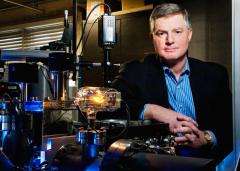
Gary Eden, a professor of electrical and computer engineering at Illinois, and colleagues have created a plasma transistor that could be used to make lighter, less expensive and higher resolution flat-panel displays. The researchers have applied for a patent. Photo by L. Brian Stauffer

(PhysOrg.com) -- By integrating a solid-state electron emitter and a microcavity plasma device, researchers at the University of Illinois have created a plasma transistor that could be used to make lighter, less expensive and higher resolution flat-panel displays.

"The new device is capable of controlling both the plasma conduction current and the light emission with an emitter voltage of 5 volts or less," said Gary Eden, a professor of electrical and computer engineering, and director of the Laboratory for Optical Physics and Engineering at the U. of I.

At the heart of the plasma transistor is a microcavity plasma, an electronic-photonic device in which an electrically charged gas (a plasma) is contained within a microscopic cavity. Power is supplied by two electrodes at voltages of up to 200 volts.

Eden and graduate student Kuo-Feng (Kevin) Chen fabricated the plasma transistor from copper-clad laminate into which a microcavity 500 microns in diameter was produced by standard photolithographic techniques. The solid-state electron emitter was made from a silicon wafer, topped with a thin layer of silicon dioxide.

The microcavity is approximately the diameter of a human hair, and is filled with a small amount of gas. When excited by electrons, atoms in the plasma radiate light. The color of light depends on what gas is placed in the microcavity. Neon emits red light, for example, and argon emits blue light.

Around the plasma is a thin boundary layer called the sheath. Within the sheath, electrical current is carried not by negatively charged electrons, but instead by positively charged ions. Much heavier than electrons and therefore harder to accelerate, the ions require a large electric field generated by a large voltage drop across the sheath.

The intense electric field within the plasma sheath also promotes electron transport, said Eden, who also is a researcher at the university's Coordinated Science Laboratory and at the Micro and Nanotechnology Laboratory. "By injecting electrons from the emitter into the sheath, we can significantly increase the flow of electrons through the plasma, which increases the plasma's conductivity and light emission."

While the microcavity plasma still requires up to 200 volts to emit light and conduct current, the current and light emission can be controlled by an electron emitter operating at 5 volts or less, Eden said. The current that is sent through the sheath to the bulk plasma determines how much current is carried by the two electrodes driving the microplasma.

In previous work, Eden's team created flat-panel plasma lamps out of two sheets of aluminum foil separated by a thin dielectric layer of clear aluminum oxide. More than 250,000 lamps can be packed into a single panel. And, because microcavity plasmas operate at atmospheric pressure, thick pieces of glass are not needed to seal them. The lightweight plasma panels are less than 1 millimeter thick.

"Being able to control each microcavity plasma independently could turn our plasma panel into a less expensive and higher resolution plasma display," Eden said. "The plasma transistor also could be used in applications where you want to use a small voltage to control a great deal of power."

Eden and Chen described the plasma transistor in the journal Applied Physics Letters. The researchers have applied for a patent.

Source: University of Illinois at Urbana-Champaign


print this article email this article download pdf blog this article bookmark this article     Stumble it Digg this share on Facebook retweet share on Reddit add to delicious
Rate this story - 4.7 /5 (9 votes)

Rank Filter

Move the slider to adjust rank threshold, so that you can hide some of the comments.


Display comments: newest first


February 4, 2009 all stories

Comments: 2

4.7 /5 (9 votes)
  • Stumble this up

  • Digg this

  • share this

  • hide
  • Related Stories

  • Scientists fabricate first plasma transistor
    created Nov 12, 2008 | popularity not rated yet | comments 0
  • New Flexible, Transparent Transistors made of Nanotubes
    created Nov 27, 2007 | popularity not rated yet | comments 0
  • 'Dropouts' pinpoint earliest galaxies
    created Nov 06, 2009 | popularity not rated yet | comments 0
  • Newly Discovered Fat Molecule: An Undersea Killer with an Upside
    created Nov 05, 2009 | popularity not rated yet | comments 0
  • Electron self-injection into an evolving plasma bubble
    created Nov 02, 2009 | popularity not rated yet | comments 0


  • hide
  • Relevant PhysicsForums posts

  • Work done on femur
    created 3 hours ago
  • Magnet and Motors?
    created 4 hours ago
  • Effect of Volume on Revolution
    created 4 hours ago
  • Hydrostatic pressure
    created 6 hours ago
  • More from Physics Forums - General Physics

Other News

Stars Fueled by Dark Matter Could Hold Secrets to the Universe

Stars Fueled by Dark Matter Could Hold Secrets to the Universe

Physics / General Physics

created Nov 03, 2009 | popularity 4.5 / 5 (51) | comments 41

(PhysOrg.com) -- The first stars in the universe may have been very different from the stars we see today, yet they may hold clues to understanding some of the mysterious features of the universe. These "dark ...


Second Law of Thermodynamics May Explain Economic Evolution

Second Law of Thermodynamics May Explain Economic Evolution

Physics / General Physics

created Nov 02, 2009 | popularity 4.3 / 5 (30) | comments 28

(PhysOrg.com) -- Terms such as the "invisible hand," laissez-faire policy, and free-market principles suggest that economic growth and decline in capitalist societies seem to be somehow self-regulated. Now, ...


High-performance plasmas may make reliable, efficient fusion power a reality

High-performance plasmas may make reliable, efficient fusion power a reality

Physics / Plasma Physics

created Nov 02, 2009 | popularity 4.7 / 5 (39) | comments 32

In the quest to produce nuclear fusion energy, researchers from the DIII-D National Fusion Facility have recently confirmed long-standing theoretical predictions that performance, efficiency and reliability ...


'Teapot effect' solved

Solving Teapot Effect

Physics / General Physics

created Nov 02, 2009 | popularity 4.9 / 5 (11) | comments 10

(PhysOrg.com) -- A team of scientists from France have worked out why teapots dribble at low flow rates, and how to stop them. The effect is called the "teapot effect", and solving it could finally put an ...


Laser accelerated protons to the highest energies so far

Researchers use trident laser to accelerate protons to record energies

Physics / General Physics

created Nov 02, 2009 | popularity 4.7 / 5 (6) | comments 10

An international team of physicists at Los Alamos National Laboratory has succeeded in using intense laser light to accelerate protons to energies never before achieved. Using this technique, scientists can ...