New findings reveal how influenza virus hijacks human cells
February 4, 2009
Influenza Polymerase Subunit

Enlarge

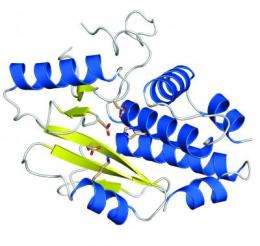
High resolution image of the key domain of the influenza virus polymerase. The active site responsible for RNA cleavage is shown in red. Its activity is crucial for the virus to multiply in human cells. Credit: Stephen Cusack, EMBL

Influenza is and remains a disease to reckon with. Seasonal epidemics around the world kill several hundred thousand people every year. In the light of looming pandemics if bird flu strains develop the ability to infect humans easily, new drugs and vaccines are desperately sought. Researchers at the European Molecular Biology Laboratory (EMBL) and the joint Unit of Virus Host-Cell Interaction (UVHCI) of EMBL, the University Joseph Fourier (UJF) and the National Centre for Scientific Research (CNRS), in Grenoble, France, have now precisely defined an important drug target in influenza. In this week's Nature they publish a high-resolution image of a crucial protein domain that allows the virus to hijack human cells and multiply in them.

When the influenza virus infects a host cell its goal is to produce many copies of itself that go on to attack even more cells. A viral enzyme, called polymerase, is key to this process. It both copies the genetic material of the virus and steers the host cell machinery towards the synthesis of viral proteins. It does this by stealing a small tag, called a cap, from host cell RNA molecules and adding it onto its own. The cap is a short extra piece of RNA, which must be present at the beginning of all messenger RNAs (mRNAs) to direct the cell's protein-synthesis machinery to the starting point. The viral polymerase binds to host cell mRNA via its cap, cuts the cap off and adds it to the beginning of its own mRNA - a process known as 'cap snatching'. But exactly how the polymerase achieves this and which of the three subunits of the enzyme does what, has remained controversial.

Researchers of the groups of Rob Ruigrok at the UVHCI and Stephen Cusack at EMBL have now discovered that part of a polymerase subunit called PA is responsible for cleaving the cap off the host mRNA.

"Our results came as a big surprise, because everybody thought that the cleaving activity resides in a different part of the polymerase," explains Rob Ruigrok, Vice-Director of the UVHCI.

"These new insights make PA a promising antiviral drug target. Inhibiting the cleaving of the cap is an efficient way to stop infection, because the virus can no longer multiply. Now we know where to focus drug design efforts," adds Stephen Cusack, Head of EMBL Grenoble and Director of the UVHCI.

The researchers produced crystals of the crucial PA domain and examined them with the powerful X-ray beams of the European Synchrotron Radiation Facility (ESRF) in Grenoble. The high-resolution image of the domain reveals the individual amino acids that constitute the active site responsible for cleaving the RNA; information that could guide the design of future antiviral drugs.

Only a few months ago the same group of scientists had already identified another key part of the influenza polymerase; a domain in the subunit called PB2 that recognises and binds to the host cap. Taken together the two findings provide a close-to-complete picture of the cap snatching mechanism that allows the influenza virus to take control over human cells.

Source: European Molecular Biology Laboratory

4.6 /5 (5 votes)  

Rank 4.6 /5 (5 votes)
Relevant PhysicsForums posts

More news stories

A mitosis mystery solved: How chromosomes align perfectly in a dividing cell

Although the process of mitotic cell division has been studied intensely for more than 50 years, Whitehead Institute researchers have only now solved the mystery of how cells correctly align their chromosomes during symmetric ...

Biology / Cell & Microbiology

created 6 hours ago | popularity 4.4 / 5 (10) | comments 0 | with audio podcast

Researchers find extensive RNA editing in human transcriptome

In a new study published online in Nature Biotechnology, researchers from BGI, the world's largest genomics organization, reported the evidence of extensive RNA editing in a human cell line by analysis of RNA-seq data, demons ...

Biology / Biotechnology

created 6 hours ago | popularity 5 / 5 (4) | comments 0 | with audio podcast

The proteins ensuring genome protection

Researchers from the University of Geneva (UNIGE), Switzerland, have discovered the crucial role of two proteins in developing a cell 'anti-enzyme shield'. This protection system, which operates at the level of molecular ...

Biology / Cell & Microbiology

created 6 hours ago | popularity 5 / 5 (3) | comments 0 | with audio podcast

Entire genome of extinct human decoded from fossil

(PhysOrg.com) -- In 2010, Svante Pääbo and his colleagues presented a draft version of the genome from a small fragment of a human finger bone discovered in Denisova Cave in southern Siberia. The ...

Biology / Biotechnology

created Feb 07, 2012 | popularity 4.7 / 5 (59) | comments 48 | with audio podcast

Why are there so few fish in the Earth's oceans?

(PhysOrg.com) -- A Stony Brook University researcher has found that, contrary to popular belief, there are not plenty of fish in the sea.

Biology / Plants & Animals

created Feb 08, 2012 | popularity 4.2 / 5 (18) | comments 27 | with audio podcast


Declining health-care productivity in England: Who says so?

Reports that the National Health Service in England has been declining in productivity in the last decade appear to have been accepted as fact. However, a Viewpoint published Online First by The Lancet disputes this. The Vi ...

Scientists discover molecular secrets of 2,000-year-old Chinese herbal remedy

For roughly two thousand years, Chinese herbalists have treated Malaria using a root extract, commonly known as Chang Shan, from a type of hydrangea that grows in Tibet and Nepal. More recent studies suggest that halofuginone, ...

New method to examine batteries -- MRI from the inside

There is an ever-increasing need for advanced batteries for portable electronics, such as phones, cameras, and music players, but also to power electric vehicles and to facilitate the distribution and storage of energy derived ...

Overeating may double risk of memory loss

New research suggests that consuming between 2,100 and 6,000 calories per day may double the risk of memory loss, or mild cognitive impairment (MCI), among people age 70 and older. The study was released today and will be ...

Lab study raises questions over nano-particle impact

Tests involving chickens have raised questions about the impact on health from engineered nano-particles, the ultra-fine grains commonly used in drugs and processed foods, scientists said on Sunday.

Google might launch Drive for cloud storage soon

(PhysOrg.com) -- Google's next big move, according to the Wall Street Journal, is a cloud storage service called Drive. Hardly first to the plate, Google is simply catching up to introducing its cloud reposi ...