NASA's SkyView Delivers the Multiwavelength Cosmos
February 4, 2009
NASA's SkyView delivers the multiwavelength cosmos

Enlarge

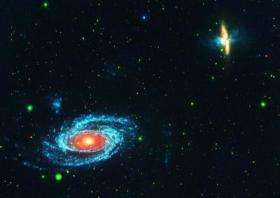
Ultraviolet radiation from hot, young stars lights up the galaxies M81 (left) and M82 in this composite. Credit: Credit: NASA/GALEX/DSS -STScI/Caltech/AURA

(PhysOrg.com) -- Some three million times a year, researchers, educators, and amateur astronomers all over the world ask NASA's SkyView virtual observatory to serve up images of some interesting corner of the cosmos. Since 1994, this digital archive has made access to and manipulation of celestial surveys its specialty. It boasts a full spectrum of data, ranging from radio to gamma-rays.

Many of the surveys hosted by SkyView are available through popular interactive tools like Google Sky and Microsoft's WorldWide Telescope (WWT). In fact, SkyView's most recently added survey -- the fourth data release from NASA's Galaxy Evolution Explorer satellite -- is available in WWT starting today.

SkyView visitors now generate an average of 300,000 images a month — up from 20,000 a month ten years ago. Over the same period, the average size of the requested images has quadrupled. So, in terms of pixels processed, SkyView's traffic has increased by more than 60 times.
Most Popular Cosmic Locations
Enlarge

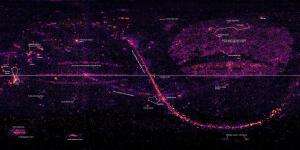
This map charts the most popular cosmic locations as measured by the number of SkyView image requests since June 2007. Brighter colors indicate more views. Credit: NASA/SkyView/Thomas McGlynn

SkyView originated as a way to help astronomers deal with the ever-increasing amount of survey data. It provides a single interface for accessing more than 36 surveys covering nearly 100 wavelength bands. Anyone can create an image without having to know the particular details of a survey's data format. Behind the scenes, SkyView handles all of the drudgery — transforming, precessing, rescaling, rotating, overlaying, and mosaicking data — so astronomers can get on with doing science.

"When we were collecting data for use in WorldWide Telescope, we found that almost every new data source required special custom code to adapt it to wide-scale visualization," says Jonathan Fay, WWT's architect at Microsoft Research in Redmond, Wash. "SkyView added support for our spherical all-sky projection, called TOAST. This was instrumental in helping us achieve our goal of making astronomy accessible to everyone."

"SkyView has been used by WWT as an engine to convert a large number of surveys into its own format," says Thomas McGlynn, who heads the project at NASA's Goddard Space Flight Center in Greenbelt, Md. "We made it easy for WWT to have broad survey coverage."

Measuring SkyView's success is becoming more difficult. That's because users now can download and run the project's Java-based software on their own computer to directly access data. "We don't count these requests -- only those made through SkyView's website," McGlynn says.

Where are people looking? McGlynn mapped the positions of millions of SkyView requests since the project's June 2007 redesign. The result is a portrait of the sky's most popular targets. These naturally include regions of importance to professional astronomers, such as areas mapped by the Sloan Digital Sky Survey, sprawling molecular clouds in the constellations Orion and Taurus, and the locations of the Hubble Space Telescope's famous Deep Field and Ultra Deep Field images. Objects of wider appeal also appear, including the Milky Way, nearby satellite galaxies called the Magellanic Clouds, and the neighboring spiral galaxies M31 and M33.

"There remains a lot of structure whose origin is unclear," McGlynn notes. "For example, the plane of Earth's orbit, the ecliptic, shows up as an enhancement even though SkyView isn't intended for viewing solar system objects."

He speculates that people looking for asteroids and comets may be using SkyView to generate comparison images, seeing if the suspect object moves or disappears. But are they amateurs or professionals?

"At one time, I thought amateur astronomers accounted for about a third of SkyView's use," McGlynn says. "I'm less willing to guess at that now -- and what does it matter, anyway? SkyView is for everyone."

Provided by NASA's Goddard Space Flight Center

4.5 /5 (2 votes)  

Rank 4.5 /5 (2 votes)
Relevant PhysicsForums posts
  • Titan's lack of impact craters
    created9 hours ago
  • Real pictures of black hole eating a star?
    createdFeb 08, 2012
  • Hypothetical way to travel faster than light, but not technically exceed lightspeed
    createdFeb 06, 2012
  • How do scientists monitor the Sun's activity?
    createdFeb 05, 2012
  • Search patterns in observational studies
    createdFeb 05, 2012
  • Derivation of Pogson's law
    createdFeb 03, 2012
  • More from Physics Forums - General Astronomy

More news stories

Deconstructing a mystery: What caused Snowmaggedon?

In the quiet after the storms, streets and cars had all but disappeared under piles of snow. The U.S. Postal Service suspended service for the first time in 30 years. Snow plows struggled to push the evidence ...

Space & Earth / Earth Sciences

created 4 hours ago | popularity 4.7 / 5 (3) | comments 1 | with audio podcast

NASA's TRMM satellite sees Cyclone Jasmine in 3-D

Data from NASA's TRMM satellite was used to create a 3-Dimensional look at Cyclone Jasmine, currently moving through the South Pacific Ocean.

Space & Earth / Earth Sciences

created 3 hours ago | popularity not rated yet | comments 0

Researchers create 3-D laser maps that show how earthquake changes landscape

Geologists have a new tool to study how earthquakes change the landscape down to a few inches, and it's giving them insight into how earthquake faults behave. In the Feb. 10 issue of the journal Science, a team ...

Space & Earth / Earth Sciences

created 6 hours ago | popularity 5 / 5 (3) | comments 0 | with audio podcast

Ocean microbe communities changing, but long-term environmental impact is unclear

As oceans warm due to climate change, water layers will mix less and affect the microbes and plankton that pump carbon out of the atmosphere – but researchers say it's still unclear whether these processes ...

Space & Earth / Earth Sciences

created 6 hours ago | popularity not rated yet | comments 0 | with audio podcast

New views show old NASA Mars landers

(PhysOrg.com) -- The High Resolution Imaging Science Experiment (HiRISE) camera on NASA's Mars Reconnaissance Orbiter recorded a scene on Jan. 29, 2012, that includes the first color image from orbit showing ...

Space & Earth / Space Exploration

created 12 hours ago | popularity 4.9 / 5 (7) | comments 5 | with audio podcast


'Dark plasmons' transmit energy

Microscopic channels of gold nanoparticles have the ability to transmit electromagnetic energy that starts as light and propagates via "dark plasmons," according to researchers at Rice University.

Anyone can learn to be more inventive, cognitive researcher says

There will always be a wild and unpredictable quality to creativity and invention, says Anthony McCaffrey, a cognitive psychology researcher at the University of Massachusetts Amherst, because an "Aha moment" is rare and ...

Ultraviolet protection molecule in plants yields its secrets

Lying around in the sun all day is hazardous not just for humans but also for plants, which have no means of escape. Ultraviolet (UV) radiation from the sun can damage proteins and DNA inside cells, leading ...

Hydrogen from acidic water: Researchers develop potential low cost alternative to platinum for splitting water

A technique for creating a new molecule that structurally and chemically replicates the active part of the widely used industrial catalyst molybdenite has been developed by researchers with the Lawrence Berkeley ...

New method makes culture of complex tissue possible in any lab

Scientists at the University of California, San Diego have developed a new method for making scaffolds for culturing tissue in three-dimensional arrangements that mimic those in the body. This advance, published online in ...

Cell biologists describes mechanism by which some people may be more susceptible to colon cancer

An international research team led by cell biologists at the University of California, Riverside has uncovered a new insight into colon cancer, the third leading cause of cancer-related deaths in the United ...