Babies & Robots: Infant power mobility on display
February 4, 2009 Babies & Robots: Infant power mobility on display

Enlarge

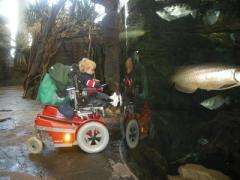
Andrew's power chair allows him to explore the world, aiding his cognitive development.

Children with mobility issues, like cerebral palsy and spina bifida, can't explore the world like other babies, because they can't crawl or walk. Infant development emerges from the thousands of daily discoveries experienced by babies as they move and explore their worlds.

Mobility-deprived kids start exploring when they can operate a traditional power wheelchair, typically at age 3 or often older.

Research done by University of Delaware researchers is turning that on its head and could potentially change the way these children's brains develop.

Physical therapy professor Cole Galloway and mechanical engineering professor Sunil Agrawal have developed tiny power chairs babies as young as 6 months can operate using a joystick.

Now, they've paired with Permobil, a national producer of power chairs, and outfitted a chair for toddlers.

Galloway will be showcasing this research next week in Las Vegas at the American Physical Therapy Association's Combined Sections Meeting. (Tuesday, February 10, 10am-3pm)

A 17-month-old boy, Andrew, who's been driving the robots for more than a year, will be on hand to demonstrate the technology. On an average day, Andrew uses his chair to navigate his home and the outside world. He is ready to attend pre-K next year, impressive progress for a child with spina bifida.

Galloway believes providing mobility to children who wouldn't have it otherwise could impact their lives in countless ways, especially when you consider the rapid brain development during infancy.

"Babies literally build their own brains through their exploration and learning in the complex world," he says. "Their actions, feelings and thinking all shape their own brain's development.

"Mobility is linked to widespread advances in cognitive development and learning abilities in typically developing infants."

The University of Delaware has filed patents and is working to bring to market a robot-enhanced mini wheelchair for children aged 6 months-2 years.

For more information, check out:

http://www.udel.edu/research/media/babiesrobots.html
http://www.udel.edu/udaily/2009/oct/robots100708.html
http://www.udel.edu/PT/About Us/People/galloway.html

Source: University of Delaware


print this article email this article download pdf blog this article bookmark this article     Stumble it Digg this share on Facebook retweet share on Reddit add to delicious
Rate this story - not rated yet


February 4, 2009 all stories

Comments: 0

not rated yet
  • Stumble this up

  • Digg this

  • share this

  • hide
  • Related Stories

  • Impairments in language development can be detected in infants as young as 3 months
    created Apr 10, 2008 | popularity not rated yet | comments 0
  • Babies learn to ride robots at UD
    created Nov 07, 2007 | popularity not rated yet | comments 0
  • Study pinpoints key mechanism in brain development, raising question about use of antiseizure drug
    created Oct 08, 2009 | popularity not rated yet | comments 0
  • Universal screening lowers risk of severe jaundice in infants
    created Sep 28, 2009 | popularity not rated yet | comments 0
  • FDA concludes mercury in dental fillings not risky
    created Jul 28, 2009 | popularity not rated yet | comments 0


  • hide
  • Relevant PhysicsForums posts

Other News

Words, gestures are translated by same brain regions, says new research

Medicine & Health / Neuroscience

created 20 minutes ago | popularity not rated yet | comments 0

Your ability to make sense of Groucho's words and Harpo's pantomimes in an old Marx Brothers movie takes place in the same regions of your brain, says new research funded by the National Institute on Deafness and Other Communication ...


Theory about long and short-term memory questioned

Medicine & Health / Neuroscience

created 29 minutes ago | popularity not rated yet | comments 0

The long-held theory that our brains use different mechanisms for forming long-term and short-term memories has been challenged by new research from UCL, published today in PNAS.


Squeak, squeak -- can you hear me now?

Squeak, squeak -- can you hear me now?

Medicine & Health / Neuroscience

created 5 hours ago | popularity 5 / 5 (1) | comments 0

What do you get when you cross a mouse with poor hearing and a mouse with even worse hearing? Ironically, a new strain of mice with "golden ears" - mice that have outstanding hearing as they age.


Deepening the search  for clues to rheumatoid arthritis

Deepening the search for clues to rheumatoid arthritis

Medicine & Health / Genetics

created 8 hours ago | popularity 5 / 5 (1) | comments 5

(PhysOrg.com) -- The gnawing pain of rheumatoid arthritis is a signal that the body’s immune system has hit the wrong target: its own cartilage and bone.


Connection between depression and osteoporosis detailed

Medicine & Health / Psychology & Psychiatry

created 1hour ago | popularity not rated yet | comments 0

Research carried out among thousands of people has shown a clear connection between depression and a loss of bone mass, leading to osteoporosis and fractures.