Infant galaxies -- small and hyperactive
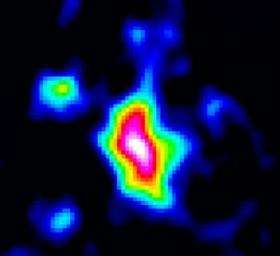
Galaxies, including our own Milky Way, consist of hundreds of billions of stars. How did such gigantic galactic systems come into being? Did a central region with stars first form then with time grow? Or did the stars form at the same time throughout the entire galaxy? An international team led by researchers from the Max Planck Institute for Astronomy is now much closer to being able to answer these questions.
The researchers studied one of the most distant known galaxies, a so-called quasar with the designation J1148+5251. Light from this galaxy takes 12.8 billion years to reach Earth; in turn, astronomical observations show the galaxy as it appeared 12.8 billion years ago, providing a glimpse of the very early stages of galactic evolution, less than a billion years after the Big Bang.
With the IRAM Interferometer, a German-French-Spanish radio telescope, the researchers were able to obtain images of a very special kind: they recorded the infrared radiation emitted by J1148+5251 at a specific frequency associated with ionized carbon atoms, which is a reliable indicator of ongoing star formation.
The resulting images show sufficient detail to allow, for the first time, the measurement of the size of a very early star-forming region. With this information, the researchers were able to conclude that, at that time, stars were forming in the core region of J1148+5251 at record rates - any faster and star formation would have been in conflict with the laws of physics.
"This galaxy's rate of star production is simply astonishing," says the article's lead author, Fabian Walter of the Max Planck Institute for Astronomy. "Every year, this galaxy's central region produces new stars with the combined mass of more than a thousand suns." By contrast, the rate of star formation within our own galaxy, the Milky Way, is roughly one solar mass per year.
Close to the physical limit
It has been known for some time that young galaxies can produce impressive amounts of new stars, but overall activity is only part of the picture. Without knowing the star-forming region's size, it is impossible to compare star formation in early galaxies with theoretical models, or with star-forming regions in our own galaxy.
With a diameter of a mere 4000 light-years (by comparison: the Milky Way galaxy's diameter amounts to 100,000 light-years), the star-forming core of J1148+5251 is extremely productive. In fact, it is close to the limits imposed by physical law. Stars are formed when cosmic clouds of gas and dust collapse under their own gravity. As the clouds collapse, temperatures rise, and internal pressure starts to build. Once that pressure has reached certain levels, all further collapse is brought to a halt, and no additional stars can form. The result is an upper limit on how many stars can form in a given volume of space in a given period of time.
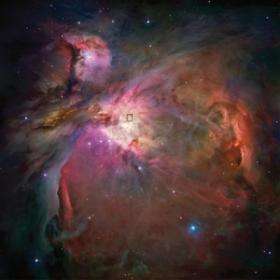
Remarkably, the star-forming core of J1148+5251 reaches this absolute limit. This extreme level of activity can be found in parts of our own galaxy, but only on much smaller scales. For example, there is a region within the Orion nebula (Fig. 2) that is just as active as what we have observed. Fabian Walter: "But in J1148+5251, we are dealing with what amounts to a hundred million of these smaller regions combined!" Earlier observations of different galaxies had suggested an upper limit that amounts to a tenth of the value now observed in J1148+5251.
Growth from within
The compact star-forming region of J1148+5251 provides a highly interesting data point for researchers modelling the evolution of young galaxies. Going by this example, galaxies grow from within: in the early stages of star formation, there is a core region in which stars form very quickly. Presumably, such core regions grow over time, mainly as a result of collisions and mergers between galaxies, resulting in the significantly larger star-filled volume of mature galaxies.
The key to these results is one novel measurement: the first resolved image of an extremely distant quasar's star-forming central region, clearly showing the region's apparent diameter, and thus its size. This measurement is quite a challenge in itself. At a distance of almost 13 billion light-years (corresponding to a red-shift z = 6.42), the star-forming region, with its diameter of 4000 light-years, has an angular diameter of 0.27 seconds of arc - the size of a one euro coin, viewed at a distance of roughly 18 kilometres (or a pound coin, viewed at a distance of roughly 11 miles).
There is one further handicap: the observations rely on electromagnetic radiation with a characteristic wavelength, which is associated with ionized carbon atoms. At this wavelength, the star-forming regions of J1148+5251 outshine even the quasar's ultra-bright core. Due to the fact that the universe is expanding, the radiation is shifted towards longer wavelengths as it travels towards Earth ("cosmological redshift"), reaching our planet in the form of radio waves with a wavelength of about one millimetre. But, owing to the general nature of waves, it is more than a thousand times more difficult to resolve minute details at a wavelength of one millimetre, compared with visible light.
Observations at the required wavelength and level of detail became possible only as recently as 2006, thanks to an upgrade of the IRAM Interferometer, a compound radio telescope on the Plateau de Bure in the French Alps.
Future telescopes
Use of the characteristic radiation of ionized carbon to detect and create images of star-forming regions of extremely distant astronomical objects had been suggested some time ago. A significant portion of the observational program for ALMA, a compound radio telescope currently under construction in Northern Chile, relies on this observational approach. But up until the measurements of Fabian Walter and his colleagues, this technique had not been demonstrated in practice. Quoting Walter: "The early stages of galaxy evolution, roughly a billion years after the Big Bang, will be a major area of study for years to come. Our measurements open up a new window on star-forming regions in very young galaxies".
On the web: The IRAM telescope - www.iram.fr/
Paper: Fabian Walter, Dominik Riechers, Pierre Cox, Roberto Neri, Chris Carilli, Frank Bertoldi, Axel Weiss, Roberto Maiolino, A kiloparsec-scale hyper-starburst in a quasar host less than 1 gigayear after the Big Bang, Nature, February 5th, 2009
Source: Max-Planck-Gesellschaft


