Good liquid, bad liquid (Video)
February 5, 2009 Good liquid, bad liquid

Enlarge

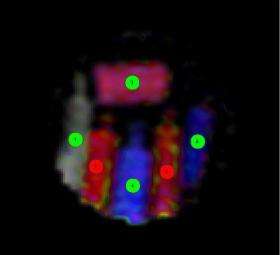
This image shows the detection of possible liquid explosive materials. Credit: DHS S&T Directorate and Los Alamos National Laboratory

For airline passengers everywhere, good news. Scientists have successfully tested a liquid explosive detection system that may eventually keep dangerous substances off airplanes. This comes barely two years after a plot to make bombs out of liquids aboard planes taking off from London was foiled.

Immediately after the liquid explosive bomb plot was uncovered in London in August 2006, the Department of Homeland Security's Science & Technology Directorate (S&T) looked to to find ways to not only detect liquids in baggage and on passengers, but also to figure out what those liquids are. Now, S&T-sponsored scientists at Los Alamos National Laboratory have developed a possible solution. They have successfully tested a liquid explosive detection system that may eventually have many security applications around the country. Machines ready for an operational environment remains a few years away, but the technology is promising to quickly detect liquid explosives within a few years.

Stephen Surko is the Program Manager for the research at S&T. He says, "Los Alamos has done an outstanding job in a relatively short period of time."

FLV player

This video shows research being conducted to detect and identify liquid explosives -- the DHS S&T MagViz program. Credit: Los Alamos National Laboratory and the DHS Science & Technology Directorate

When S&T last reported on this technology, it was still in the conceptual phase, and went by a different name. Now known as MagViz, the system adapts the magnetic resonance imaging (MRI) technology, typically used by doctors to scan brains, to screen for harmful liquids, gels, and lotions.

Similar in size and shape to an X-ray machine, a working MagViz prototype was on display at the Albuquerque International Sunport in December. The system is linked to an electronic database that currently contains chemical fingerprints for 50 liquids. As shown in the images here, if a threat liquid is identified, the machine marks the container on the display screen with a red dot. Harmless liquids like water or shampoo are marked with a green dot. If MagViz cannot identify a liquid it marks the container with a yellow dot, requiring further inspection. (See the Los Alamos video for more on the science behind MagViz.)

As development of the system continues, more liquids will be added to the database, and more refinements will help reduce the amount of detection time.

"Our vision for MagViz is that it would be operated in series with more traditional X-ray systems, and a conveyor belt would seamlessly move baggage or other items from one to the next," said Surko, who also noted that individual agencies will make the ultimate determination on the best way to use the technology.

Researchers hope to have the machines detecting dangerous fluids by 2012, and the "3-1-1" rule may eventually become a thing of the past.

Source: US Department of Homeland Security


print this article email this article download pdf blog this article bookmark this article     Stumble it Digg this share on Facebook retweet share on Reddit add to delicious
Rate this story - 5 /5 (4 votes)

Rank Filter

Move the slider to adjust rank threshold, so that you can hide some of the comments.


Display comments: newest first

  • Egnite - Feb 05, 2009
    • Rank: not rated yet
    Finally the truth can come out! Will the airlines spend money on this device and staff to manage it? Or carry on making a killing from passengers buying thier over-priced refreshments?
  • dirk_bruere - Feb 05, 2009
    • Rank: 5 / 5 (1)
    Still preparing for the last terrorist threat, instead of the next. There are plenty of things one can get onto a plane that are equally as dangerous, if not more so.
  • bmcghie - Feb 05, 2009
    • Rank: 5 / 5 (1)
    Next step: Use it on humans, to detect anything explosive in their GI tract. Because if I was a terrorist, the next logical move would be undetectable suicide bombing... but this machine could perhaps let the feds get ahead of the curve.

    NOT that I would like to be subjected to this kind of scanning before flying.
  • ArtflDgr - Feb 06, 2009
    • Rank: 5 / 5 (1)
    wow... now all they have to do is shift over and shoot the engines like malvo shot people. millions spent each year to prevent this is just going to keep hanging millstones.

    the tactical point is not the fear of the explosions and such... the tactical point is the attrition costs over years that this creates. keep doing it and all the expenses aer too much and a state you cant invade, or attack, collapses under its own stupidity in wasting resources on tactically impossible ends.


February 5, 2009 all stories

Comments: 4

5 /5 (4 votes)
  • Stumble this up

  • Digg this

  • share this

  • hide
  • Related Stories

  • Engineer Discovers Why Particles Like Flour Disperse on Liquids
    created Nov 16, 2009 | popularity not rated yet | comments 0
  • 0.2 second test for explosive liquids
    created Oct 20, 2009 | popularity not rated yet | comments 0
  • Chemists look for cleaner, cheaper rocket fuel
    created Dec 02, 2008 | popularity not rated yet | comments 0
  • Explosion on chip sets liquid in motion
    created Oct 30, 2008 | popularity not rated yet | comments 0
  • Explosives go 'green'
    created Aug 28, 2008 | popularity not rated yet | comments 0


  • hide
  • Relevant PhysicsForums posts

  • Achromat lens - magnifying LCD
    created 20 hours ago
  • Control System
    created Nov 24, 2009
  • Base Isolation Systems in Skyscrapers?
    created Nov 23, 2009
  • Need to interview a Computer Hardware Engineer for school project
    created Nov 23, 2009
  • More from Physics Forums - General Engineering

Other News

Building real security with virtual worlds

Technology / Computer Sciences

created 2 hours ago | popularity 3 / 5 (2) | comments 0

(PhysOrg.com) -- Advances in computerized modeling and prediction of group behavior, together with improvements in video game graphics, are making possible virtual worlds in which defense analysts can explore and predict ...


Roku adds more 'channels' of video and other digital content

Technology / Telecom

created 2 hours ago | popularity not rated yet | comments 0

Owners of Roku's digital video player will soon have a bunch more channels to choose from.


Sony optimistic on 3-D TVs, in-house display (AP)

Sony optimistic on 3-D TVs, in-house display

Technology / Hi Tech

created 8 hours ago | popularity not rated yet | comments 0

(AP) -- A third to a half of the Sony Corp. TV sets sold annually will be packed with 3-D features by the year ending March 2013, a senior executive said Thursday.


Holiday Web shopping looks brighter than last year

Technology / Internet

created 4 hours ago | popularity not rated yet | comments 0

(AP) -- Online retailers hope the convenience of the Web, plus discounts and deals, spur still-nervous shoppers to spend more online this holiday season - even as traditional retailers brace for mediocre sales.


Should I buy a PC or Mac?

Technology / Software

created 19 hours ago | popularity 3.7 / 5 (6) | comments 12

Q. Our 6-year-old PC computer is dying a slow death and we are considering moving to a new iMac but have a few concerns. First, of all, we have several Word documents on our disk drive now that we want to keep and add to ...