Exceptionally deep view of strange galaxy
February 5, 2009 Exceptionally deep view of strange galaxy

Enlarge

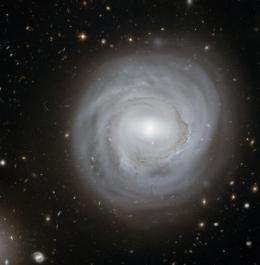
This very deep image taken with the NASA/ESA Hubble Space Telescope shows the spiral galaxy NGC 4921 along with a spectacular backdrop of more distant galaxies. It was created from a total of 80 separate pictures through yellow and near-infrared filters. Credit: NASA, ESA and K. Cook (Lawrence Livermore National Laboratory, USA)

(PhysOrg.com) -- The Coma Galaxy Cluster, in the northern constellation of Coma Berenices, the hair of Queen Berenice, is one of the closest very rich collections of galaxies in the nearby Universe. The cluster, also known as Abell 1656, is about 320 million light-years from Earth and contains more than 1000 members. The brightest galaxies, including NGC 4921 shown here, were discovered back in the late 18th century by William Herschel.

The galaxies in rich clusters undergo many interactions and mergers that tend to gradually turn gas-rich spirals into elliptical systems without much active star formation. As a result there are far more ellipticals and fewer spirals in the Coma Cluster than are found in quieter corners of the Universe.

NGC 4921 is one of the rare spirals in Coma, and a rather unusual one — it is an example of an "anaemic spiral" where the normal vigorous star formation that creates a spiral galaxy's familiar bright arms is much less intense. As a result there is just a delicate swirl of dust in a ring around the galaxy, accompanied by some bright young blue stars that are clearly separated out by Hubble's sharp vision. Much of the pale spiral structure in the outer parts of the galaxy is unusually smooth and gives the whole galaxy the ghostly look of a vast translucent jellyfish.
Exceptionally deep view of strange galaxy
Enlarge

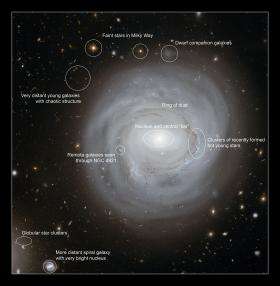
Very deep NASA/ESA Hubble Space Telescope imaging of NGC 4921 with annotation to indictate the locations of some of the more interesting features of the galaxy and its surroundings. Credit: NASA, ESA and K. Cook (Lawrence Livermore National Laboratory, USA)

The long exposure times and sharp vision of Hubble also allowed it to not just image NGC 4921 in exquisite detail but also to see far beyond into the distant Universe. All around, and even through the galaxy itself, thousands of much more remote galaxies of all shapes, sizes and colours are visible. Many have the spotty and ragged appearance of galaxies at a time before the familiar division into spirals and ellipticals had become established.

The Hubble images used to make this picture were originally obtained by a team led by Kem Cook (Lawrence Livermore National Laboratory, California). The team was using Hubble to search for Cepheid variable stars in NGC 4921 that could be used to measure the distance to the Coma Cluster and hence the expansion rate of the Universe. Unfortunately the failure of the Advanced Camera for Surveys in early 2007 meant that they had insufficient data to complete their original programme, although they hope to continue after the servicing mission. Very deep imaging data like this, which is available to anyone from the Hubble archives, may also be used for other interesting scientific explorations of this galaxy and its surroundings.

This image was created from 50 separate exposures through a yellow filter and another 30 exposures through a near-infrared filter using the Wide Field Channel of the Advanced Camera for Surveys on Hubble. The total exposure times were approximately seventeen hours and ten hours respectively.

Source: ESA/Hubble Information Centre


print this article email this article download pdf blog this article bookmark this article     Stumble it Digg this share on Facebook retweet share on Reddit add to delicious
Rate this story - 4.9 /5 (15 votes)


February 5, 2009 all stories

Comments: 0

4.9 /5 (15 votes)
  • Stumble this up

  • Digg this

  • share this

  • hide
  • Related Stories

  • The hunt for dark matter
    created Sep 17, 2009 | popularity not rated yet | comments 0
  • Living fossils hold record of 'supermassive' kick
    created Jul 09, 2009 | popularity not rated yet | comments 0
  • Hubble's sweeping view of the Coma Galaxy Cluster
    created Jun 10, 2008 | popularity not rated yet | comments 0
  • Astronomers find most powerful supernova
    created Oct 11, 2007 | popularity not rated yet | comments 0
  • Spitzer nets thousands of galaxies in a giant cluster
    created May 28, 2007 | popularity not rated yet | comments 0


  • hide
  • Relevant PhysicsForums posts

  • The shape of our solar system's orbits.
    created Nov 07, 2009
  • Above or Below the Line of Nodes
    created Nov 07, 2009
  • Supernova vs. Nova?
    created Nov 07, 2009
  • Supernova's Gamma Rays and Comets
    created Nov 06, 2009
  • More from Physics Forums - General Astronomy

Other News

Scientists seek safe carbon dioxide storage for 'greener' power generation (w/ Video)

Space & Earth / Environment

created 13 minutes ago | popularity not rated yet | comments 0

The U.S. Department of Energy (DOE) has announced plans to fund research at the University of Alabama at Birmingham (UAB) School of Engineering on technologies that would help reduce greenhouse gas emissions through the capture ...


Antarctica glacier retreat creates new carbon dioxide store

Antarctica glacier retreat creates new carbon dioxide store

Space & Earth / Earth Sciences

created 3 hours ago | popularity 5 / 5 (1) | comments 1

Large blooms of tiny marine plants called phytoplankton are flourishing in areas of open water left exposed by the recent and rapid melting of ice shelves and glaciers around the Antarctic Peninsula. This ...


Success in 'space elevator' competition (AP)

Success in 'space elevator' competition (Update 3)

Space & Earth / Space Exploration

created Nov 05, 2009 | popularity 4.3 / 5 (33) | comments 53

(AP) -- A robot powered by a ground-based laser beam climbed a long cable dangling from a helicopter on Wednesday to qualify for prize money in a $2 million competition to test the potential reality of the ...


In a Galaxy Far, Far Away...

In a Galaxy Far, Far Away...

Space & Earth / Astronomy

created Nov 06, 2009 | popularity 4.8 / 5 (5) | comments 15

(PhysOrg.com) -- Astronomers have published the discovery of the farthest known object in the cosmos: a star that exploded when the universe was only 630 million years old -- only 4.6% of its current age. ...


'Dropouts' pinpoint earliest galaxies

'Dropouts' pinpoint earliest galaxies

Space & Earth / Astronomy

created Nov 06, 2009 | popularity 4.2 / 5 (10) | comments 13

Astronomers, conducting the broadest survey to date of galaxies from about 800 million years after the Big Bang, have found 22 early galaxies and confirmed the age of one by its characteristic hydrogen signature ...