Nanotube's 'tapestry' controls its growth
February 5, 2009 Nanotube Tapestry

Enlarge

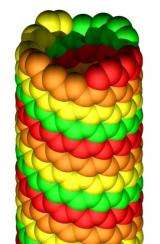
A new theory suggests nanotubes are 'woven' from twisting carbon threads. Credit: Morteza Bankehsaz/Rice University

HOUSTON -- (Feb. 5, 2009) -- Rice University materials scientists have put a new "twist" on carbon nanotube growth. The researchers found the highly touted nanomaterials grow like tiny molecular tapestries, woven from twisting, single-atom threads.

Carbon nanotubes are hollow tubes of pure carbon that measure about one nanometer, or one-billionth of a meter, in diameter. In molecular diagrams, they look like rolled-up sheets of chicken wire. And just like a roll of wire or gift-wrapping paper, nanotubes can be rolled at an odd angle with excess hanging off the end.

Though nanotubes are much-studied, their growth is poorly understood. They grow by "self assembly," forming spontaneously from gaseous carbon feedstock under precise catalytic circumstances. The new research, which appears online this week in the Proceedings of the National Academy of Sciences, finds a direct relationship between a nanotube's "chiral" angle -- the amount it's twisted -- and how fast it grows.

"Our study offers some clues about this intimate 'self assembly' process," said Rice's Boris Yakobson, professor in mechanical engineering and materials science and of chemistry. New theory suggests that each tube is 'woven' from many twisting threads. Each grows independently, with new atoms attaching themselves to the exposed thread ends. The more threads there are, the faster the whole tapestry grows.

Yakobson, the lead researcher on the project, said the new formula's predictions have been borne out by a number of laboratory reports. For example, the formula predicts that nanotubes with the largest chiral angle will grow fastest because they have the most exposed threads -- something that's been shown in several experiments.

"Chirality is one of the primary determinants of a nanotube's properties," said Yakobson. "Our approach reveals quantitatively the role that chirality plays in growth, which is of great interest to all who hope to incorporate nanotubes into new technologies."

Source: Rice University


print this article email this article download pdf blog this article bookmark this article     Stumble it Digg this share on Facebook retweet share on Reddit add to delicious
Rate this story - 5 /5 (2 votes)


February 5, 2009 all stories

Comments: 0

5 /5 (2 votes)
  • Stumble this up

  • Digg this

  • share this

  • hide
  • Related Stories


  • hide
  • Relevant PhysicsForums posts

  • Distortion of Zr2Cu crystal structures?
    created Nov 10, 2009
  • Poynting Effect, more than one meaning?
    created Nov 10, 2009
  • Pipeline Drying
    created Nov 10, 2009
  • Polymer Properties Question
    created Nov 08, 2009
  • More from Physics Forums - Materials & Chemical Engineering

Other News

Understanding mechanical properties of silicon nanowires paves way for nanodevices

Understanding mechanical properties of silicon nanowires paves way for nanodevices

Nanotechnology / Nanomaterials

created 13 hours ago | popularity 4.5 / 5 (2) | comments 0

Silicon nanowires are attracting significant attention from the electronics industry due to the drive for ever-smaller electronic devices, from cell phones to computers. The operation of these future devices, ...


carbon fiber

Ultra-Long Carbon Nanotubes Could Serve as Future Transmission Lines

Nanotechnology / Nanomaterials

created Nov 10, 2009 | popularity 4.8 / 5 (19) | comments 13

(PhysOrg.com) -- When it comes to carbon nanotubes, the majority of research so far has focused on small-scale applications. But now, a team of researchers from Rice University has created carbon nanotubes ...


New Digital 'Electronics' Concept May Continue Moore's Law

New Digital 'Electronics' Concept May Continue Moore's Law

Nanotechnology / Nanophysics

created Nov 05, 2009 | popularity 4.6 / 5 (62) | comments 9

(PhysOrg.com) -- Computers of the future could be operating not on electrons, but on tiny waves traveling through an electron "fluid," if a new proposal is successful. The new circuit design, recently introduced ...


Argonne 'homegrown' hybrid solar cell aims for low-cost power

Argonne 'homegrown' hybrid solar cell aims for low-cost power

Nanotechnology / Nanomaterials

created Nov 10, 2009 | popularity 4 / 5 (9) | comments 3

(PhysOrg.com) -- Scientists at the U.S. Department of Energy’s (DOE) Argonne National Laboratory have refined a technique to manufacture solar cells by creating tubes of semiconducting material and then "growing" ...


Nanoparticles for gene therapy improve

Nanoparticles for gene therapy improve

Nanotechnology / Bio & Medicine

created Nov 06, 2009 | popularity 5 / 5 (5) | comments 3

(PhysOrg.com) -- About five years ago, Professor Janet Sawicki at the Lankenau Institute in Pennsylvania read an article about nanoparticles developed by MIT's Robert Langer for gene therapy, the insertion ...