A Better Mesh: Researchers 'Tighten' Body's Protective Coating
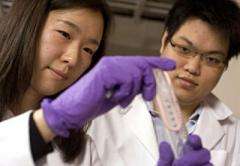
A net with large holes won't catch small fish. Likewise, the microscopic fibers in the protective mucus coatings of the eyes, lungs, stomach or reproductive system naturally bundle together and allow the tiniest disease-causing bugs, allergens or pollutants to slip by. But Johns Hopkins researchers have discovered a way to chemically shrink the holes in the mucus layer's netting so that it will keep out more of the unwanted particles.
"The mucus layer is an outstanding barrier to most things, but not a perfect one for objects smaller than several hundred nanometers (about 1,000 times smaller than the width a human hair). We still get sick far too often," says Samuel Lai, a chemical and biomolecular researcher in the Whiting School of Engineering and a member of the university's Institute for NanoBioTechnology (INBT).
"The question we asked was, 'Can we shrink the size of the holes in the human mucus barrier to help prevent its penetration by potentially harmful nano-size objects?' " says Justin Hanes, principal investigator of the study and a professor of chemical and biomolecular engineering. Hanes also is director of therapeutics for the INBT.
The team showed that tiny strands in the mucus layer -- the mucin fibers -- naturally tend to bundle and bunch together, creating gaps large enough for pathogens and potentially dangerous pollutants to get in. But by adding a simple detergent to the mix, Lai and his colleagues partially disrupted the bundling of mucin fibers, a procedure that decreased the size of the holes in the mesh. Particles in the range of 200 nanometers in diameter that previously slipped through easily now became trapped in the more finely strung netting.
Join PhysOrg.com on Facebook
The findings were reported in the Jan. 28 online edition of the journal PLoS ONE. For this research, the team studied protective coatings taken from the female reproductive tract, conducting high-resolution microscopy experiments with particles as large as 1 micron and as small as 100 nanometers in size.
To shrink the holes in the network's mesh, the researchers used a detergent commonly found in many personal care products. Mucus treated with the detergent slowed nanoparticle movement dramatically, especially in the 200-500 nanometer range, which was clearly demonstrated in videos enhanced by fluorescent imaging.
"We suspected the fibers are bundled together, making large holes in the mucus mesh, but this was the first time it was shown definitively," says Ying-Ying Wang, a doctoral student and National Science Foundation graduate fellowship recipient in biomedical engineering. "And we didn't know going into this study exactly how much we could shrink the holes, if at all. It was exciting to see particles the size of many potentially dangerous substances become completely trapped in mucus, since mucus trapping typically leads to harmless removal from our bodies," Wang adds.
The team, which also includes Richard Cone, a biophysics professor and INBT-affiliated faculty member from the Krieger School of Arts and Sciences, and Denis Wirtz, professor of chemical and biomolecular engineering and INBT's associate director, envisions many potential applications for this concept.
"If there is an outbreak of influenza, for example, we imagine that doctors and nurses could inhale these agents in an aerosolized form and be protected against the virus for several hours," Lai says. "People who work where there are high levels of nanoparticles in the air, such as mine workers or builders, could use a product with these fiber debundling detergents to prevent dangerous exposure."
Since the mucus layer constantly clears from the body, any enhancement to its protective ability would be short-lived, adds Lai. For example, coatings clear from the lungs in as little as 30 minutes, while the mucus lining in the stomach and intestine takes several hours to renew.
This study is only a start, Lai explains, and the technique has not yet been tested in humans. "The next step will be to try different substances, perhaps those paired to specific pathogens, and observe how these substances improve the performance of the mucus barrier," he says. In addition, microbe-killing agents could be combined with detergents to not only slow but destroy the trapped potential pathogens, he says. Animal studies are being planned.
Study: Samuel K. Lai, Ying-Ying Wang, Richard Cone, Denis Wirtz and Justin Hanes and entit;ed "Altering Mucus Rheology to 'Solidify' Human Mucus at the Nanoscale" -- can be viewed online at: www.plosone.org/article/info%3Adoi%2F10.1371%2Fjournal.pone.0004294 .
Source: Johns Hopkins University


