Black wolves: The first genetically modified predators?
February 5, 2009
Black and White Wolves

Enlarge

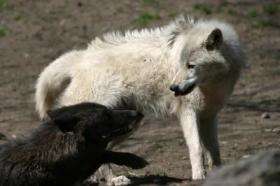
Black wolves dominate packs in the forests of North America, while white wolves are more numerous in the treeless tundra. Credit: Marco Musiani, University of Calgary

Emergence of black-colored wolves is the direct result of humans raising dogs as pets and beasts of burden, according to new research by a University of Calgary biologist published today by the prestigious academic journal Science. And dark coloring may also aid the survival of the species as wolf habitat is affected by climate change in the future, the study suggests.

"Although it happened by accident, black wolves are the first example of wolves being genetically-engineered by people," said Marco Musiani, an internationally-recognized expert on wolves and a professor in the U of C's Faculty of Environmental Design. "Domestication of dogs has led to dark-colored coats in wolves, which has proven to be a valuable trait for wolf populations as their arctic habitat shrinks," Musiani said. "It also shows that human activities can help enrich the genetic diversity of wild animal populations, which is a very unexpected finding."

The study by Musiani and colleagues from around the world is published in the Feb. 5 edition of Science Express. Using genetic analysis of gray wolf populations from North America and Europe, the researchers traced the source of the dominant gene responsible for dark coat color in wolves to domesticated dogs and conclude the trait was passed to the gray wolf population, as well as to coyotes, by mating between the closely-related wild and domestic canid species. The transition could have taken place as recently as the arrival of European domestic dogs in North America or as long as 14,000 years ago when humans migrated into North America across the Bering Strait.

Since then, black fur has become commonplace in wolf packs, perhaps because snow-covered northern environments are shrinking and darker coloring allows for greater stealth while hunting in areas without snow. While gray wolves can be found in colors ranging from white to gray to black, light-coloration is predominantly found in the arctic tundra where wolves prey on barren ground caribou. The researchers note that the relationship between coat color and habitat is often attributed to adaptation and natural selection, but this is the first example of a genetic modification that likely arose due to human selection becoming adaptive and selected for when back in nature.

"I have spent a lot of time in tree-line areas at the southern edge of the tundra and it has always surprised me that there are white wolves and black wolves but no gray wolves in these areas," Musiani said. "This work may provide an explanation: Wolf populations are quickly adapting to conditions with less snow by taking advantage of the human-created shortcut of black coloration."

With tundra habitat expected to decline in coming years due to northern expansion of boreal forests related to global warming, the researchers note that black coloring may also help gray wolves adapt to their changing environment.

"It is somewhat ironic that a trait that was created by humans may now prove to be beneficial for wolves as they deal with human-caused changes to their habitat," Musiani said.

More information: The paper "Molecular and evolutionary history of melanism in North American gray wolves" is available online at: http://www.sciencexpress.org

Source: University of Calgary

4.3 /5 (15 votes)  

Filter


Move the slider to adjust rank threshold, so that you can hide some of the comments.


Display comments: newest first

Modernmystic
Feb 06, 2009

Rank: 1 / 5 (1)
Idiotic parsing of words. The climate is modifying these wolves, even their own research says so.
deatopmg
Feb 06, 2009

Rank: 3 / 5 (2)
Black, white, red, or grey - wolves have survived many all natural ice ages and many all natural global warmings. This piece has a little bit of substance, i.e. genetic pressure from human competition to produce black colored wolves, based on good academic work, and a lot of unsubstantiated AGW silliness. Proselytizing ones faith has NO place in scientific work.
Rank 4.3 /5 (15 votes)
Relevant PhysicsForums posts

More news stories

A mitosis mystery solved: How chromosomes align perfectly in a dividing cell

Although the process of mitotic cell division has been studied intensely for more than 50 years, Whitehead Institute researchers have only now solved the mystery of how cells correctly align their chromosomes during symmetric ...

Biology / Cell & Microbiology

created 1 hour ago | popularity 5 / 5 (2) | comments 0 | with audio podcast

The proteins ensuring genome protection

Researchers from the University of Geneva (UNIGE), Switzerland, have discovered the crucial role of two proteins in developing a cell 'anti-enzyme shield'. This protection system, which operates at the level of molecular ...

Biology / Cell & Microbiology

created 1 hour ago | popularity 5 / 5 (2) | comments 0 | with audio podcast

Researchers find extensive RNA editing in human transcriptome

In a new study published online in Nature Biotechnology, researchers from BGI, the world's largest genomics organization, reported the evidence of extensive RNA editing in a human cell line by analysis of RNA-seq data, demons ...

Biology / Biotechnology

created 1 hour ago | popularity 5 / 5 (3) | comments 0 | with audio podcast

Entire genome of extinct human decoded from fossil

(PhysOrg.com) -- In 2010, Svante Pääbo and his colleagues presented a draft version of the genome from a small fragment of a human finger bone discovered in Denisova Cave in southern Siberia. The ...

Biology / Biotechnology

created Feb 07, 2012 | popularity 4.7 / 5 (58) | comments 48 | with audio podcast

Why are there so few fish in the Earth's oceans?

(PhysOrg.com) -- A Stony Brook University researcher has found that, contrary to popular belief, there are not plenty of fish in the sea.

Biology / Plants & Animals

created Feb 08, 2012 | popularity 4.3 / 5 (17) | comments 27 | with audio podcast


Lab study raises questions over nano-particle impact

Tests involving chickens have raised questions about the impact on health from engineered nano-particles, the ultra-fine grains commonly used in drugs and processed foods, scientists said on Sunday.

Iran blocks email, restricts net access: reports

Iran has further restricted access to the Internet and blocked popular email services for the past few days, in a move a top lawmaker said could "cost the regime dearly," media reports said on Sunday.

Salvage workers begin pumping fuel from Italian shipwreck

Salvage workers Sunday began pumping fuel from the shipwrecked Italian cruise liner Costa Concordia, a day ahead of schedule, officials said.

Scientists discover molecular secrets of 2,000-year-old Chinese herbal remedy

For roughly two thousand years, Chinese herbalists have treated Malaria using a root extract, commonly known as Chang Shan, from a type of hydrangea that grows in Tibet and Nepal. More recent studies suggest that halofuginone, ...

New method to examine batteries -- MRI from the inside

There is an ever-increasing need for advanced batteries for portable electronics, such as phones, cameras, and music players, but also to power electric vehicles and to facilitate the distribution and storage of energy derived ...

Starve a virus, feed a cure? Findings show how some cells protect themselves against HIV

A protein that protects some of our immune cells from the most common and virulent form of HIV works by starving the virus of the molecular building blocks that it needs to replicate, according to research published online ...