Origin of claws seen in 390-million-year-old fossil
February 5, 2009
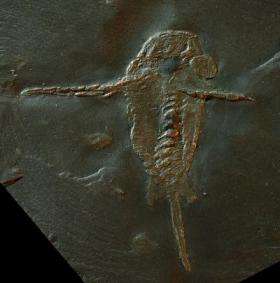
This is a photograph of Schinderhannes bartelsi. Credit: Steinmann Institute/University of Bonn
A missing link in the evolution of the front claw of living scorpions and horseshoe crabs was identified with the discovery of a 390 million-year-old fossil by researchers at Yale and the University of Bonn, Germany.
The specimen, named Schinderhannes bartelsi, was found fossilized in slate from a quarry near Bundenbach in Germany, a site that yields spectacularly durable pyrite-preserved fossils — findings collectively known as the Hunsrück Slate. The Hunsrück Slate has previously produced some of the most valuable clues to understanding the evolution of arthropods - including early shrimp-like forms, a scorpion and sea spiders as well as the ancient arthropods trilobites.
"With a head like the giant Cambrian aquatic predator Anomalocaris and a body like a modern arthropod, the specimen is the only known example of this unusual creature," said Derek Briggs, director of Yale's Peabody Museum of Natural History and an author of the paper appearing in the journal Science.
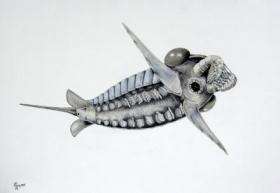
Reconstruction of Schinderhannes bartelsi. Credit: Elke Groening
Scientists have puzzled over the origins of the paired grasping appendages found on the heads of scorpions and horseshoe crabs. The researchers suggest that Schinderhannes gives a hint. Their appendages may be an equivalent to those found in the ancient predatory ancestor, Anomalocaris — even though creatures with those head structures were thought to have become extinct by the middle of the Cambrian Period, 100 million years before Schinderhannes lived.Join PhysOrg.com on Facebook
The fossil's head section has large bulbous eyes, a circular mouth opening and a pair of segmented, opposable appendages with spines projecting inward along their length. The trunk section is made up of 12 segments, each with small appendages, and a long tail spine. Between the head and trunk, there is a pair of large triangular wing-like limbs — that likely propelled the creature like a swimming penguin, according to Briggs. Unlike its ancestors from the Cambrian period, which reached three feet in length, Schinderhannes is only about 4 inches long.
This finding caps almost 20 years of study by Briggs on the Hunsrück Slate. "Sadly, the quarry from which this fabulous material comes has closed for economic reasons, so the only additional specimens that are going to appear now are items that are already in collectors' hands and that may not have been fully prepared or realized for what they are," said Briggs.
Source: Yale University
-
Big pest, small genome: Blueprint of spider mite may yield better pesticides
Nov 23, 2011 |
5 / 5 (1) |
0
-
How does DEET work? Study says it confuses insects (Update)
Sep 21, 2011 |
5 / 5 (1) |
0
-
Excitation and inhibition remain balanced, even when the brain undergoes reorganization
Sep 07, 2011 |
not rated yet |
0
-
Evolution in reverse: insects recover lost 'wings'
May 05, 2011 |
5 / 5 (4) |
15
-
What sea squirts can teach us about the heart
Apr 11, 2011 |
5 / 5 (1) |
0
-
Engineers build first sub-10-nm carbon nanotube transistor
Feb 01, 2012 |
4.9 / 5 (33) |
30
-
Something old, something new: Evolution and the structural divergence of duplicate genes
Jan 31, 2012 |
4.6 / 5 (7) |
1
-
The hidden nanoworld of ice crystals: Revealing the dynamic behavior of quasi-liquid layers
Jan 30, 2012 |
5 / 5 (4) |
1
-
Stock market network reveals investor clustering
Jan 27, 2012 |
3.9 / 5 (23) |
8
-
Of microchemistry and molecules: Electronic microfluidic device synthesizes biocompatible probes
Jan 26, 2012 |
5 / 5 (2) |
0
-
Factors affecting beet root cell membrane
16 hours ago
-
Stem cell question.
Feb 10, 2012
-
Protease cleavage
Feb 10, 2012
-
Pertubance in a model
Feb 10, 2012
-
Cancer drugs and Alzheimer's, Oh my!
Feb 09, 2012
-
Squishing cells
Feb 09, 2012
- More from Physics Forums - Biology
More news stories
A frank discussion of the power law and linking correlation to causation
(PhysOrg.com) -- Michael Stumpf a mathematics professor at Imperial College in London, and Mason Porter a lecturer at Oxford have teamed together to write and publish a perspective piece in Science regarding the in ...
US workers are 'giving away the store,' costing firms billions
Nearly 70 percent of the nation's service employees give away free goods and services from hamburgers to cable TV costing companies billions of dollars a year, according to a groundbreaking study.
Other Sciences / Economics & Business
Feb 09, 2012 |
3 / 5 (5) |
11
Employers feel no love for unscrupulous practice of 'service sweethearting'
A new study led by two Florida State University marketing professors finds that some frontline service employees who are rewarded for hikes in customer loyalty and satisfaction also may engage in "service ...
Other Sciences / Economics & Business
Feb 10, 2012 |
3.3 / 5 (3) |
10
New insights into how to correct false knowledge
The abundance of false information available on the Internet, in movies and on TV has created a big challenge for educators.
Other Sciences / Social Sciences
Feb 07, 2012 |
4.9 / 5 (7) |
9
|
Neanderthal demise due to many influences, including cultural changes: study
As an ice age crept upon them thousands of years ago, Neanderthals and modern human ancestors expanded their territory ranges across Asia and Europe to adapt to the changing environment.
Other Sciences / Archaeology & Fossils
Feb 07, 2012 |
4.4 / 5 (5) |
8
|
Scientists discover molecular secrets of 2,000-year-old Chinese herbal remedy
For roughly two thousand years, Chinese herbalists have treated Malaria using a root extract, commonly known as Chang Shan, from a type of hydrangea that grows in Tibet and Nepal. More recent studies suggest that halofuginone, ...
New method to examine batteries -- MRI from the inside
There is an ever-increasing need for advanced batteries for portable electronics, such as phones, cameras, and music players, but also to power electric vehicles and to facilitate the distribution and storage of energy derived ...
A mitosis mystery solved: How chromosomes align perfectly in a dividing cell
Although the process of mitotic cell division has been studied intensely for more than 50 years, Whitehead Institute researchers have only now solved the mystery of how cells correctly align their chromosomes during symmetric ...
Google might launch Drive for cloud storage soon
(PhysOrg.com) -- Google's next big move, according to the Wall Street Journal, is a cloud storage service called Drive. Hardly first to the plate, Google is simply catching up to introducing its cloud reposi ...
Lab study raises questions over nano-particle impact
Tests involving chickens have raised questions about the impact on health from engineered nano-particles, the ultra-fine grains commonly used in drugs and processed foods, scientists said on Sunday.
Starve a virus, feed a cure? Findings show how some cells protect themselves against HIV
A protein that protects some of our immune cells from the most common and virulent form of HIV works by starving the virus of the molecular building blocks that it needs to replicate, according to research published online ...

Feb 05, 2009
Rank: 5 / 5 (1)
Feb 05, 2009
Rank: not rated yet
its quite possible its ancestor did die off 100 million years earlier...we just need to find the direct predecessor is all. it will turn up eventually, just like it all does.