Sea level rise could be worse than anticipated
February 5, 2009
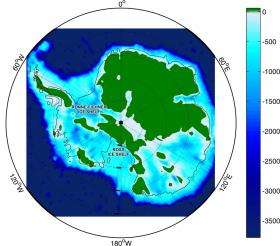
A digital image of what Antarctica would look like if it consisted only of land actually above sea level.
If global warming some day causes the West Antarctic Ice Sheet to collapse, as many experts believe it could, the resulting sea level rise in much of the United States and other parts of the world would be significantly higher than is currently projected, a new study concludes.
The catastrophic increase in sea level, already projected to average between 16 and 17 feet around the world, would be almost 21 feet in such places as Washington, D.C., scientists say, putting it largely underwater. Many coastal areas would be devastated. Much of Southern Florida would disappear.
The report will be published Friday in the journal Science, by researchers from Oregon State University and the University of Toronto. The research was funded by the National Science Foundation and other agencies from the U.S. and Canada.
"We aren't suggesting that a collapse of the West Antarctic Ice Sheet is imminent," said Peter Clark, a professor of geosciences at Oregon State University. "But these findings do suggest that if you are planning for sea level rise, you had better plan a little higher."
The Intergovernmental Panel on Climate Change has estimated that a collapse of this ice sheet would raise sea levels around the world by about 16.5 feet, on average, and that figure is still widely used. However, that theoretical average does not consider several key forces, such as gravity, changes in the Earth's rotation or a rebound of the land on which the massive glacier now rests, scientists say in the new study.
Join PhysOrg.com on Facebook
Right now, this ice sheet has a huge mass, towering more than 6,000 feet above sea level over a large section of Antarctica. This mass is sufficient to exert a substantial gravitational attraction, researchers say, pulling water toward it - much as the gravitational forces of the sun and moon cause the constant movement of water on Earth commonly known as tides.
"A study was done more than 30 years ago pointing out this gravitational effect, but for some reason it became virtually ignored," Clark said. "People forgot about it when developing their sea level projections for the future."
And aside from incorporating the gravitational effect, the new study adds further wrinkles to the calculation - the weight of the ice forcing down the land mass on which it sits, and also affecting the orientation of the Earth's spin. When the ice is removed, it appears the underlying land would rebound, and the Earth's axis of rotation defined by the North and South Pole would actually shift about one-third of a mile, also affecting the sea level at various points.
When these forces are all taken into calculation, the sea level anywhere near Antarctica would actually fall, the report concludes, while many other areas, mostly in the Northern Hemisphere, would go up.
If the West Antarctic Ice Sheet completely melted, the East Coast of North America would experience sea levels more than four feet higher than had been previously predicted - almost 21 feet - and the West Coast, as well as Miami, Fla., would be about a foot higher than that. Most of Europe would have seas about 18 feet higher.
"If this did happen, there would also be many other impacts that go far beyond sea level increase, including much higher rates of coastal erosion, greater damage from major storm events, problems with ground water salinization, and other issues," Clark said. "And there could be correlated impacts on other glaciers and ice sheets in coastal areas that could tend to destabilize them as well."
It's still unclear, Clark said, when or if a breakup of the West Antarctic Ice Sheet might occur, or how fast it could happen. It may not happen for hundreds of years, he said, and even then it may not melt in its entirety. Research should continue to better understand the forces at work, he said.
"However, these same effects apply to any amount of melting that may occur from West Antarctica," Clark said. "So many coastal areas need to plan for greater sea level rise than they may have expected."
A significant part of the concern is that much of the base of this huge ice mass actually sits below sea level, forced down to the bedrock by the sheer weight of the ice above it. Its edges flow out into floating ice shelves, including the huge Ross Ice Shelf and Ronne Ice Shelf. This topography makes it "inherently unstable," Clark said.
"There is widespread concern that the West Antarctic Ice Sheet, which is characterized by extensive marine-based sectors, may be prone to collapse in a warming world," the researchers wrote in their report.
Source: Oregon State University


As for the gravitational effect of the ice sheet, would the sheet be gaining more mass as it melts? Of course not, so I'd like to see more specifics on the effect as I'm unfamiliar with it. How would the gravitational effect actually change if the sheet collapsed? Presumably the sheet would have to entirely melt or be broken to a point where force would drive it's constituent pieces apart to disturb the gravitational effect of the ice sheet.
Wow the whingers about "AGW" are showing both that they can't read and stating they don't understand basic physics concepts like gravity in one comment
Velnarris the first sentence makes it pretty clear he is not talking about floating "ice sheet already in the water". As for the "effect as I'm unfamiliar with" ,read the first sentce I quoted again. That ice has mass and and is pulling watter towards it. If it melts the water will no longer sit atop the
Antarctic, so it would no longer pull water towards it. Pretty basic stuff, clearly explained in the article.
Predictive prowess is only impressive if you actually get something right now and then. The IPCC? Come on! Why not ask the Raelians for their opinion? The IPCC is a social club for UN bureaucrats.
Yes, and if the icecap melts that's understood as I said in my comment.
Now since they're talking about collapse, I'd like to know exactly how a collapse will distribute the mass far enough to disturb the gravitational effect.
Thanks though.
You should rephrase it to say "are redrawing the maps to reflect the recently reopened northwest passage." This would be more correct since it was open in the 1930s through late 1940s.
"I'm not suggesting that an apocolypse is imminent, but this model does suggest that if you are planning for an asteroid the size of New Hampshire to hit the earth, you had better plan to get a little warmer."
The north polar ice cap melts in places every year--and refreezes every year. The Gorian video of a polar bear "stranded" on floating ice was taken in August, which is when the ice melts in the Arctic. This is something little known among IPCC supporters.
And, in the ancient past there were times when there was no Arctic ice cap. Yet, Homosapiens Sapiens was not walking the earth at that time, much less making massive CO2 emissions.
This means that the amount of water in the glass must represent a to-scale model of the earth. The same must be the same with the measurement of the ice to be placed into the glass. In addition, you also must factor in evaporation, absorption, and so forth. Failure to do this is puerile at best and methodologically challenged at worst.
Simply dumping ice cubes into a glass of water and measuring the results does NOT coincide with any known reality. Environmentalists and climatologists who think it does need to quit their day-jobs and go back to school. :)
Meaning the our bloody days will be getting even longer! Damn
When the water levels get higher than these latter two measurements, then it is time to worry and not until then.
Here is the thing: It was much hotter globally in the ancient past than it now is, and we still only got a short-term sea level rise of only about between 3 and 6 meters higher than present! Why all the unnecessary gloom and doom predictions about 21 meter rises? This and many other reasons cause me to doubt the predictions of the IPCC and others of their ilk.
Fact is, there is money to be made in new technologies, and Gore and company have made substantial investments in these. They stand to make a lot of money on the fear-mongering, particularly since Gore gets around $150,000 each time he goes somewhere to speak on the subject of something not really proven to everyone's satisfaction.
Correct. However, since these ice flows are already partially submerged one would have to establish what the volume of the ice will translate into in terms of water prior to annoucing any sort of rise as water is more dense and occupies less volume for the mass.
If the total amount of melt water occupies a smaller volume than the ice sheet currently displaces between the bedrock and the surface of the water, the net gain in water level would be zero. This is most likely not the case, but it's still a possibility as the ice is not floating.
Agreed! Another thing to consider is the shape of the earth. The earth is not a perfect sphere. It has more of a much rounded pear shape, with the larger diameter in the southern hemisphere.
I do not doubt that this shape is partially to be attributed to the distortion of the crust by the weight of the ice of Antartica interacting with gravity.
If all the ice were to melt, we also have to take into consideration the resulting change in the shape of the globe. With less distortion of the crust it is likely that there will not be as appreciable a rise of sea level as distortions of the crust change the amount of water that the oceans can hold.
I do not say that this is a certainty but it should be taken into consideration and may well be the reason why we had not more than a 6 meter rise higher in sea level 120,000 years ago than now.
That pretty much sums up the level of discourse of the deniers.
However, Antarctic ice is growing, not receding, even considering the occasional break-off of ice pack edges into the ocean; they are growing and shedding their edges.
This, however, is not a "huge" amount of nonsense. For instance, what I posted above is fact based on the science. It also raises questions regarding the accuracy of the AGW supporter information.
For instance, if all we got was a temporary 6-meter rise in sea level higher than present when the global environment was much warmer than now, where did all the extra water that would give us a future 21-meter rise come from?
AGW data raises more questions than it answers and that is the main reason why people deny it. I am one of those because I have seen nothing conclusive as of yet that does not raise more questions than the data answers.
If the IPCC and others of their ilk could just give us something substantive that fits the available data without twisting the data and facts thereof, and without trying to panic people into action where action may not be warranted, there might be less deniers.
Actually, the ice skater reference is rather good. Antartica is on the axis, like a skaters arms when they are directly above their head. If the ice sloughs off then it would head from the axis towards the equator. If you think otherwise then you're basically speaking against the premise of the article.
Big Oil Sock Muppet is one of your fellow AGW supporters. He makes these wild comments so people like yourself can attempt to paint all AGCC skeptics as right wing lunatics. Interesting, seeing as that is a tactic that was repeatedly used by the Catholic church to get heretics out into the open.
Who's argument is based on faith now?
http://www.opinio...10008220
Outlines many of the reasons why an AGCC skeptic is a skeptic.
Ummm... in case you hadn't noticed, the meltwater will be moving away from the spin axis, so the skater analogy does hold.
Yeah but I'd rather he didn't antagonize the posters who do actually bring discussion to the table like Barakn and theophys.
Well, 21 feet would yield nearly 7 meters. That is pretty near what the sea level was 120,000 years ago.
So, even if such melting did happen, it does not have to be attributable to AGW but would correspond to certain solar cycles!
At the very least it would be a return to what was rather than something new....
Well, it would not really become green, per se. The ocean current that encircles Antarctica prevents that from happening.
Now, if we were to fill in the area between the South American and Antarctic continental shelves, then Antarctica indeed would become green and habitable. It would be a return to conditions existing there over 50 million years ago.
Antarctica was once a forest land with many diverse forms of life. When a deepened split occurred between the two continental shelves, oceanic currents changed, causing the current to encircle Antarctica and plunge Antarctica into a perpetual ice age.