Predicting diversity within hotspots to enhance conservation
With limited funding and an inadequate number of scientists, governments in countries containing "hotspots" of threatened biodiversity are wrestling with how to protect plants and animals in disappearing habitats.
But a new strategy developed by University of California, Berkeley, biologists could help scientists, governments and private organizations worldwide to identify the areas within hotspots where they should focus their time, effort and money - areas likely to have a wealth of unique diversity.
The research, led by UC Berkeley post-doctoral fellow Ana Carolina Carnaval and evolutionary biologist Craig Moritz, professor of integrative biology and director of UC Berkeley's Museum of Vertebrate Zoology, appears this week in the journal Science. Their colleagues are Michael J. Hickerson of Queens College, New York, Célio F. B. Haddad of Universidade Estadual Paulista, and Miguel T. Rodrigues of Universidade de São Paulo, Brazil.
The UC Berkeley researchers' strategy involves looking at multiple species in an area and, based on current range and models of past climate, estimating the species' past distributions. This gives an indication of which regions have been climatically stable, and thus likely to harbor a diversity of species, and which areas have been unstable and likely to be less biodiverse.
"With this method, we can identify areas that have been working as refugia for biodiversity," Carnaval said. "These are areas that have remained climatically stable through time, where local communities have been able to persist. Despite the fact that we haven't sampled them exhaustively yet, we think there is a lot of undocumented, hidden diversity there, the potential for a lot of species still unknown to science, and, especially, a lot of endemism."
Applying their strategy to the Atlantic forest hotspot, which extends from Brazil's southern border, stretching inland to Argentina and Paraguay, to the country's northeast coast, they pinpointed the central part of the Atlantic forest, much of it in Bahia state, as more diverse than previously thought. This is all the more remarkable because the central forest is among the least studied yet most threatened components of the Atlantic forest, Carnaval said.
"The study demonstrates that the southern portion of the Atlantic forest was more climatically unstable during the Late Pleistocene, relative to the central corridor, which served as a large climatic refuge for neotropical species," she said. "Yet, the central region is poorly known and under extreme anthropogenic pressure. This unveils new priorities for conservation that must reach policymakers, the public and NGOs (non-governmental organizations)."
Two decades ago, scientists proposed identifying "biodiversity hotspots" where "exceptional concentrations of endemic species are undergoing exceptional loss of habitat" so that conservation planners could focus on these hotspots "in proportion to their share of the world's species at risk," in the words of Oxford University's Norman Myers and colleagues, who published the first hotspot map in 2000 in the journal Nature. Endemic species are native species found nowhere else.
Carnaval and her colleagues have taken the next step, which is to narrow the focus even more, using the Atlantic forest of Brazil - which, unlike the much larger Amazon, is considered a threatened hotspot - as a test case.
The central Atlantic rainforests, home to tamarins and marmosets, include mangrove swamps along the coast, moist evergreen tropical forests nearby, semi-deciduous inland forests, where many trees drop their leaves in the dry season, and dry forests of deciduous trees even farther from the coast. Much of this rainforest has been cleared for farming, primarily for sugar cane, and only an estimated 8 percent of the original area remains. More than 60 percent of Brazil's population - approximately 100 million people - lives in cleared forest areas in the region.
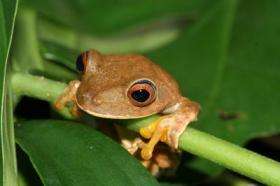
Focusing on three species of tree frogs found throughout the forest, the UC Berkeley researchers modeled the species' distributions 6,000 years ago, when local conditions were generally cooler and wetter, as well as 21,000 years ago, a cool-dry period. Based on their model, they predicted that southern areas of the forest appear to have been comparatively less stable from a climatic standpoint, and thus recently colonized by the study species and likely to hold far less genetic diversity than the central region.
The team tested this prediction by looking at genetic variation among the frog species today. Frogs in stable areas should have more genetic variation because they have lived and evolved for a longer period of time, while in unstable areas, frogs that may have moved in recently should have less variation. Presumably, frog diversity will reflect diversity throughout the ecosystem.
That is exactly the pattern the researchers found. Taking DNA samples from 184 frogs of three treefrog species - Hypsiboas albomarginatus, H. semilineatus and H. faber - at dozens of sites within the Brazilian coastal rainforest, they sequenced mitochondrial DNA from each and compared the sequences of the same gene from all individuals. Southern frogs had much less genetic diversity than those in the central and northern regions.
"We find a lot of diversity in areas shown as climatically stable by the paleomodels and much less diversity in the south, where models suggest climatic instability," said Carnaval. "Also, we find evidence of population expansion from the central region to the south."
Reanalyzing previously published genetic data by others, Carnaval and Moritz also found supporting evidence from mammals and reptiles. Similar patterns have also been published for birds.
"The study has shown us that the central Atlantic forest, which hasn't had the investment of resources and effort as the southern, has been stable from a climatic standpoint and therefore is likely more diverse than currently believed. But because this area is under great human impact, it deserves conservation and research priority," Moritz said.
"We are not saying the south is not important; today, we find lots of endemics in the south and lots of diversity in the south," she added. "But the data point to another area that should receive more attention from both the conservation and research standpoint."
The method tested on Brazil's Atlantic forest should work in other understudied, highly threatened tropical regions worldwide, Moritz and Carnaval emphasized.
"The broader story is that we think this technique could be applied in other countries and other hotspot areas to identify regions that haven't been well sampled yet, regions that could possibly harbor as yet undiscovered unique diversity," Carnaval said. "This is a general method for identifying and prioritizing hotspots within hotspots, for finding highly diverse areas that have not been fully explored."
"Ana and her colleagues have discovered, using a very simple approach of combining genetics and environmental modeling, how we can make pretty strong predictions that can guide conservation efforts," Moritz said.
Source: University of California - Berkeley


