Mars Rover device gets new mission on Earth
February 5, 2009 Mars Rover device gets new mission on Earth

Enlarge

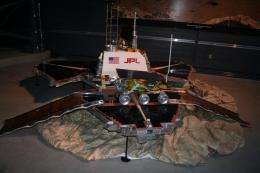
Mars Rover at the Udvar-Hazy Center of the National Air and Space Museum in Chantilly, Va. Credit: Wikipedia Commons

Developed to sniff out extraterrestrial life on other planets, a portable device known as the Mars Organic Analyzer (MOA) is taking on a new role in detecting air pollutants on Earth. Researchers in California report the development of a modified MOA able to detect polycyclic aromatic hydrocarbons (PAHs), potentially carcinogenic molecules from cigarette smoke and wood smoke, volcanic ash, and other sources. The report appeared in the Jan. 15 issue of ACS’ semi-monthly journal Analytical Chemistry.

In the report, Richard A. Mathies and colleagues indicate that current earthbound PAH detection focuses on the cleanup of environmental contamination sites. On other planets, the concentration of organic PAH molecules can provide valuable insight into environmental conditions and the potential for extraterrestrial life. But existing PAH detection methods are slow and costly. Scientists thus are seeking an inexpensive, rapid and nondestructive technique for the measurement of PAH contamination.

The researchers tested samples from Lake Erie and a hydrothermal vent from the Gulf of California, as well as a Martian analogue sample from the Mars-like Atacama Desert, one of the driest spots on earth. They found that the detection sensitivity of the device was on par with current laboratory methods. “The method of PAH analysis developed here significantly advances the MOA’s capabilities for organic carbon detection and may also prove useful for environmental monitoring,” says Mathies.

Article: "Polycyclic Aromatic Hydrocarbon Analysis with the Mars Organic Analyzer Microchip Capillary Electrophoresis System”, Analytical Chemistry

Provided by ACS


print this article email this article download pdf blog this article bookmark this article     Stumble it Digg this share on Facebook retweet share on Reddit add to delicious
Rate this story - 5 /5 (1 vote)


February 5, 2009 all stories

Comments: 0

5 /5 (1 vote)
  • Stumble this up

  • Digg this

  • share this

  • hide
  • Related Stories

  • New study expands the list of hazardous chemicals in smokeless tobacco
    created Aug 16, 2009 | popularity not rated yet | comments 0
  • A child's IQ can be affected by mother's exposure to urban air pollutants
    created Jul 20, 2009 | popularity not rated yet | comments 0
  • Pavement sealcoat a source of toxins in stormwater runoff
    created Apr 08, 2009 | popularity not rated yet | comments 0
  • New findings on emerging contaminants
    created Feb 16, 2008 | popularity not rated yet | comments 0
  • Cosmic Cockroaches
    created Sep 03, 2007 | popularity not rated yet | comments 0


  • hide
  • Relevant PhysicsForums posts

  • Zinc Oxide reduction
    created 5 hours ago
  • depolymerization of HDPE
    created 21 hours ago
  • Question, whats the best chemistry software for a college student?
    created Nov 08, 2009
  • Why only opposite spin electrons in an orbital ?
    created Nov 08, 2009
  • More from Physics Forums - Chemistry

Other News

Toward home-brewed electricity with 'personalized solar energy'

Toward home-brewed electricity with 'personalized solar energy'

Chemistry / Materials Science

created Nov 04, 2009 | popularity 3.4 / 5 (9) | comments 4

New scientific discoveries are moving society toward the era of "personalized solar energy," in which the focus of electricity production shifts from huge central generating stations to individuals in their ...


Scientists Reproduce a Building Block of Life in Laboratory

Scientists Reproduce a Building Block of Life in Laboratory

Chemistry / Biochemistry

created Nov 06, 2009 | popularity 4.8 / 5 (23) | comments 0

(PhysOrg.com) -- NASA scientists studying the origin of life have reproduced uracil, a key component of our hereditary material, in the laboratory.


Newly Discovered Fat Molecule: An Undersea Killer with an Upside

Newly Discovered Fat Molecule: An Undersea Killer with an Upside

Chemistry / Biochemistry

created Nov 05, 2009 | popularity 4.8 / 5 (10) | comments 0

(PhysOrg.com) -- A chemical culprit responsible for the rapid, mysterious death of phytoplankton in the North Atlantic Ocean has been found by collaborating scientists at Rutgers University and the Woods Hole ...


CU-Boulder map of human bacterial diversity shows wide interpersonal differences

Map of Human Bacterial Diversity Shows Wide Interpersonal Differences

Chemistry / Biochemistry

created Nov 05, 2009 | popularity 4.7 / 5 (11) | comments 0

(PhysOrg.com) -- A University of Colorado at Boulder team has developed the first atlas of bacterial diversity across the human body, charting wide variations in microbe populations that live in different ...


Mimicking nature, scientists can now extend redox potentials

Mimicking nature, scientists can now extend redox potentials

Chemistry / Biochemistry

created Nov 04, 2009 | popularity 4.8 / 5 (5) | comments 0

(PhysOrg.com) -- New insight into how nature handles some fundamental processes is guiding researchers in the design of tailor-made proteins for applications such as artificial photosynthetic centers, long-range ...