Researchers observe evolution chain reaction
February 5, 2009 Researchers observe evolution chain reaction

Enlarge

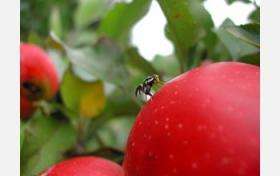
A female apple maggot fly, Rhagoletis pomonella, implants an egg into an apple. Wasps that attack the flies and eat their larvae appear to be changing on a genetic level in the same way that the flies themselves appear to be changing genetically. Credit: Rob Oakleaf

(PhysOrg.com) -- A team of researchers are reporting the ongoing emergence of a new species of fruit fly--and the sequential development of a new species of wasp--in the February 6 issue of the journal Science.

Jeff Feder, a University of Notre Dame biologist, and his colleagues say the introduction of apples to America almost 400 years ago ultimately may have changed the behavior of a fruit fly, leading to its modification and the subsequent modification of a parasitic wasp that feeds on it.

The result is a chain reaction of biodiversity where the modification of one species triggers the sequential modification of a second, dependent species. The National Science Foundation supports the research.

"It's a nice demonstration of how the initial speciation of one organism opens up an opportunity for another species in the ecosystem to speciate in kind," said Feder. "Biodiversity in essence is the source for new biodiversity."

View video: http://nsfgov.http.internapcdn.net/nsfgov_vitalstream_com/feder.swf


Join PhysOrg.com on Facebook

For almost 250 years after the introduction of apples to North America, insects referred to as hawthorn flies, Rhagoletis pomonella, continued to meet on the small, red fruit of hawthorn trees to mate and lay eggs. Then, in the mid-1800s, some of these "hawthorn flies" began to mate and lay eggs on apples instead. According to Feder, the flies attracted to apples eventually became genetically differentiated from the flies attracted to hawthorns, and so did the wasps that live on the flies' larvae.

The genetic distinctions mainly show up as gene frequency differences between the flies and their associated wasp populations rather than fixed, all or none, differences. This is consistent with the process by which new biological species arise.

"The Diachasma alloeum wasp that we studied is just one of several wasps that spend a significant portion of their lives attached to hawthorn and apple flies," said Feder. "We have preliminary evidence that one of the other wasps also may be forming specialized races on the flies, but it is too early to tell definitively."

"What is startling is how fast populations can ecologically adapt to new habitats and begin to evolve into different species in front of our eyes," he said.

Feder says the research is important because it provides insights into solving Darwin's mystery of the origins of new species. "Clues can be found right before us as we sit on our deck chairs barbecuing and drinking pop. All we have to do is open our eyes and we can see new life forms coming into being in that scraggly old apple tree in our backyard."

Source: National Science Foundation


Rate this story - 4.4 /5 (15 votes)

Rank Filter

Move the slider to adjust rank threshold, so that you can hide some of the comments.


Display comments: newest first

  • Szkeptik - Feb 05, 2009
    • Rank: 3 / 5 (2)
    But the fruit fly didn't become a dog so evolution is a myth. /sarcasm
  • thales - Feb 05, 2009
    • Rank: 1 / 5 (1)
    Right, this puts to rest the creationist argument that macroevolution has not been observed.
  • LuckyBrandon - Feb 05, 2009
    • Rank: 3 / 5 (2)
    thales-you know better than that buddy. the creationists will say god willed the fly to the apple, or that he made it so enticing to them to instigate the change, and that the wasp's change was his divine plan too since they use the flies for prey. AKA, they're gonna say a bunch of bs to keep their religions going for another 100 yrs or so.
    But ahhh, soon, but probably not in our lifetimes, this whole god jazz will be eliminated. Then we can take on santa and the tooth fairy...oh oh, and the easter bunny. :D
  • dachpyarvile - Feb 06, 2009
    • Rank: not rated yet
    Even Darwin wasn't willing to leave God entirely out of the equation in his theorem. Anyone who has read "The Origin of Species" knows at least that much.
  • pseudophonist - Feb 06, 2009
    • Rank: 5 / 5 (1)
    dachpyarvile: That Darwin wasn't willing to leave God out of the equation shows that he was a religious man, not that evolution requires God. You imply a fallacy.
  • Geggamojja - Feb 06, 2009
    • Rank: not rated yet
    All Darwin said was god _may_ have started it all, that events in the material world are brought about "by the establishment of general laws" rather than by individual miracles.
  • raron - Feb 06, 2009
    • Rank: 4 / 5 (1)
    I'm glad I like green apples:p

    Sorry I don't have any more educated comment here. Also, bring back the black background please, or at least a switch or stored in preferences in the profile. Luckily I have just that, a switch (java-applet) but still, annoying to always switch it manually. White pages are an eye-strain!
  • dachpyarvile - Feb 06, 2009
    • Rank: not rated yet
    dachpyarvile: That Darwin wasn't willing to leave God out of the equation shows that he was a religious man, not that evolution requires God. You imply a fallacy.


    Ummm...Where did I state that evolution required God? Nowhere here. I merely stated the fact that even Darwin was not willing to discard the idea entirely. That is fact, not fallacy.
  • lengould100 - Feb 06, 2009
    • Rank: 1 / 5 (1)
    White pages are an eye-strain!


    What sort of eyes have your species evolved?
  • dachpyarvile - Feb 06, 2009
    • Rank: not rated yet
    All Darwin said was god _may_ have started it all, that events in the material world are brought about "by the establishment of general laws" rather than by individual miracles.


    Yes, I understand fully regarding what Darwin wrote. I have no disagreement with that stance. All I said was that Darwin was not willing to throw God under the proverbial bus--in so many words. But, one who believes in God might say that the natural law was set up by God in the first place and that evolution ran its course.

    I have said nothing more nor less other than the fact that even Darwin did not exclude God entirely from the equation. I am aware of what Darwin wrote and agree with it. I do not believe that each species exists due to individual Divine Fiat, either.
  • LuckyBrandon - Feb 09, 2009
    • Rank: not rated yet
    dachpyarvile-back in darwins day, in some places, you were considered a wtich or warlock and burned at the stake, or drowned with an attached rock, or anything of that nature for NOT believing in a god, or for that matter, even for being an alchemist or scientist. so it makes complete sense whether he was a believer or not to have stated something like that.

    the sad fact is, the argument can always be made that maybe some god did start it all...and thats likely, as long as god is something like an interdimensional membrane capable of invoking the existence of another membrane....such as in M theory. I am a FIRM believer of fact and not fiction, and that the whole god mess is a means to power and financial gain...there can be no arguement there... Rattling on here sorry...

    We know now that Darwin was on the right track, but still wrong, but ONLY because they didn't have the scientific abilities we have with today's tools of science. If he would have had those, the mention of a god im sure would have been left out of the origin of species, and he would have changed his tree into a bush, or a series of twisted vines...

February 5, 2009 all stories

Comments: 11

4.4 /5 (15 votes)

  • hide
  • Related Stories


Other News

bee

Are bees also addicted to caffeine and nicotine?

Biology / Plants & Animals

created 25 minutes ago | popularity 5 / 5 (2) | comments 0 | with audio podcast

A study carried out at the University of Haifa has found that bees prefer nectar with a small concentration of caffeine and nicotine over nectar that does not comprise these substances at all. "This could ...


giant oarfish

Bizarre giant oarfish filmed (w/ Video)

Biology / Plants & Animals

created 4 hours ago | popularity 4.3 / 5 (4) | comments 0 | with audio podcast report

(PhysOrg.com) -- A rare giant oarfish, probably the largest bony fish in the ocean, has been filmed off the Gulf of Mexico. This is possibly the first time the fish has been observed in its natural environment.


Scientists crash test DNA's replication machinery

Biology / Cell & Microbiology

created 2 hours ago | popularity 5 / 5 (2) | comments 0 | with audio podcast

(PhysOrg.com) -- Important molecular machines routinely crash into one another while plying their trades on DNA. New research shows that the enzymes that copy DNA before cell division, called replisomes, are the kings of ...


Great tits: birds with character

Great tits: birds with character

Biology / Plants & Animals

created 17 hours ago | popularity 5 / 5 (3) | comments 3 | with audio podcast

(PhysOrg.com) -- In humans and animals alike, individuals differ in sets of traits that we usually refer to as personality. An important part of the individual difference in personality is due to variation ...


Benefits of badger culling not long lasting for reducing cattle TB, says study

Benefits of badger culling not long lasting for reducing cattle TB, says study

Biology / Ecology

created 3 hours ago | popularity not rated yet | comments 0

(PhysOrg.com) -- Badger culling is unlikely to be a cost-effective way of helping control cattle TB in Britain, according to research published today in PLoS ONE.