Researchers Test Steep-Terrain Rover
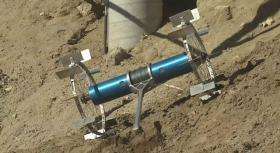
February 5, 2009 Axel rover prototype

Enlarge

Axel rover prototype. Image credit: NASA/JPL

(PhysOrg.com) -- Engineers from NASA's Jet Propulsion Laboratory and students at the California Institute of Technology have designed and tested a versatile, low-mass robot that can rappel off cliffs, travel nimbly over steep and rocky terrain, and explore deep craters.

This prototype rover, called Axel, might help future robotic spacecraft better explore and investigate foreign worlds such as Mars. On Earth, Axel might assist in search-and-rescue operations.

"Axel extends our ability to explore terrains that we haven't been able to explore in the past, such as deep craters with vertically-sloped promontories," said Axel's principal investigator, Issa A.D. Nesnas, of JPL's robotics and mobility section. "Also, because Axel is relatively low-mass, a mission may carry a number of Axel rovers. That would give us the opportunity to be more aggressive with the terrain we would explore, while keeping the overall risk manageable."

The simple and elegant design of Axel, which can operate both upside down and right side up, uses only three motors: one to control each of its two wheels and a third to control a lever. The lever contains a scoop to gather lunar or planetary material for scientists to study, and it also adjusts the robot's two stereo cameras, which can tilt 360 degrees.

Axel's cylindrical body has computing and wireless communications capabilities and an inertial sensor to operate autonomously. It also sports a tether that Axel can unreel to descend from a larger lander, rover or anchor point. The rover can use different wheel types, from large foldable wheels to inflatable ones, which help the rover tolerate a hard landing and handle rocky terrain.

Nesnas co-leads the project with Joel Burdick, a mechanical and bioengineering professor at Caltech, who supervises a handful of Caltech graduate and undergraduate students working on the rover system. Last fall, the JPL-Caltech team demonstrated Axel at the annual Smithsonian Folklife Festival in Washington, which showcased NASA for the agency's 50th anniversary.

"Collaboration with Caltech has been key to the success of this project," Nesnas said. "The students contributed significantly to the design of the tethered Axel. Their creative work enabled us to analyze, design and build new wheels, sampling tools and software. The students also played a key role in field-testing this robot. Without them, we would not have been able to accomplish such goals, given our limited resources."

JPL began developing Axel in 1999, in partnership with Purdue University, West Lafayette, Ind., and Arkansas Tech University, Russellville, Ark. The Axel project was funded through NASA's Exploration System Mission Directorate.

More information on Axel is at:
http://www-robotics.jpl.nasa.gov/systems/system.cfm?System=16 and at http://robotics.caltech.edu/~pablo/axel/home.html .

Provided by NASA


print this article email this article download pdf blog this article bookmark this article     Stumble it Digg this share on Facebook retweet share on Reddit add to delicious
Rate this story - 3 /5 (1 vote)

Rank Filter

Move the slider to adjust rank threshold, so that you can hide some of the comments.


Display comments: newest first

  • DGBEACH - Feb 06, 2009
    • Rank: not rated yet
    Am I the only one who thinks that projects like these will be on the chopping block? I just don't see this happening quite frankly!

February 5, 2009 all stories

Comments: 1

3 /5 (1 vote)
  • Stumble this up

  • Digg this

  • share this

  • hide
  • Related Stories

  • Space Droids In The Desert
    created Sep 15, 2006 | popularity not rated yet | comments 0
  • Mars Mission Lasts Well Past Sell-By Date
    created Jul 22, 2006 | popularity not rated yet | comments 0
  • Finding life on Mars and outer space begins by examining Earth's inner space
    created Feb 01, 2006 | popularity not rated yet | comments 0
  • 1000 'Missions' And Counting
    created Jun 16, 2005 | popularity not rated yet | comments 0
  • Despite hurdles, human missions to Mars are in the works
    created May 10, 2005 | popularity not rated yet | comments 0


  • hide
  • Relevant PhysicsForums posts

  • Consistency of Meteor Shower Dates (i.e. the peak of Perseids always on Aug 13th)
    created Nov 10, 2009
  • Favourite Astronomy Book?
    created Nov 10, 2009
  • dark energy
    created Nov 10, 2009
  • The shape of our solar system's orbits.
    created Nov 07, 2009
  • More from Physics Forums - General Astronomy

Other News

Exoplanets Clue to Sun's Curious Chemistry

Exoplanets Clue to Sun's Curious Chemistry

Space & Earth / Astronomy

created 10 hours ago | popularity 4.9 / 5 (14) | comments 11

(PhysOrg.com) -- A ground-breaking census of 500 stars, 70 of which are known to host planets, has successfully linked the long-standing "lithium mystery" observed in the Sun to the presence of planetary systems. ...


Earth's early ocean cooled more than a billion years earlier than thought: Stanford study

Earth's early ocean cooled more than a billion years earlier than thought (w/ Video)

Space & Earth / Earth Sciences

created 10 hours ago | popularity 4.8 / 5 (6) | comments 0

(PhysOrg.com) -- The scalding-hot sea that supposedly covered the early Earth may in fact never have existed, according to a new study by Stanford University researchers who analyzed isotope ratios in 3.4 ...


A bubbling ball of gas

A bubbling ball of gas (w/ Video)

Space & Earth / Space Exploration

created 11 hours ago | popularity 5 / 5 (12) | comments 4

The Sun is a bubbling mass. Packages of gas rise and sink, lending the sun its grainy surface structure, its granulation. Dark spots appear and disappear, clouds of matter dart up - and behind the whole thing ...


A Tale of Planetary Woe

A Tale of Planetary Woe (w/ Video)

Space & Earth / Space Exploration

created 7 hours ago | popularity 5 / 5 (4) | comments 1

Once upon a time — roughly four billion years ago — Mars was warm and wet, much like Earth. Liquid water flowed on the Martian surface in long rivers that emptied into shallow seas. A thick atmosphere blanketed ...


Researchers Discover Use for Carbon Dioxide in Conversion of Biomass Into Biofuel

Researchers Discover Use for Carbon Dioxide in Conversion of Biomass Into Biofuel

Space & Earth / Environment

created 7 hours ago | popularity 3.7 / 5 (7) | comments 1

(PhysOrg.com) -- Researchers at Columbia University have successfully discovered a beneficial use for carbon dioxide in the conversion of organic materials, such as grass and bark, into fuel. Their findings ...