Astronomers spot cosmic dust fountain
(PhysOrg.com) -- Space dust annoys astronomers just as much as the household variety when it interferes with their observations of distant stars. And yet space dust also poses one of the great mysteries of astronomy.
"We not only do not know what the stuff is, but we do not know where it is made or how it gets into space," said Donald York, the Horace B. Horton Professor in Astronomy and Astrophysics at the University of Chicago.
But now York, the University of Toledo's Adolf Witt and their collaborators have observed a double-star system that displays all the characteristics that astronomers suspect are associated with dust production. The Astrophysical Journal will publish a paper reporting their discovery in March.
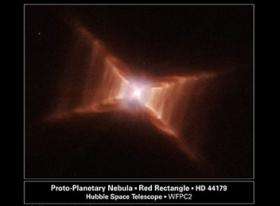
The double star system, designated HD 44179, sits within what astronomers call the Red Rectangle, an interstellar cloud of gas and dust (nebula) located approximately 2,300 light years from Earth.
Join PhysOrg.com on Facebook
One of the double stars is of a type that astronomers regard as a likely source of dust. These stars, unlike the sun, have already burned all the hydrogen in their cores. Labeled post-AGB (post-asymptotic giant branch) stars, these objects collapsed after burning their initial hydrogen, until they could generate enough heat to burn a new fuel, helium.
Dust in the solar wind
During this transition, which takes place over tens of thousands of years, these stars lose an outer layer of their atmosphere. Dust may form in this cooling layer, which radiation pressure coming from the star's interior pushes out the dust away from the star, along with a fair amount of gas.
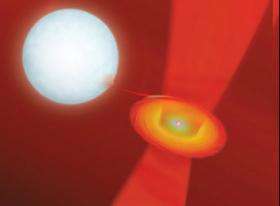
In double-star systems, a disk of material from the post-AGB star may form around the second smaller, more slowly evolving star. "When disks form in astronomy, they often form jets that blow part of the material out of the original system, distributing the material in space," York explained.
This seems to be the phenomenon that Witt's team observed in the Red Rectangle, probably the best example so far discovered. The discovery has wide-ranging implications, because dust is critical to scientific theories about how stars form.
"If a cloud of gas and dust collapses under its own gravity, it immediately gets hotter and starts to evaporate," York said. Something, possibly dust, must immediately cool the cloud to prevent it from reheating.
The giant star sitting in the Red Rectangle is among those that are far too hot to allow dust condensation within their atmospheres. And yet a giant ring of dusty gas encircles it.
Witt's team made approximately 15 hours of observations on the double star over a seven-year period with the 3.5-meter telescope at Apache Point Observatory in New Mexico. "Our observations have shown that it is most likely the gravitational or tidal interaction between our Red Rectangle giant star and a close sun-like companion star that causes material to leave the envelope of the giant," said Witt, an emeritus distinguished university professor of astronomy.
Some of this material ends up in a disk of accumulating dust that surrounds that smaller companion star. Gradually, over a period of approximately 500 years, the material spirals into the smaller star.
Bipolar behavior
Just before this happens, the smaller star ejects a small fraction of the accumulated matter in opposite directions via two gaseous jets, called "bipolar jets."
Other quantities of the matter pulled from the envelope of the giant end up in a disk that skirts both stars, where it cools. "The heavy elements like iron, nickel, silicon, calcium and carbon condense out into solid grains, which we see as interstellar dust, once they leave the system," Witt explained.
Cosmic dust production has eluded telescopic detection because it only lasts for perhaps 10,000 years—a brief period in the lifetime of a star. Astronomers have observed other objects similar to the Red Rectangle in Earth's neighborhood of the Milky Way. This suggests that the process Witt's team has observed is quite common when viewed over the lifetime of the galaxy.
"Processes very similar to what we are observing in the Red Rectangle nebula have happened maybe hundreds of millions of times since the formation of the Milky Way," said Witt, who teamed up with longtime friends at Chicago for the study.
Witt (Ph.D.,'67) and York (Ph.D.,'71) first met in graduate school at Chicago's Yerkes Observatory, where Lew Hobbs, now Professor Emeritus in Astronomy & Astrophysics, had just joined the University faculty. Other co-authors include Julie Thorburn of Yerkes Observatory; Uma Vijh, University of Toledo; and Jason Aufdenberg, Embry-Riddle Aeronautical University in Florida.
The team had set out to achieve a relatively modest goal: find the Red Rectangle's source of far-ultraviolet radiation. The Red Rectangle displays several phenomena that require far-ultraviolet radiation as a power source. "The trouble is that the very luminous central star in the Red Rectangle is not hot enough to produce the required UV radiation," Witt said, so he and his colleagues set out to find it.
It turned out neither star in the binary system is the source of the UV radiation, but rather the hot, inner region of the disk swirling around the secondary, which reaches temperatures near 20,000 degrees. Their observations, Witt said, "have been greatly more productive than we could have imagined in our wildest dreams."
Provided by University of Chicago


