February 5, 2009 weblog
Japanese Robot/Humanoid Innovations Update: Mankind's Best New Friend is Getting Better (Videos)
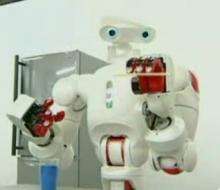
(PhysOrg.com) -- The combined efforts of the University of Tokyo with private sector partners and the Information and Robot Technology Research Technology Initiative have moved one-step closer to creating a robot capable of performing fine motor skills, balancing on one foot and lifting. These skills are required in order for the robot to serve as a housekeeper/caregiver for the disabled and an aging population.
In other developments, Japanese scientists and engineers at Waseda University in Tokyo unveiled their latest humanoid robot named Twenty-One. This new and improved humanoid robot is equipped with manual dexterity capable of picking up a drinking straw, placing it into a tumbler and handing off the drink to it's human counter-part. Twenty-One looks like a robotic version of Steven Spielberg's kind-eyed character ET. Japan is truly taking one giant step forward for mankind.
The collaborative efforts of the University of Tokyo, Toyota, Fujitsu, Mitsubishi, Panasonic, Sega and Olympus under the auspices of IRT, (Robot Technology Research Technology Initiative) have formed a Home Assistant Robot Project. The robot is 61-inches in height by 25.6-inches wide with a depth of 31.31-inches. The new home assistant has not been officially named, but currently goes by the name AR, the initials of "Assistant Robot."
AR is equipped with a wide-angle stereo camera, a telephoto stereo camera and ultra-sensitive sensors. AR operates on a two-wheel drive base with balancing wheels. The battery life is estimated to run 30-minutes to 1-hour. Seeing is believing, but in short AR can sweep the floor, pick up a tray of dirty dishes, move them to the sink, load up the dishwasher, move chairs, put dirty clothes in the washer and more.
In other news, Japan's Digital Content Expo in late October 2008 allowed robot developers to show off robots performing a range of gymnastic and calisthenic feats including balancing on one foot, playing a game of limbo, moving from floor position to upright and more. A poorly translated version of the event is available by clicking on the original animated Japanese version at robot.watch.impress.co.jp/cda/ … 2008/10/24/1394.html . English speaking readers may simply log-on to Yahoo Babelfish or use Google translator to view the entire page.
The human assistant robot is in the fine-tuning stage and holds great promise for the pending influx of baby-boomers in need of a little help while in a care facility or at home.
© 2009 PhysOrg.com


