New genes involved in acute lymphoblastic leukemia play fundamental role in prognosis of the disease
February 6, 2009
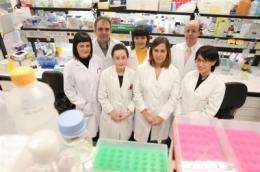
This is the researcher group from Clinica de la Universidad de Navarra. Credit: Clinica de la Universidad de Navarra
The inactivity or "silence" of certain genes plays a fundamental role in the prognosis of acute lymphoblastic leukemia as well as in response to treatment, according to the results of research involving a team made up of specialists from the University Hospital of Navarra and the Center for Applied Medical Research at the same University of Navarra, as well as the Reina Sofía Hospital in Cordoba, Andalusia.
In concrete, the work confirmed that the inactivation of 13 microRNAs (a type of gene) by an epigenetic mechanism (capable of modulating the functions of the genetic code), is associated with higher mortality amongst patients with ALL. In total, the study involved 353 patients - 179 children and 174 adults - with acute lymphoblastic leukaemia). The results open up new therapeutic options on demonstrating the possibility of using these microRNAs as new targets in the treatment of this cancer illness. The conclusions of the research were recently published in the scientific journal with the greatest international impact in its speciality, the Journal of Clinical Oncology.
Involved in the research work was a team made up of specialists from the University Hospital of Navarra and the Centre for Applied Medical Research (CIMA) of the University of Navarra. Specialists from the Reina Sofía Hospital in Córdoba and the Institute of Human Genetics at the Schleswig-Holstein University Hospital, Kiel Campus in Germany also participated in the study and the publication of results.
It is notable that acute lymphoblastic leukaemia is the most common oncological illness amongst children. It makes up 25% of all cancers amongst paediatric patients and approximately 75% of cases of leukemia in infancy, although current survival rates in developed countries stand at about 75% of diagnosed patients.
Subgroup with worst prognosis
With this research a set of 13 microRNAs was identified which showed up as epigenetically regulated in 65% of the patients studied with acute lymphoblastic leukaemia, according to Doctor Prósper. Epigenetic regulation is the modulation of the genes expression that does not depend on changes in the sequence of the genetic code and the influence of which in cancer is increasingly being demonstrated. They are, thus, reversible changes in the DNA that manage to get the genes to be expressed or not (to be activated or silent) depending on external conditions.
In the subgroup of patients amongst which this set of genes appears as regulated, it was shown that, although these patients initially responded to treatment, they were the ones who with greater frequency subsequently suffered relapse, disimprove and present the worst prognosis and survival rates. These are the patients amongst whom the disease is much more resistant to treatment and amongst whom a silencing of the expression of the microRNAs is produced, according to the specialist.
Most efficacious pharmaceutical drugs
Given these result, Doctor Prósper concludes that epigenetic regulation plays a fundamental role in the development of this disease. Moreover, he points out, it would seem that the most recent pharmaceutical drugs, capable of producing epigenetic alterations, can be effective in 65% of patients who respond worst to conventional therapies for acute lymphoblastic leukaemia.
Source: Elhuyar Fundazioa
-
Google Earth typhoid maps reveal secrets of disease outbreaks
Oct 16, 2011 |
4.6 / 5 (5) |
0
-
Potential leukaemia drug could be a good BET
Oct 02, 2011 |
5 / 5 (1) |
0
-
Nursing care in a virtual world
Sep 14, 2011 |
not rated yet |
0
-
ESC calls for research into vulnerable plaques
Jun 14, 2011 |
not rated yet |
0
-
Cytokinetics announces fundamental research in cardiac myosin activation
Mar 17, 2011 |
not rated yet |
0
-
Fast photon control brings quantum photonic technologies closer
10 hours ago |
5 / 5 (4) |
0
-
Engineers build first sub-10-nm carbon nanotube transistor
Feb 01, 2012 |
4.9 / 5 (33) |
30
-
Something old, something new: Evolution and the structural divergence of duplicate genes
Jan 31, 2012 |
4.6 / 5 (7) |
1
-
The hidden nanoworld of ice crystals: Revealing the dynamic behavior of quasi-liquid layers
Jan 30, 2012 |
5 / 5 (5) |
1
-
Stock market network reveals investor clustering
Jan 27, 2012 |
3.9 / 5 (23) |
8
-
Is Everyday Technology Killing Us?
Feb 08, 2012
-
Exercise and weight loss
Feb 08, 2012
-
Why do we have head aches? Our brains can't feel anything.
Feb 07, 2012
-
"The end of diseases" by David Agus, interview from Daily Show with Jon Stewart
Feb 04, 2012
-
Oncolytic adenovirus
Feb 04, 2012
-
Nutrition label stuffs and diets
Feb 02, 2012
- More from Physics Forums - Medical Sciences
More news stories
Discovery paves way for salmonella vaccine
(Medical Xpress) -- An international research team led by a University of California, Davis, immunologist has taken an important step toward an effective vaccine against salmonella, a group of increasingly antibiotic-resistant ...
42 minutes ago |
5 / 5 (2) |
0
|
First-of-its-kind stem cell study re-grows healthy heart muscle in heart attack patients
Results from a Cedars-Sinai Heart Institute clinical trial show that treating heart attack patients with an infusion of their own heart-derived cells helps damaged hearts re-grow healthy muscle.
Medicine & Health / Cardiology
48 minutes ago |
5 / 5 (1) |
2
|
Ovarian cancer arises in fallopian tube of knockout mice
(Medical Xpress) -- The most deadly form of "ovarian" cancer arises in the fallopian tubes not the ovaries of knockout mice that lack two genes associated with the disease, said researchers led by Baylor College ...
43 minutes ago |
not rated yet |
0
|
Smoking bans lead to less, not more, smoking at home: study
Smoking bans in public/workplaces don't drive smokers to light up more at home, suggests a study of four European countries with smoke free legislation, published online in Tobacco Control.
48 minutes ago |
not rated yet |
0
UK cases of progressive sight loss condition set to rise a third by 2020
New cases of the progressive sight loss condition, known as age-related macular degeneration, or AMD for short, are set to rise by a third in the UK over the next decade, reveals research published online in the British Jo ...
47 minutes ago |
not rated yet |
0
Time of year important in projections of climate change effects on ecosystems
(PhysOrg.com) -- Does it matter whether long periods of hot weather, such as last year's heat wave that gripped the U.S. Midwest, happen in June or July, August or September?
Medical school link to wide variations in pass rate for specialist exam
Wide variations in doctors' pass rates, for a professional exam that is essential for one type of specialty training, seem to be linked to the particular medical school where the student graduated, indicates research published ...
Scientists discover reason for Mt. Hood's non-explosive nature
(PhysOrg.com) -- For a half-million years, Mount Hood has towered over the landscape, but unlike some of its cousins in Oregons Cascade Mountains and many other volcanoes around the Pacific Rim ...
Missing dark matter located: Intergalactic space is filled with dark matter
Researchers at the University of Tokyos Institute for the Physics and Mathematics of the Universe (IPMU) and Nagoya University used large-scale computer simulations and recent observational data of gravitational ...
Plants use circadian rhythms to prepare for battle with insects
In a study of the molecular underpinnings of plants' pest resistance, Rice University biologists have shown that plants both anticipate daytime raids by hungry insects and make sophisticated preparations to ...
Sensing self and non-self: New research into immune tolerance
At the most basic level, the immune system must distinguish self from non-self, that is, it must discriminate between the molecular signatures of invading pathogens (non-self antigens) and cellular constituents that usually ...