New Smart Material Bends Under Internal Heat Source
February 6, 2009 By Lisa Zyga New Smart Material Bends Under Internal Heat Source

Enlarge

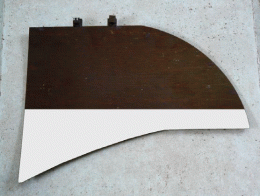
A prototype of an aerodynamic flap made of the new smart material. The smart material consists of thin plates containing carbon yarns that can carry a current, which heats and bends the material. Image credit: H. Drobez, et al.

(PhysOrg.com) -- Scientists have developed a new smart material that can bend under the influence of an internal heat source. The material could be used as an aerodynamic flap in cars, in order to stabilize the vehicles at high speeds. Because the entire structure actively bends, the material could have advantages over actuators that need to be externally fixed to a structure.

A team of scientists from CETIM CERMAT and the Laboratoire de Physique et de Mécanique Textiles (LPMT), both in Mulhouse, France, have been working on the active structure for the past few years. In a recent study published in Smart Materials and Structures, they present the material called CBCM (controlled behavior composite material), which can bend when heated.

“The main advantage of the CBCM is that the entire structure is active, compared to classical actuators used in this kind of structures, such as shape memory alloys (SMA) or piezoelectric materials, so there is no problem of junction and connection between the actuator and the structure,” coauthor Gildas L'Hostis of LPMT told PhysOrg.com. “Moreover, the load that can carry the structure is much greater than the one carried by an SMA or piezoelectric material because the performances are not as limited by the rigidity of the composite structure. A third advantage is the simplicity of use - directly on DC current with a variator.”

The CBCM consists of thin laminate plates, inside of which are highly conductive carbon yarns that are connected to a generator and serve as the internal heating source. When the power is turned on, the current circulates in the carbon yarns and the temperature rises in the plates. The increased temperature causes the plates to bend, and the deformation can be controlled by controlling the amount of current.

The researchers experimented with two kinds of plates: “single effect” plates that can bend in one direction, and “double effect” plates that can bend in two directions. In the thin single effect plates, the temperature reached 57°C (135°F) and the structure deflected up to 15 mm. In the double effect plates (which consist of a conductive layer on one side and insulating layer on the other), the temperature reached 70°C (158°F) on the conductive side and 42°C (108°F) on the insulated side, and deflected up to 3.7 mm. While the single effect plates could deflect more, the double effect plates could lift a heavier load.

The scientists also discussed incorporating a control system into the material. By adding temperature and strain sensors to the CBCM, such a system could detect variations in its background and then adapt to the new context.

To demonstrate the new material, the researchers built a prototype of a 4-mm-thick retractable aerodynamic flap that could be used on cars for stabilization at high speeds. Unlike the existing flap, which has three joints and is moved with a jack, the smart material structure could move simply due to its thermomechanical properties.

With its advantages over other actuators and moving components, the CBCM smart material could be useful for a variety of applications. However, more research is needed to overcome some difficulties, which the scientists highlighted in their study. For instance, future research could include testing the rigidity of the plates and minimizing local overheating, possibly with the use of carbon nanotubes.

“The CBCM has already been used to manufacture an active binder for pipes,” said coauthor Karine Buet-Gautier of LPMT. “Today, some other active connectors are under study.”

More information: Drobez, H.; L’Hostis, G.; Buet Gautier, K; Laurent, F.; and Durand, B. “A new active composite.” Smart Materials and Structures 18 (2009) 205020 (7pp).

Copyright 2009 PhysOrg.com.
All rights reserved. This material may not be published, broadcast, rewritten or redistributed in whole or part without the express written permission of PhysOrg.com.


print this article email this article download pdf blog this article bookmark this article     Stumble it Digg this share on Facebook retweet share on Reddit add to delicious
Rate this story - 4 /5 (9 votes)

Rank Filter

Move the slider to adjust rank threshold, so that you can hide some of the comments.


Display comments: newest first

  • QubitTamer - Feb 06, 2009
    • Rank: not rated yet
    Erm... Cars? Is this the best vision that the writer of this piece could come up with? Why not interview the researchers as to the possibilities of this being used in fixed wing airplanes where the dream of computer controlled deformable wings and other surfaces has been long held but unrealized?

    The advances in safety, fuel savings, and performance for such technology in airplane wings is staggering so i hope someone is going for the big picture and not just cars...
  • moj85 - Feb 06, 2009
    • Rank: not rated yet
    the problem, im assuming, is the number of times this bending can be repeated. perhaps it only works 1000 times, or 10000 times, before it succumbs to stress. Anyone read the whole article?
  • NeilFarbstein - Feb 06, 2009
    • Rank: not rated yet
    this will waste a lot of energy
  • tpb - Feb 06, 2009
    • Rank: not rated yet
    The faster the car goes, the more heat the moving air will remove from the aerodynamic flap, and this means more power.
  • h0dges - Feb 07, 2009
    • Rank: not rated yet
    moj85 you mean fatigue?

    To be honest, liquid crystal elastomers can do the same thing but I believe on a smaller scale with smaller voltages.
  • DonR - Feb 11, 2009
    • Rank: not rated yet
    One word comes to mind, let's see how many people pick up the reference; "Compliance!".

February 6, 2009 all stories

Comments: 6

4 /5 (9 votes)
  • Stumble this up

  • Digg this

  • share this

  • hide
  • Related Stories

  • New Sumatra quake takes seismologists by surprise
    created Oct 01, 2009 | popularity not rated yet | comments 0
  • Lab-on-a-Chip Performs 1,000 Chemical Reactions At Once
    created Sep 27, 2009 | popularity not rated yet | comments 0
  • Smart memory foam made smarter
    created Sep 24, 2009 | popularity not rated yet | comments 0
  • New accounting rules mean boost to Apple, others (Update)
    created Sep 23, 2009 | popularity not rated yet | comments 0
  • States send mixed message on texting and driving
    created Sep 18, 2009 | popularity not rated yet | comments 0


  • hide
  • Relevant PhysicsForums posts

Other News

Solving big problems

Solving big problems with new quantum algorithm

Physics / Quantum Physics

created 6 hours ago | popularity 4.4 / 5 (11) | comments 0

(PhysOrg.com) -- In a recently published paper, Aram Harrow at the University of Bristol and colleagues from MIT in the United States have discovered a quantum algorithm that solves large problems much faster ...


The LHC tunnel

Peckish bird briefly downs big atom smasher

Physics / General Physics

created 18 hours ago | popularity 3.8 / 5 (9) | comments 11

A peckish bird briefly knocked out part of the world's biggest atom smasher by causing a chain reaction with a piece of bread, the European Organisation for Nuclear Research (CERN) said Monday.


First Bose-Einstein condensation of strontium

First Bose-Einstein condensation of strontium

Physics / Quantum Physics

created 11 hours ago | popularity 5 / 5 (4) | comments 1

In an international first, scientists from the Institute of Quantum Optics and Quantum Information (IQOQI, Austria) produced a Bose-Einstein condensate of the alkaline-earth element strontium, thus narrowly ...


Contracts Awarded for Production of NSLS-II Storage Ring Magnets

Physics / General Physics

created 4 hours ago | popularity not rated yet | comments 0

(PhysOrg.com) -- All seven contracts for the production of the NSLS-II storage ring magnets have now been awarded -- a significant milestone for the project. The magnets -- 750 in total -- will be made by vendors in the United ...


Ginzburg helped develop the Soviet Union's hydrogen bomb in the late 1940s and early 1950s

Russian bomb physicist Ginzburg dead at 93

Physics / General Physics

created 20 hours ago | popularity 5 / 5 (4) | comments 0

Nobel Physics prize winner Vitaly Ginzburg, who helped develop the Soviet hydrogen bomb, has died at age 93, the Russian Academy of Sciences said Monday.