New Environmental Satellite Successfully Launched
February 6, 2009 by Cynthia M. O’Carroll Weather satellite blasts off from SoCal coast (AP)

Enlarge

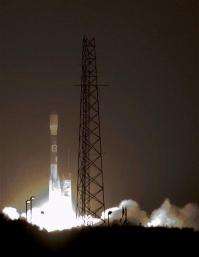
In this image provided by the US Air Force a Delta II rocket launches Feb. 6, 2009 from Space Launch Complex-2 at Vandenberg Air Force Base in Calif. The rocket carried a NOAA-N Prime polar-orbiting weather satellite for NASA and the National Oceanic and Atmospheric Administration. This was Vandenberg’s first launch of 2009. (AP Photo/U.S. Air Force - Andrew Lee)

(PhysOrg.com) -- A new environmental satellite that will improve weather forecasting and monitor environmental events around the world soared into space this morning after a picture-perfect launch from Vandenberg Air Force Base, Calif. The National Oceanic and Atmospheric Administration NOAA-N Prime spacecraft lifted off at 2:22 a.m. PST aboard a United Launch Alliance Delta II rocket from NASA's Space Launch Complex 2. Approximately 65 minutes later, the spacecraft separated from the Delta II SLV.

Shortly after liftoff, flight controllers tracked the launch vehicle’s progress using real-time telemetry data relayed through NASA’s Tracking and Date Relay Satellite System. NOAA-N Prime was in a power positive mode with its solar array deployed approximately five minutes after spacecraft separation. NOAA-N Prime was renamed NOAA-19 after achieving orbit.

"NOAA-19 is in a nominal orbit with all spacecraft systems functioning properly," stated Wayne McIntyre, the NASA POES Project Manager. "The NASA/NOAA partnership continues to produce enormous results with environmental missions, now exceeding more than three decades."

NOAA-19 is the fifth in a series of five Polar-orbiting Operational Environmental Satellites (POES) with advanced microwave sounding instruments that provide imaging and sounding capabilities. As it orbits the Earth, NOAA-N Prime will collect data about the Earth’s surface and atmosphere that are vital inputs to NOAA’s weather forecasts.

NOAA-N Prime has instruments that support the Search and Rescue Satellite-Aided Tracking System (SARSAT), part of the international satellite system that includes the Russian provided satellites (COSPAS). Since SARSAT was established in 1982, NOAA polar-orbiting satellites have been detecting emergency distress beacons set by aviators, mariners and individuals in remote locations and relaying them to ground stations so that rescue teams may be dispatched. More than 24,500 lives have been saved through the satellite based Search and Rescue system to date.

NOAA-N Prime will replace NOAA-18 in a 2:00 p.m. local solar time orbit as the primary afternoon spacecraft. NOAA-N Prime will carry the same primary instruments as NOAA-18 plus an Advanced Data Collection System and an improved Search and Rescue Processor provided by France.

NOAA-N Prime is the sixteenth and last satellite in a series of polar-orbiting satellites dating back to 1978. A new generation of environmental satellites called the National Polar Operational Environmental Satellite System (NPOESS) will become operational after the POES satellites complete their mission. NPOESS is a tri-agency (NOAA, U.S. Department of Defense, NASA) program. NPOESS will provide more capable sensors for improved data collection and better weather forecasts beginning in 2013.

NOAA manages the polar-orbiting operational environmental satellite program and establishes requirements, provides all funding and distributes environmental satellite data for the United States. NASA's Goddard Space Flight Center in Greenbelt, Md., procures and manages the development and launch of the satellites for NOAA on a cost reimbursable basis.

NOAA-N Prime integration with the Delta II, countdown and launch management is the responsibility of the NASA Launch Services Program headquartered at the Kennedy Space Center.

Twenty-one days after it is launched, NASA will transfer operational control of NOAA-19 to NOAA. NASA's comprehensive on-orbit verification period is expected to last approximately 45 days after launch.

Provided by Goddard Space Flight Center


print this article email this article download pdf blog this article bookmark this article     Stumble it Digg this share on Facebook retweet share on Reddit add to delicious
Rate this story - 4 /5 (4 votes)


February 6, 2009 all stories

Comments: 0

4 /5 (4 votes)
  • Stumble this up

  • Digg this

  • share this

  • hide
  • Related Stories

  • SMOS forms three-pointed star in the sky (w/ Video)
    created Nov 03, 2009 | popularity not rated yet | comments 0
  • NRL sensor provides critical space weather observations
    created Nov 03, 2009 | popularity not rated yet | comments 0
  • STAR TRAK for November: Mars is prominent again
    created Nov 02, 2009 | popularity not rated yet | comments 0
  • SMOS, Proba-2: Two new ESA satellites successfully lofted into orbit (w/ Video)
    created Nov 02, 2009 | popularity not rated yet | comments 0
  • New Celestial Map Gives Directions for GPS
    created Oct 29, 2009 | popularity not rated yet | comments 0


  • hide
  • Relevant PhysicsForums posts

  • The shape of our solar system's orbits.
    created 14 hours ago
  • Above or Below the Line of Nodes
    created 18 hours ago
  • Supernova vs. Nova?
    created Nov 07, 2009
  • Supernova's Gamma Rays and Comets
    created Nov 06, 2009
  • More from Physics Forums - General Astronomy

Other News

Success in 'space elevator' competition (AP)

Success in 'space elevator' competition (Update 3)

Space & Earth / Space Exploration

created Nov 05, 2009 | popularity 4.3 / 5 (33) | comments 50

(AP) -- A robot powered by a ground-based laser beam climbed a long cable dangling from a helicopter on Wednesday to qualify for prize money in a $2 million competition to test the potential reality of the ...


'Dropouts' pinpoint earliest galaxies

'Dropouts' pinpoint earliest galaxies

Space & Earth / Astronomy

created Nov 06, 2009 | popularity 4.1 / 5 (9) | comments 12

Astronomers, conducting the broadest survey to date of galaxies from about 800 million years after the Big Bang, have found 22 early galaxies and confirmed the age of one by its characteristic hydrogen signature ...


Space hotel taking bookings for 2012 opening

Space hotel taking bookings for 2012 opening

Space & Earth / Space Exploration

created Nov 05, 2009 | popularity 4.4 / 5 (20) | comments 11

(PhysOrg.com) -- The first orbiting space hotel is on track to open for its first customers in 2012, but hurry, as bookings are filling fast.


In a Galaxy Far, Far Away...

In a Galaxy Far, Far Away...

Space & Earth / Astronomy

created Nov 06, 2009 | popularity 4.8 / 5 (4) | comments 11

(PhysOrg.com) -- Astronomers have published the discovery of the farthest known object in the cosmos: a star that exploded when the universe was only 630 million years old -- only 4.6% of its current age. ...


This undated file picture shows part of the Pastoruri snowcapped mountain in the central Peruvian Andes

'Whitewash' could slow global warming: Peruvian scientist

Space & Earth / Earth Sciences

created Nov 04, 2009 | popularity 1.4 / 5 (9) | comments 11

A Peruvian scientist has called on his country to help slow the melting of Andean glaciers by daubing white paint on the rock and earth left behind by receding ice so they will absorb less heat.