Nine institutions officially sign agreement for 25-meter Giant Magellan Telescope
February 6, 2009
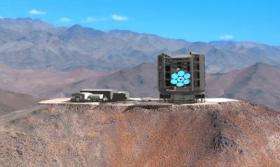
Artist's Rendition of GMT Site

Enlarge

This artist's rendering shows the Giant Magellan Telescope and support facilities at Las Campanas Observatory, Chile, high in the Andes Mountains. Credit: Todd Mason/Mason Productions

The Giant Magellan Telescope (GMT) Corporation is pleased to announce that nine astronomical research organizations from three continents have signed the Founders' Agreement to construct and operate the 25-meter Giant Magellan Telescope at Las Campanas Observatory in the Andes Mountains of Chile. In the United States the participating institutions are the Carnegie Institution for Science, Harvard University, the Smithsonian Institution, Texas A& M University, the University of Arizona, and the University of Texas at Austin. The two Australian members of the Founders group are the Australian National University and Astronomy Australia Limited. Most recently, the South Korean government has approved participation in the GMT project, with the Korean Astronomy and Space Science Institute as the representative of the Korean astronomical community.

GMT Corporation Board Chairperson and Carnegie Observatories Director, Wendy Freedman noted that "the Founders' Agreement establishes the framework for the construction and operation of the telescope. The Founders group represents an extraordinary team of institutions each of which has made important contributions to the development of the most advanced telescopes and instrumentation over the last 100 years. The GMT continues this remarkable legacy."

Added Charles Alcock, Director of the Center for Astrophysics representing Harvard University and the Smithsonian Institution, "We are very pleased to be joining this project, which will allow us to remain at the forefront of astronomical discovery in the 21st century."

With its seven co-mounted 8.4-meter primary segments and adaptive secondary system, the GMT will provide unique capabilities in optical and infrared astronomy. It will open new windows onto the Universe and help answer questions that cannot be answered with existing facilities. The GMT will teach us about the nature of dark matter and dark energy, the origin of the first stars and first galaxies, the mysteries of star and planet formation, galaxy evolution, and black hole growth. The GMT will also play a key role in the detection and imaging of planets around nearby stars.

Scheduled for completion around 2019, the GMT will have the resolving power of a single 24.5-meter (80-foot) primary mirror. Each of the primary mirror segments weighs 20 tons, and the telescope enclosure has a height of about 200 feet. The project is aiming to complete the detailed design for this telescope over the next two years. Fundraising for the project is ongoing. A total of $130 million out of approximately $700 million needed has been raised to date. Construction will begin in 2012.

The signing of the Founders Agreement accompanies two other project milestones. The first of GMT's six "off-axis" honeycomb mirrors, cast in 2005, has just been generated to its almost-final surface at the University of Arizona Mirror Lab, and polishing and testing will be completed in early 2010. "Completion of this off-axis mirror retires one of the largest technical challenges of the project," said Mirror Lab Director, Roger Angel. The GMT Project has also recently reached another milestone in choosing to build the GMT at Las Campanas Observatory, overlooking the Atacama Desert in the Chilean Andes. Las Campanas is owned and operated by the Carnegie Institution. "In both the mirror technology and the site, the GMT project is building on the superb heritage demonstrated by the two very successful 6.5-meter Magellan telescopes that have been in operation at Las Campanas since 2000," according to Matt Johns, GMT Project Manager.

"The science opportunities for this telescope are extraordinary," observes astronomer and GMT Acting Director Patrick McCarthy. "It will shed light not only upon the nature of the Universe but also on the fundamental laws of physics that govern its evolution. As such, it seems especially fitting that this international Founders' Agreement should have been signed in the International Year of Astronomy and the 400th anniversary of the first astronomical use of a telescope by Galileo."

Source: Carnegie Institution

4.9 /5 (7 votes)  

Rank 4.9 /5 (7 votes)
Related Stories
Relevant PhysicsForums posts
  • Is Venus Slowing Down?
    created11 hours ago
  • Never ending outer space.....
    createdFeb 11, 2012
  • Neutron Star fragments?
    createdFeb 11, 2012
  • stationary or not?
    createdFeb 11, 2012
  • Scale of the Universe
    createdFeb 10, 2012
  • Titan's lack of impact craters
    createdFeb 09, 2012
  • More from Physics Forums - General Astronomy

More news stories

Scientists discover reason for Mt. Hood's non-explosive nature

(PhysOrg.com) -- For a half-million years, Mount Hood has towered over the landscape, but unlike some of its cousins in Oregon’s Cascade Mountains and many other volcanoes around the Pacific “Rim ...

Space & Earth / Earth Sciences

created 41 minutes ago | popularity 5 / 5 (1) | comments 0 | with audio podcast

Time of year important in projections of climate change effects on ecosystems

(PhysOrg.com) -- Does it matter whether long periods of hot weather, such as last year's heat wave that gripped the U.S. Midwest, happen in June or July, August or September?

Space & Earth / Environment

created 13 minutes ago | popularity 5 / 5 (1) | comments 0 | with audio podcast

Missing dark matter located: Intergalactic space is filled with dark matter

Researchers at the University of Tokyo’s Institute for the Physics and Mathematics of the Universe (IPMU) and Nagoya University used large-scale computer simulations and recent observational data of gravitational ...

Space & Earth / Astronomy

created 1 hour ago | popularity 4 / 5 (4) | comments 3 | with audio podcast

Planck mission steps closer to the cosmic blueprint

(PhysOrg.com) -- ESA's Planck mission has revealed that our Galaxy contains previously undiscovered islands of cold gas and a mysterious haze of microwaves. These results give scientists new treasure to mine ...

Space & Earth / Astronomy

created 9 hours ago | popularity 5 / 5 (8) | comments 2 | with audio podcast

Scientists say Obama Mars cuts to hit research (Update)

The United States will scale back Mars exploration under a proposed budget by President Barack Obama released Monday that has some scientists fuming over the risk of a NASA brain-drain.

Space & Earth / Space Exploration

created 7 hours ago | popularity 5 / 5 (3) | comments 23


First-of-its-kind stem cell study re-grows healthy heart muscle in heart attack patients

Results from a Cedars-Sinai Heart Institute clinical trial show that treating heart attack patients with an infusion of their own heart-derived cells helps damaged hearts re-grow healthy muscle.

Discovery paves way for salmonella vaccine

(Medical Xpress) -- An international research team led by a University of California, Davis, immunologist has taken an important step toward an effective vaccine against salmonella, a group of increasingly antibiotic-resistant ...

Smoking bans lead to less, not more, smoking at home: study

Smoking bans in public/workplaces don't drive smokers to light up more at home, suggests a study of four European countries with smoke free legislation, published online in Tobacco Control.

Ovarian cancer arises in fallopian tube of knockout mice

(Medical Xpress) -- The most deadly form of "ovarian" cancer arises in the fallopian tubes – not the ovaries – of knockout mice that lack two genes associated with the disease, said researchers led by Baylor College ...

UK cases of progressive sight loss condition set to rise a third by 2020

New cases of the progressive sight loss condition, known as age-related macular degeneration, or AMD for short, are set to rise by a third in the UK over the next decade, reveals research published online in the British Jo ...

Medical school link to wide variations in pass rate for specialist exam

Wide variations in doctors' pass rates, for a professional exam that is essential for one type of specialty training, seem to be linked to the particular medical school where the student graduated, indicates research published ...