Satellites Capture Sea Surface Heights Around the World
February 6, 2009 by Rob Gutro Satellites Capture Sea Surface Heights Around the World

Enlarge

Credit: NASA JPL

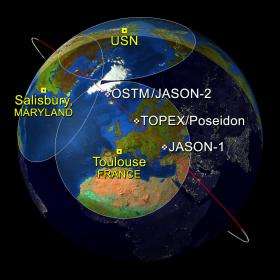
(PhysOrg.com) -- This artist's rendering shows a "family portrait" of Jason-1, Topex/Poseidon, and OSTM/Jason-2, all NASA satellites that collect data about sea surface heights around the world. Sea surface heights are one component helpful to hurricane forecasters, as higher seas indicate warmer waters (that power storms) while lower seas indicate cooler waters (such as those in La Nina events in the eastern Pacific).

This image shows the position of all three satellites on January 28, 2009, as they descended to the southeast, passing over NASA's ground station just outside of Toulouse, France.

Glenn M. Shirtliffe, Jason-1 Project Manager at NASA's Jet Propulsion Laboratory, Pasadena, Calif., where the satellites are managed, said, "As a result of the maneuvers performed on January 26 and 27, Jason-1 has now drifted well ahead of OSTM/Jason-2 and Topex/Poseidon, on its way to a new operational orbit on the other side of Earth, 162 degrees ahead of OSTM/Jason-2."

The steamy and warm surface waters of the late-summer tropical oceans are the fuel that powers tropical cyclones. NASA's fleet of altimetry missions have often flown over these great storms, charting sea surface height (a measure of the subsurface thermal structure, or heat content). Warmer features like ocean eddies can cause these storms to intensify. Since the altimeters also measure the waves generated by these monster storms, as well as wind speeds, these measurements are routinely used in near-real-time wave and weather forecasts.

Jason-1 completed its seventh year on orbit on December 7, 2008. From its vantage point 1,330 kilometers (860 miles) above Earth, this follow-on to the highly successful Topex/Poseidon mission has provided measurements of the surface height of the world's ocean to an accuracy of 3.3 centimeters (1.3 inches).
Satellites Capture Sea Surface Heights Around the World
Enlarge

Credit: NASA JPL

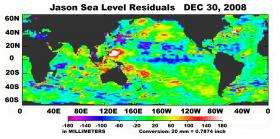
This image from Jason-1 data shows sea surface height data around the world as of December 30, 2008. The purple and blue areas depict sea level heights (in millimeters "mm") lower than normal. One area is in the central Pacific Ocean, which indicates a La Nina event. The red areas indicate higher than normal sea surface heights.

The Ocean Surface Topography Mission on the Jason-2 satellite (OSTM/Jason-2) is a follow-on to the Jason-1 mission. It launched June 20, 2008, from Vandenberg Air Force Base in California.

"Topex/Poseidon was launched in August 1992 and during its first few days, flew over the monster Category 5 Hurricane Andrew, measuring wind and waves," said Bill Patzert, a JPL climatologist. "Our altimetry fleet was launched during a hurricane and has been chasing cyclones for more than 15 years."

Topex/Poseidon is a joint venture between CNES and NASA to map ocean surface topography. Among its many achievements, Topex/Poseidon has measured sea levels with unprecedented accuracy to better than 5 centimeters (X inches), mapped year-to-year changes in heat stored in the upper ocean, and produced the most accurate global maps of tides ever.

For more information about NASA's Ocean Surface Topography from Space:
http://topex-www.jpl.nasa.gov/mission/jason-1.html

Provided by Goddard Space Flight Center


print this article email this article download pdf blog this article bookmark this article     Stumble it Digg this share on Facebook retweet share on Reddit add to delicious
Rate this story - 3.3 /5 (9 votes)


February 6, 2009 all stories

Comments: 0

3.3 /5 (9 votes)
  • Stumble this up

  • Digg this

  • share this

  • hide
  • Related Stories

  • NASA's Aqua satellite sees Nida explode into a category 5 Super typhoon
    created Nov 25, 2009 | popularity not rated yet | comments 0
  • Ships warned about icebergs headed for New Zealand
    created Nov 25, 2009 | popularity not rated yet | comments 0
  • Dead Sea needs world help to stay alive
    created Nov 24, 2009 | popularity not rated yet | comments 0
  • Oceans absorbing carbon dioxide more slowly, scientist finds
    created Nov 24, 2009 | popularity not rated yet | comments 0
  • From Greenhouse to Icehouse
    created Nov 24, 2009 | popularity not rated yet | comments 0


  • hide
  • Relevant PhysicsForums posts

  • The IPCC and the term "most"
    created Nov 23, 2009
  • Is global warming a fact?
    created Nov 23, 2009
  • Random variability of wind patterns
    created Nov 23, 2009
  • Record precipitation in the UK
    created Nov 22, 2009
  • More from Physics Forums - Earth

Other News

Past regional cold and warm periods linked to natural climate drivers

Space & Earth / Earth Sciences

created 14 hours ago | popularity 3.8 / 5 (11) | comments 16

Intervals of regional warmth and cold in the past are linked to the El Niņo phenomenon and the so-called "North Atlantic Oscillation" in the Northern hemisphere's jet stream, according to a team of climate scientists. These ...


Russia: no space for space tourists (AP)

Russia: no space for space tourists

Space & Earth / Space Exploration

created 22 hours ago | popularity 2.7 / 5 (3) | comments 2

(AP) -- A top Russian space official says there is no space for tourists wishing to fly to the International Space Station.


Astronauts surprised by holiday turkey dinners (AP)

Astronauts surprised by holiday turkey dinners

Space & Earth / Space Exploration

created 17 hours ago | popularity 5 / 5 (1) | comments 0

(AP) -- Space shuttle Atlantis' astronauts thought they were going to give thanks with pantry leftovers Thursday as their mission drew to a close, but found turkey dinners awaiting them.


Gullies and Flow Features on Crater Wall

Gullies and Flow Features on Crater Wall

Space & Earth / Space Exploration

created 18 hours ago | popularity 5 / 5 (1) | comments 0

(PhysOrg.com) -- This image from the High Resolution Imaging Science Experiment (HiRISE) camera on NASA's Mars Reconnaissance Orbiter shows a sample of the variety and complexity of processes that may occur ...


Thanksgiving last full day in space for shuttle (AP)

Thanksgiving last full day in space for shuttle

Space & Earth / Space Exploration

created 21 hours ago | popularity not rated yet | comments 0

(AP) -- Space shuttle Atlantis' astronauts will spend Thanksgiving checking their ship for the ride home.