Microbe Survives in Ocean's Deepest Realm, Thanks to Genetic Adaptations
February 6, 2009 The Pompeii worm

Enlarge

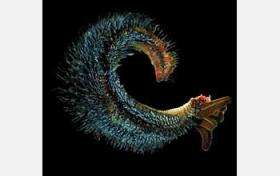
The Pompeii worm, the most heat-tolerant animal on Earth, lives in the deep ocean at super-heated hydrothermal vents. Covering this deep-sea worm's back is a fleece of bacteria. These microbes contain all the genes necessary for life in extreme environments. Credit: University of Delaware

(PhysOrg.com) -- The genome of a marine bacterium living 2,500 meters below the ocean's surface is providing clues to how life adapts in extreme environments, according to a paper published Feb. 6, 2009, in the journal PLoS Genetics.

The research focused on the bacterium Nautilia profundicola, a microbe that survives near deep-sea hydrothermal vents. It was found in a fleece-like lining on the backs of Pompeii worms, a type of tubeworm that lives at hydrothermal vents, and in bacterial mats on the surfaces of the vents' chimney structures.

One gene, called rgy, allows the bacterium to manufacture a protein called reverse gyrase when it encounters extremely hot fluids from the Earth's interior released from the sea floor.

"The discovery of reverse gyrase in Nautilia profundicola suggests that it plays a key role in this microbe's ability to thrive near deep-sea hydrothermal vents, where conditions are thought to resemble those found on early Earth," said Matt Kane, program director in the National Science Foundation (NSF)'s Division of Environmental Biology, which funded the research. "Knowledge of microbes living near vents may aid our understanding of how life evolved."

The study involved scientists at the University of Delaware, the University of California, the Universities of Louisville, Ky., and Waikato, New Zealand, and the J. Craig Venter Institute.

They combined genome analysis with physiological and ecological observations to investigate the importance of one gene, rgy, in N. profundicola's ability to adapt to the extreme changes it's exposed to in the deep sea.

"Previous studies found the gene only in microorganisms growing in temperatures greater than 80 degrees Celsius, but Nautilia profundicola thrives best at much lower temperatures," said Barbara Campbell, a marine scientist at the University of Delaware.

"The gene's presence in Nautilia profundicola suggests that it might play a role in the bacterium's ability to survive rapid and frequent temperature fluctuations in its environment."

Photosynthesis doesn't occur in this dark environment, where hot, toxic fluids oozing from below the seafloor combine with cold seawater at very high pressures.

Microorganisms that thrive at hydrothermal vents must adapt to fluctuations in temperature and oxygen levels, ranging from the hot, sulfide- and heavy metal-laden plume at the vents' outlets to cold seawater in the surrounding region.

The researchers uncovered further adaptations to the vent environment in Nautilia profundicola, including genes necessary for growth and for sensing environmental conditions. They also proposed a new route for bacterial nitrate assimilation related to how other bacteria use ammonia as an energy source.

Nautilia profundicola contains all the genes necessary for life in conditions widely believed to mimic those in our planet's early biosphere.

"It will be an important model system," said Campbell, "for understanding early microbial life on Earth."

Provided by NSF


print this article email this article download pdf blog this article bookmark this article     Stumble it Digg this share on Facebook retweet share on Reddit add to delicious
Rate this story - 4.8 /5 (4 votes)


February 6, 2009 all stories

Comments: 0

4.8 /5 (4 votes)
  • Stumble this up

  • Digg this

  • share this

  • hide
  • Related Stories

  • Climate variability impacts the deep sea
    created Nov 02, 2009 | popularity not rated yet | comments 0
  • Autosub6000 dives to depth of 3.5 miles
    created Oct 28, 2009 | popularity not rated yet | comments 0
  • Oases for Life on the Mid-Caymen Rise
    created Oct 21, 2009 | popularity not rated yet | comments 0
  • Searching for Alien Life, on Earth
    created Oct 05, 2009 | popularity not rated yet | comments 0
  • Seeking Life's Shadow
    created Oct 01, 2009 | popularity not rated yet | comments 0


Other News

Scientists successfully reprogram blood cells

Biology / Cell & Microbiology

created 7 hours ago | popularity 5 / 5 (2) | comments 0

Researchers have transplanted genetically modified hematopoietic stem cells into mice so that their developing red blood cells produce a critical lysosomal enzyme -preventing or reducing organ and central nervous system damage ...


Study shows that some malignant tumors can be shut down after all

Biology / Cell & Microbiology

created 10 hours ago | popularity 5 / 5 (3) | comments 1

Oncologists have had their hands tied because more than half of all human cancers have mutations that disable a protein called p53. As a critical anti-cancer watchdog, p53 masterminds several cancer-fighting operations within ...


Iowa State University researcher discovers key to vital DNA, protein interaction

Researchers discover key to vital DNA, protein interaction

Biology / Other

created 2 hours ago | popularity not rated yet | comments 0

(PhysOrg.com) -- A researcher at Iowa State University has discovered how a group of proteins from plant pathogenic bacteria interact with DNA in the plant cell, opening up the possibility for what the scientist ...


New discovery allows scientists for the first time to experimentally annotate genomes

New discovery allows scientists for the first time to experimentally annotate genomes

Biology / Biotechnology

created 5 hours ago | popularity 5 / 5 (3) | comments 0

Over the last 20 years, the sequencing of the human genome, along with related organisms, has represented one of the largest scientific endeavors in the history of mankind. The information collected from genome ...


Wasp

Well-traveled wasps provide hope for vanishing species

Biology / Plants & Animals

created 6 hours ago | popularity not rated yet | comments 0

They may only be 1.5mm in size, but the tiny wasps that pollinate fig trees can travel over 160km in less than 48 hours, according to research from scientists at the University of Leeds. The fig wasps are transporting ...