Scientists deconstruct cell division
February 8, 2009
Scientists deconstruct cell division

Enlarge

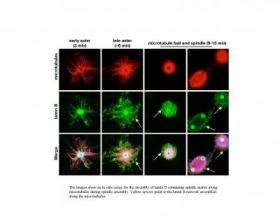
This image shows an in vitro assay for the assembly of lamin B containing spindle matrix along microtubules during spindle assembly. Yellow arrows point to the lamin B network assembled along the microtubules. Credit: Image courtesy Yixian Zheng

The last step of the cell cycle is the brief but spectacularly dynamic and complicated mitosis phase, which leads to the duplication of one mother cell into two daughter cells. In mitosis, the chromosomes condense and the nucleus breaks down.

Fibrous structures called spindles form, which then move the chromosomal material toward opposite ends of a cell and help partition other cell contents. If something goes wrong, diseases such as cancer can arise. Scientists have tried for years to unravel the process of spindle assembly. Now, researchers at Carnegie's Department of Embryology have found that two proteins— dynein and Nudel—involved in other cell-division functions, are essential to regulate assembly of the spindle matrix.

"The mechanisms that cells use during division to partition both chromosomes and regulatory factors into their daughters are widely recognized as among the most fundamental processes in all of biology. During the last several years no one has done more than Yixian Zheng to broaden our understanding of how dividing cells control these critical events," said Allan Spradling, Department of Embryology director.

"To ensure proper cell division, the mother cell needs to separate its genetic materials, the chromosomes, equally, but also partition its cellular content properly into daughter cells," explained co-author Yixan Zheng. "Cell division allows a fertilized egg to develop into multicellular organisms with different types of cells. It also replenishes adult tissues, such as skin and bones. Forming a spindle requires the assembly of a 'skeleton' from tube-like microtubules and the construction of a poorly defined scaffold called a spindle matrix."

In 2006, Zheng and colleagues discovered that a protein found in the nucleus during the interphase of the cell division cycle, called lamin-B, is a structural component of the spindle matrix (Science 31 March 2006, 311: 1887-1893). Based on this finding, she and colleagues have now isolated the spindle matrix. Interestingly, both dynein and Nudel are components of the spindle matrix. Nudel binds to lamin-B and brings it to microtubules where both Nudel and dynein then help the lamin-B assemble into the spindle matrix. The lamin-B-containing spindle matrix, in turn, works with microtubules to orchestrate spindle assembly and cell division.

"Isolating the spindle matrix and identifying its components has also allowed us to show that the matrix contains not only factors important for spindle assembly, but also proteins essential for cell fate choices," remarked Zheng. "We believe that by understanding how the spindle matrix is assembled in mitosis, it will be possible to understand how, after mitosis, two daughters can chose to become the same or different cell types—a decision that cells need to make both during the development of an organism and during the maintenance of adult tissues."

The research is published on line in the February 8 Nature Cell Biology (http://www.nature.com/ncb/).

Source: Carnegie Institution


Rank 5 /5 (1 vote)
Relevant PhysicsForums posts

More news stories

A mitosis mystery solved: How chromosomes align perfectly in a dividing cell

Although the process of mitotic cell division has been studied intensely for more than 50 years, Whitehead Institute researchers have only now solved the mystery of how cells correctly align their chromosomes during symmetric ...

Biology / Cell & Microbiology

created 2 hours ago | popularity 5 / 5 (3) | comments 0 | with audio podcast

The proteins ensuring genome protection

Researchers from the University of Geneva (UNIGE), Switzerland, have discovered the crucial role of two proteins in developing a cell 'anti-enzyme shield'. This protection system, which operates at the level of molecular ...

Biology / Cell & Microbiology

created 2 hours ago | popularity 5 / 5 (2) | comments 0 | with audio podcast

Researchers find extensive RNA editing in human transcriptome

In a new study published online in Nature Biotechnology, researchers from BGI, the world's largest genomics organization, reported the evidence of extensive RNA editing in a human cell line by analysis of RNA-seq data, demons ...

Biology / Biotechnology

created 2 hours ago | popularity 5 / 5 (3) | comments 0 | with audio podcast

Entire genome of extinct human decoded from fossil

(PhysOrg.com) -- In 2010, Svante Pääbo and his colleagues presented a draft version of the genome from a small fragment of a human finger bone discovered in Denisova Cave in southern Siberia. The ...

Biology / Biotechnology

created Feb 07, 2012 | popularity 4.7 / 5 (58) | comments 48 | with audio podcast

Why are there so few fish in the Earth's oceans?

(PhysOrg.com) -- A Stony Brook University researcher has found that, contrary to popular belief, there are not plenty of fish in the sea.

Biology / Plants & Animals

created Feb 08, 2012 | popularity 4.3 / 5 (17) | comments 27 | with audio podcast


Scientists discover molecular secrets of 2,000-year-old Chinese herbal remedy

For roughly two thousand years, Chinese herbalists have treated Malaria using a root extract, commonly known as Chang Shan, from a type of hydrangea that grows in Tibet and Nepal. More recent studies suggest that halofuginone, ...

New method to examine batteries -- MRI from the inside

There is an ever-increasing need for advanced batteries for portable electronics, such as phones, cameras, and music players, but also to power electric vehicles and to facilitate the distribution and storage of energy derived ...

Google might launch Drive for cloud storage soon

(PhysOrg.com) -- Google's next big move, according to the Wall Street Journal, is a cloud storage service called Drive. Hardly first to the plate, Google is simply catching up to introducing its cloud reposi ...

Lab study raises questions over nano-particle impact

Tests involving chickens have raised questions about the impact on health from engineered nano-particles, the ultra-fine grains commonly used in drugs and processed foods, scientists said on Sunday.

Starve a virus, feed a cure? Findings show how some cells protect themselves against HIV

A protein that protects some of our immune cells from the most common and virulent form of HIV works by starving the virus of the molecular building blocks that it needs to replicate, according to research published online ...

Injured boomers beware: Know when to see doctor

(AP) -- It happened to nurse Jane Byron years after an in-line skating fall, business owner Haralee Weintraub while doing "men's" push-ups, and avid cyclist Gene Wilberg while lifting a heavy box.