A Zen discovery: Unrusted iron in ocean
February 8, 2009 A Zen discovery: Unrusted iron in ocean

Enlarge

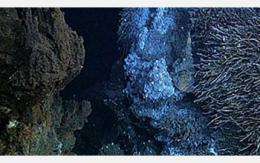
Iron spewed from hydrothermal vents and carried away by seawater does not rust. Credit: Nicolle Rager-Fuller, National Science Foundation

Iron dust, the gold of the oceans and rarest nutrient for most marine life, can be washed down by rivers or blown out to sea or - a surprising new study finds - float up from the sea floor. The discovery, published online Feb. 8 in Nature Geoscience, connects life at the surface to events occurring at extreme depths and pressures.

The two worlds were long assumed to have little interaction.

A team from the University of Southern California, Woods Hole Oceanographic Institution and Lawrence Berkeley National Laboratory took samples from the East Pacific Rise, a volcanic mid-ocean ridge.

The group found that organic compounds capture some iron spewed by hydrothermal vents, enabling it to be carried away in seawater.

Iron trapped in this way does not rust.

For the scientists, discovering shiny iron in the ocean was like fishing a dry sponge out of a bath.

"Everything we know about the chemical properties of iron tells us that it should be oxidized. It should be rusted," said team leader Katrina Edwards of USC.

The metal's purity has practical value. Aquatic organisms metabolize pure iron much more easily than its rusted form, Edwards said.

How much captured iron floats into surface waters remains unknown. But any that does would nourish ocean life more efficiently than the oxidized iron from regular sources.

"This is one potential mechanism of creating essentially a natural iron fertilization mechanism that's completely unknown," Edwards said.

Some marine scientists have called for iron fertilization because of the metal's crucial place in the aquatic food chain. Iron is the limiting nutrient in most parts of the oceans, meaning that its scarcity is the only thing standing in the way of faster growth.

Iron's equivalent on land is nitrogen. Crop yields rose dramatically during the 20th century in part because of increased nitrogen fertilization.

The expedition team discovered the phenomenon of iron capture serendipitously. Edwards and her collaborators were studying deep-sea bacteria that catalyze the iron rusting reaction.

Of the possible reactions that support microbial communities on rocks, iron oxidation is one of the most important, Edwards explained.

Unfortunately, she added, "it's probably the least well understood major metabolic pathway in the microbial world."

The bacteria involved do not grow well in culture, so the researchers are using a range of molecular techniques to search for genes related to iron oxidation.

One major question involves the importance of bacteria-catalyzed oxidation versus the conventional rusting process. How much of the world's iron is deposited with bacterial help? And how much escapes both bacteria and the natural oxidation process?

The sea floor holds the answer.

The samples were collected continuously using a remote sampling device deployed and retrieved from the research vessel Atlantis between May 16 and June 27, 2006.

Source: University of Southern California


Rate this story - 4.3 /5 (17 votes)

Rank Filter

Move the slider to adjust rank threshold, so that you can hide some of the comments.


Display comments: newest first

  • NeilFarbstein - Feb 08, 2009
    • Rank: 1.8 / 5 (9)
    Hey! Giant OTEC machines could suction up water from the depths of the ocean and spread nutrients to the top layers of the ocean where iron will fertilize the plankton that can absorb carbon dioxide. Dropping depth charges into the deep oceans will stir up iron laden sediments also. My bet; you heard it here first. contact me at protn7@att.net
  • Going - Feb 08, 2009
    • Rank: 1.3 / 5 (8)
    Another argument to use against those who say that fertilization of the oceans with iron is a risky unnatural experiment. We cannot wait for natural process to remove the excessive CO2 we've allowed to accumulate in our atmosphere, even if we stop emitting it tomorrow. We must set up artificial processes to remove the carbon from circulation and iron fertilization of the oceans is emerging as the best way to do this.
  • tkjtkj - Feb 08, 2009
    • Rank: not rated yet
    The article fails to make it clear that the 'Woods Hole Oceanographic Institute' is an entirely separate entity , and part of the study.

  • TJ_alberta - Feb 09, 2009
    • Rank: 5 / 5 (1)
    anyone find the original article. I am quite skeptical about "pure iron". maybe an iron chelate?

    I had thought that iron sulphate breakdown by bacteria had been studied for decades. iron oxidation is of immense economic significance. If bacteria play an important part is is difficult to imagine how or why it has not been studied to date.
  • KBK - Feb 09, 2009
    • Rank: 1 / 5 (4)
    Alchemy 101.

    If you find such a comment either unfathomable, bizarre, or outside your ability to take seriously, then you are not ready for the subject.

    When you are serious and real then it will be revealed to you, if you put yourself into it.

    It is purposely pitched that way to keep those who do not yet posses the psychology to deal with it - out of it.

    What it requires is a stable psychological condition. Dump the monkey-and you may then possibly reach the answers it has always inherently held.
  • Velanarris - Feb 09, 2009
    • Rank: 4.2 / 5 (5)
    I think you mean chemistry 101, which we're well past in the scope of this article.

    In regard to iron fertilization, most opponents to iron fertilization aren't necessarily against iron itself, but are more against the iron composites being used. Most experiments want to use iron based sulfates and sulfides which lead to acidification reactions.
  • LariAnn - Feb 09, 2009
    • Rank: 4.2 / 5 (5)
    I'm curious; the AGW naysayers position is that it is not possible for humans to have any appreciable effect on the warming of the earth via CO2 emissions or any other means. If this is so, why are the naysayers not jumping in here to point out how silly it is to think that human action could spread enough billions of tons of iron fertilizer around the vast oceans to have any significant impact whatsoever on CO2 in the atmosphere?
  • Roach - Feb 09, 2009
    • Rank: 4 / 5 (4)
    Lari,
    Maybe because the idea of fertilizing the oceans is ludicrous enough not to need naysayers? I don't think you really need to address the CO2 implications of this experiment, the staggering cost of fertilization.

    Let's start with some fun math. Volume of the ocean = 1.35 X10^21 Liters of water. lets say a low level fertilization and aim for 10ppm. Or 10mg/L 1.35 X 10^15 Kilograms, For reference that's 1.35 quadrillion kilograms. Or 1,350 billion metric tons.

    For those of you keeping track, if we divert the total of the Worlds iron production annually direct to the oceans, then we will have increased the iron content of the oceans by 10 parts per million by 3010AD give or take a couple decades, assuming we don%u2019t run out first.. This does not factor in settling and deposition, or the fact that 10ppm is not really enough to make a difference over the next millenia. If AGW is right the 1000 years might be a little bit long on the time scale don'tcha think?

    And to the first tree stump to say we don't need 10ppm, ok, at 100ppb we're still talking about a 10 year project costing the value of the entire world production of iron plus the cost of processing and transportation. For the record 1,350 billion metric tons is going to run in the neighborhood of US$300 Trillion give or take several Trillion, it's hard to be accurate when the rounding error is geting as large as a small countries entire GNP.
  • Velanarris - Feb 09, 2009
    • Rank: 3.7 / 5 (3)
    Good question Lari, great answer from Roach.

    Iron fertilization wouldn't be feasable on a large enough scale to be considered in a CO2 "solution" as Roach has pointed out.

    Realistically iron fertilization is a means by which to revitalize depleted wildlife banks for the commercial fishing and other sea based food industries. Effectively arguing against it is similar to arguing against using fertilizer on corn fields. No one in their right mind would argue against it, but conversely, no one in their right mind would support this as a CO2 fix regardless of whether CO2 needs fixing or not. I doubt the scientists involved are really touting this as an AGW fix beyond it's ability to gain grant money.
  • Velanarris - Feb 09, 2009
    • Rank: 3.7 / 5 (3)
    And Lari, Just as a matter of clarity:

    the AGW naysayers position is that it is not possible for humans to have any appreciable effect on the warming of the earth via CO2 emissions or any other means.
    This statement is incorrect by virtue of adding "by any other means".

    I'm a firm believer that land use has a pronounced effect on climate however, I have no reason to believe that man-made CO2 emmision has any discernable effect on climate beyond natural variation. Many people who are AGW naysayers don't necessarily believe that human action has no effect on the environment, we simply denounce people who try to state that CO2 drives our climate in the manner in which it's been painted.

  • Going - Feb 09, 2009
    • Rank: 3 / 5 (4)
    Roach's assumption that the iron level will have to be raised throughout the entire ocean volume is false. Fertilization would only need to take place in the top meter or so of selected areas where iron content is low. Careful targeting would be needed.
  • Velanarris - Feb 09, 2009
    • Rank: 2.3 / 5 (3)
    Roach's assumption that the iron level will have to be raised throughout the entire ocean volume is false. Fertilization would only need to take place in the top meter or so of selected areas where iron content is low. Careful targeting would be needed.
    So instead you assume we can control the descent of iron in sea water as well as the depths at which the currents circulate and where the iron remains. Who's more off base?
  • Roach - Feb 09, 2009
    • Rank: 3.7 / 5 (3)
    Iron Floats? At a specific gravity of 1.6(ferric sulfate)? That's a neat trick, but Going you are absolutely right, in order to raise the top by the amount that would make a difference we'd probably have to over load the lower portions of the oceans, everything below the top 1 meter by at least double to keep diffusion on our side? Since the majority is below that 1 meter then we can safely say we actually need to dump iron at a rate closer to 1.5 to 2 times the annual global production of iron in order to meet the timeline of 1000 years.
  • Velanarris - Feb 09, 2009
    • Rank: 2.3 / 5 (3)
    Iron Floats? At a specific gravity of 1.6(ferric sulfate)? That's a neat trick, but Going you are absolutely right, in order to raise the top by the amount that would make a difference we'd probably have to over load the lower portions of the oceans, everything below the top 1 meter by at least double to keep diffusion on our side? Since the majority is below that 1 meter then we can safely say we actually need to dump iron at a rate closer to 1.5 to 2 times the annual global production of iron in order to meet the timeline of 1000 years.

    Actually you'd increase the specific gravity of the ocean overall if you did that. This is assuming no iron precipitation. An average aquarist would know that increasing the specific gravity of the water by that much would cause massive die offs at the top and would bring a lot of pressure loving life closer to the surface of the water.
  • Going - Feb 10, 2009
    • Rank: 2.3 / 5 (3)
    Microscopic iron dust particles don't float but their viscosity in water will mean they will stay in the top few meters long enough to have an effect on biology. This already happens naturally with wind blown dust particles, a phenomenon that can be studied to ensure we understand the physical processes involved.
  • Velanarris - Feb 10, 2009
    • Rank: 3 / 5 (2)
    Microscopic iron dust particles don't float but their viscosity in water will mean they will stay in the top few meters long enough to have an effect on biology. This already happens naturally with wind blown dust particles, a phenomenon that can be studied to ensure we understand the physical processes involved.


    Seeing as "dust" is made of organic or silicate based materials which are all lighter than water I don't doubt that they stay in the top few meters and readily dissolve into sea water.

    Iron is not lighter than water and it does not readily dissolve into water. This is not an apples to apples comparison.

February 8, 2009 all stories

Comments: 16

4.3 /5 (17 votes)

  • hide
  • Related Stories

  • Scientists Show How Bacteria Move Electrons Across a Membrane
    created Dec 29, 2009 | popularity not rated yet | comments 0
  • Biologists discover bacterial defense mechanism against aggressive oxygen
    created Nov 20, 2009 | popularity not rated yet | comments 0
  • Nickel isotope may be methane producing microbe biomarker
    created Jun 22, 2009 | popularity not rated yet | comments 0
  • The rise of oxygen caused Earth's earliest ice age
    created May 07, 2009 | popularity not rated yet | comments 0
  • Discovery of tuberculosis bacterium enzyme paves way for new TB drugs
    created Mar 27, 2009 | popularity not rated yet | comments 0


  • hide
  • Relevant PhysicsForums posts

  • Carbon Dioxide emissions question
    created Feb 08, 2010
  • Photosynthesis vs. carbonization
    created Feb 07, 2010
  • Sheep's footprints
    created Feb 05, 2010
  • How did Victorians estimate the ages of fossils?
    created Feb 03, 2010
  • More from Physics Forums - Earth

Other News

Climate 'Tipping Points' May Arrive Without Warning, Says Top Forecaster

Space & Earth / Environment

created 26 minutes ago | popularity not rated yet | comments 0 | with audio podcast

(PhysOrg.com) -- A new University of California, Davis, study by a top ecological forecaster says it is harder than experts thought to predict when sudden shifts in Earth's natural systems will occur -- a worrisome finding ...


URI researcher calls for global effort to monitor marine pollutants

Space & Earth / Environment

created 1hour ago | popularity 5 / 5 (1) | comments 1

A University of Rhode Island researcher who studies chemical pollutants in the marine environment has called on colleagues around the world to establish a global monitoring network to verify that the chemicals banned by the ...


A new 3-D map of the interstellar gas within 300 parsecs from the sun

A new 3D map of the interstellar gas within 300 parsecs from the Sun

Space & Earth / Astronomy

created 3 hours ago | popularity 5 / 5 (3) | comments 0 | with audio podcast

(PhysOrg.com) -- Astronomy & Astrophysics is publishing new 3D maps of the interstellar gas in the local area around our Sun. A French-American team of astronomers presents new absorption measurements toward ...


Rho Ophiuchus cloud

Professor: We have a 'moral obligation' to seed universe with life

Space & Earth / Astronomy

created 11 hours ago | popularity 3.7 / 5 (19) | comments 33 | with audio podcast report

(PhysOrg.com) -- Eventually, the day will come when life on Earth ends. Whether that’s tomorrow or five billion years from now, whether by nuclear war, climate change, or the Sun burning up its fuel, the last ...


New international satellite observations help assess future earthquake risk in Haiti

New international satellite observations help assess future earthquake risk in Haiti

Space & Earth / Earth Sciences

created 3 hours ago | popularity not rated yet | comments 0

Virginia Key, Florida--Scientists at the University of Miami have analyzed images based on Synthetic Aperture Radar (SAR) observations taken before and just after Haiti's earthquake, on January 12. The images ...