Nearly 50 new species of prehistoric creatures discovered in record time
February 9, 2009
Nearly 50 new species of prehistoric creatures discovered in record time

Enlarge

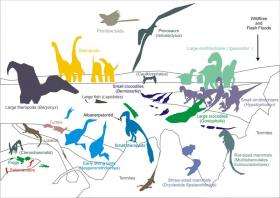
The key to animals depicted in Mark Witton’s paleoart.

In just four years a University of Portsmouth palaeontologist has discovered 48 new species from the age of the dinosaurs - while other scientists took 180 years to identify the same number.

Dr Steve Sweetman’s discoveries, found hidden in mud on the Isle of Wight, are around 130 million years old and shed valuable light on the poorly understood world in which well known dinosaurs roamed.

Steve, a research associate with the School of Earth and Environmental Sciences, has found in ancient river deposits, at least eight new dinosaurs, many different types of lizard, frogs, salamanders, and perhaps rarest of all from the time of the dinosaurs, six tiny mammals, some as small as a shrew.

Palaeontologists have previously relied on conventional surface prospecting to collect fossils exposed naturally by weather and waves. Broken bits and pieces of bone stick out of the ground which often leads to a larger fossil being discovered.

The techniques Steve adopted are far more thorough - he carried some three and a half tonnes of mud along beaches and up cliffs in buckets and backpacks before driving samples back to his farm on the island where he has set up his own laboratory.

He dried and sieved it until buckets of mud became bowls of sand and then examined every single grain under a microscope. It wasn’t long before he was picking out tiny fossil bones and teeth.

Steve said: “It has taken me just four years of hard graft to make my discoveries. Living on the Isle of Wight made this research physically possible. You can get to most places within half an hour, so transporting tonnes of mud wasn’t too much of an obstacle. It would have been near impossible if I had been based on the mainland.

“In the very first sample I found a tiny jaw of an extinct newt-sized, salamander-like amphibian and then new species just kept coming.

“Although we knew a lot about the larger species that existed on the island during the Early Cretaceous no-one had ever filled in the gaps. With these discoveries I can paint a really detailed picture of the creatures that scurried at the feet and in the shadows of the dinosaurs,” he said.

The research wouldn’t have happened had it not been for a chance meeting with University of Portsmouth palaeontologist Dr Dave Martill on a beach on the south-west coast of the island. On this beach, while standing on ancient remains - the famous Hypsilophodon Bed, Steve was persuaded to renew his interest in palaeontology and study for a PhD.

Steve said: “I graduated from Oxford in the 1970s with a degree in Geology and had planned to go on to study for a PhD doing the research I am now involved with. However, plans had to be shelved for financial reasons - I got married!”

Steve grew up on the Isle of Wight, sometimes referred to as ‘Dinosaur Island’ as it is the richest source of dinosaur remains in Europe. He has always been interested in fossils and decided to return there after 25 years on the mainland.

Dr Martill from the School of Earth and Environmental Sciences said: “Steve is an exceedingly diligent worker and is tireless in his efforts to discover ancient life. His hard work has really paid off, but it probably helped that his first samples were productive, yielding the remains of extremely rare Mesozoic mammals - our earliest ancestors.

“Steve has become internationally recognised as a leading expert in his field and has many more exciting discoveries yet to be announced. He has already discovered 48 new species and he hasn’t even started on the fish.

Source: University of Portsmouth

4.3 /5 (4 votes)  

Rank 4.3 /5 (4 votes)
Relevant PhysicsForums posts
  • Factors affecting beet root cell membrane
    createdFeb 12, 2012
  • Stem cell question.
    createdFeb 10, 2012
  • Protease cleavage
    createdFeb 10, 2012
  • Pertubance in a model
    createdFeb 10, 2012
  • Cancer drugs and Alzheimer's, Oh my!
    createdFeb 09, 2012
  • Squishing cells
    createdFeb 09, 2012
  • More from Physics Forums - Biology

More news stories

A lost world? How zooarchaeology can inform biodiversity conservation

A new study of tropical forests will provide a 50,000-year perspective on how animal biodiversity has changed, explored through an archaeological investigation of animal bones.

Other Sciences / Archaeology & Fossils

created 57 minutes ago | popularity 3 / 5 (2) | comments 0

Myths and shame keep many from seeking bankruptcy protection

(PhysOrg.com) -- Two interesting facts that may counter modern ideas about bankruptcy: The overwhelming majority of U.S. filings belong to individuals rather than corporations or entities, and most of these ...

Other Sciences / Economics & Business

created 47 minutes ago | popularity 1 / 5 (1) | comments 1

Cattle producers advised to use caution as prices march higher

Cattle producers should be mindful to not get too caught up in reacting to high market prices, according to a Texas AgriLife Extension Service economist.

Other Sciences / Other

created 1 hour ago | popularity not rated yet | comments 0

Putting the magic into maths

Queen Mary, University of London has developed a new educational resource for teachers to help students use amazing magic tricks to learn about maths.

Other Sciences / Mathematics

created 2 hours ago | popularity not rated yet | comments 0

New basal beaked ornithurine bird found from the lower cretaceous of Western Liaoning, China

Based on a well-preserved specimen from the Lower Cretaceous Jiufotang Formation in Jianchang, western Liaoning, China, Paleontologists of Institute of Vertebrate Paleontology and Paleoanthropology (IVPP), ...

Other Sciences / Archaeology & Fossils

created 1 hour ago | popularity not rated yet | comments 0


Fast photon control brings quantum photonic technologies closer

(PhysOrg.com) -- Using photons instead of electrons to transmit information could lead to faster and more secure ways to communicate, among other advantages. Now a team of physicists has taken another step toward realizing ...

Planck mission steps closer to the cosmic blueprint

(PhysOrg.com) -- ESA's Planck mission has revealed that our Galaxy contains previously undiscovered islands of cold gas and a mysterious haze of microwaves. These results give scientists new treasure to mine ...

New ability to regrow blood vessels holds promise for treatment of heart disease

(Medical Xpress) -- University of Texas at Austin researchers have demonstrated a new and more effective method for regrowing blood vessels in the heart and limbs — a research advancement that could have ...

Big Society could threaten biodiversity conservation

A study of the Moray Firth Seal Management Plan (MFSMP), in north-east Scotland, identified four key conditions for long-term success, three of which pointed to the importance of direct government involvement.

Motivation to exercise affects behavior

(Medical Xpress) -- For many people, the motivation to exercise fluctuates from week to week, and these fluctuations predict whether they will be physically active, according to researchers at Penn State. In an effort to ...

'It's not nutritious until it's eaten'

As part of her "Let's Move! Initiative," First Lady Michelle Obama unveiled a new web resource highlighting new changes in the Chefs Move to Schools, during a CMST gathering in Dallas, TX today. CMTS advocates ...