Carbon nanotube avalanche process nearly doubles current
February 9, 2009 Carbon nanotube avalanche process nearly doubles current

Enlarge

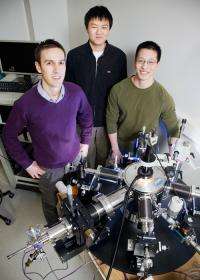
Electrical and computer engineering professor Eric Pop, from left, worked with undergraduate Yang Zhao and graduate student Albert Liao, both in ECE, to demonstrate a remarkable increase in the current-carrying capacity of carbon nanotubes. Photo by L. Brian Stauffer

(PhysOrg.com) -- By pushing carbon nanotubes close to their breaking point, researchers at the University of Illinois have demonstrated a remarkable increase in the current-carrying capacity of the nanotubes, well beyond what was previously thought possible.

The researchers drove semiconducting carbon nanotubes into an avalanche process that carries more electrons down more paths, similar to the way a multilane highway carries more traffic than a one-lane road.

"Single-wall carbon nanotubes are already known to carry current densities up to 100 times higher than the best metals like copper," said Eric Pop, a professor of electrical and computer engineering at the U. of I. "We now show that semiconducting nanotubes can carry nearly twice as much current as previously thought."

As reported in the journal Physical Review Letters, the researchers found that at high electric fields (10 volts per micron), energetic electrons and holes can create additional electron-hole pairs, leading to an avalanche effect where the free carriers multiply and the current rapidly increases until the nanotube breaks down.

The sharp increase in current, Pop said, is due to the onset of avalanche impact ionization, a phenomenon observed in certain semiconductor diodes and transistors at high electric fields, but not previously seen in nanotubes.

While the maximum current carrying capacity for metallic nanotubes has been measured at about 25 microamps, the maximum current carrying capacity for semiconducting nanotubes is less established. Previous theoretical predictions suggested a similar limit for single-band conduction in semiconducting nanotubes.

To study current behavior, Pop, graduate student Albert Liao and undergraduate student Yang Zhao first grew single-wall carbon nanotubes by chemical vapor deposition from a patterned iron catalyst. Palladium contacts were used for measurement purposes. The researchers then pushed the nanotubes close to their breaking point in an oxygen-free environment.

"We found that the current first plateaus near 25 microamps, and then sharply increases at higher electric fields," said Pop, who also is affiliated with the Beckman Institute and the Micro and Nanotechnology Laboratory at the U. of I. "We performed repeated measurements, obtaining currents of up to 40 microamps, nearly twice those of previous reports."

By inducing very high electric fields in the nanotubes, the researchers drove some of the charge carriers into nearby subbands, as part of the avalanche process. Instead of being in just one "lane," the electrons and holes could occupy several available lanes, resulting in much greater current.

The avalanche process (which cannot be observed in metallic carbon nanotubes because an energy gap is required for electron-hole multiplication) offers additional functionality to semiconducting nanotubes, Pop said. "Our results suggest that avalanche-driven devices with highly nonlinear turn-on characteristics can be fashioned from semiconducting single wall nanotubes."

Provided by University of Illinois at Urbana-Champaign


print this article email this article download pdf blog this article bookmark this article     Stumble it Digg this share on Facebook retweet share on Reddit add to delicious
Rate this story - 4.5 /5 (12 votes)


February 9, 2009 all stories

Comments: 0

4.5 /5 (12 votes)
  • Stumble this up

  • Digg this

  • share this

  • hide
  • Related Stories

  • Carbon nanotubes may cheaply harvest sunlight
    created Oct 19, 2009 | popularity not rated yet | comments 0
  • Opposites attract -- but they may not stay together
    created Sep 24, 2009 | popularity not rated yet | comments 0
  • Nuclear fusion research key to advancing computer chips
    created Aug 18, 2009 | popularity not rated yet | comments 0
  • High-intensity lights may help cut energy costs
    created Jul 13, 2009 | popularity not rated yet | comments 0
  • Electric fish could spark healthcare innovation
    created Jun 19, 2009 | popularity not rated yet | comments 0


  • hide
  • Relevant PhysicsForums posts

  • I need some help with this project (optics and lens design)
    created 31 minutes ago
  • black hole gravity
    created 1hour ago
  • Photoelectric effect
    created 3 hours ago
  • Ranges of coherence lengths for......
    created 6 hours ago
  • More from Physics Forums - General Physics

Other News

Findings show nanomedicine promising for treating spinal cord injuries

Findings show nanomedicine promising for treating spinal cord injuries

Nanotechnology / Bio & Medicine

created 16 hours ago | popularity 4.5 / 5 (4) | comments 0

(PhysOrg.com) -- Researchers at Purdue University have discovered a new approach for repairing damaged nerve fibers in spinal cord injuries using nano-spheres that could be injected into the blood shortly ...


New Digital 'Electronics' Concept May Continue Moore's Law

New Digital 'Electronics' Concept May Continue Moore's Law

Nanotechnology / Nanophysics

created Nov 05, 2009 | popularity 4.6 / 5 (55) | comments 9

(PhysOrg.com) -- Computers of the future could be operating not on electrons, but on tiny waves traveling through an electron "fluid," if a new proposal is successful. The new circuit design, recently introduced ...


Nanoparticles for gene therapy improve

Nanoparticles for gene therapy improve

Nanotechnology / Bio & Medicine

created Nov 06, 2009 | popularity 5 / 5 (4) | comments 3

(PhysOrg.com) -- About five years ago, Professor Janet Sawicki at the Lankenau Institute in Pennsylvania read an article about nanoparticles developed by MIT's Robert Langer for gene therapy, the insertion ...


Breakthrough in industrial-scale nanotube processing

Breakthrough in industrial-scale nanotube processing

Nanotechnology / Nanomaterials

created Nov 02, 2009 | popularity 4.9 / 5 (20) | comments 3

(PhysOrg.com) -- Rice University scientists today unveiled a method for the industrial-scale processing of pure carbon-nanotube fibers that could lead to revolutionary advances in materials science, power ...


Nanoparticles may cause DNA damage across a cellular barrier

Nanoparticles may cause DNA damage across a cellular barrier

Nanotechnology / Bio & Medicine

created Nov 05, 2009 | popularity 4.3 / 5 (9) | comments 1

(PhysOrg.com) -- Scientists have shown in the laboratory that metal nanoparticles damaged the DNA in cells on the other side of a cellular barrier. The research, by the University of Bristol, is published ...