Astronauts Swab the Deck
February 9, 2009
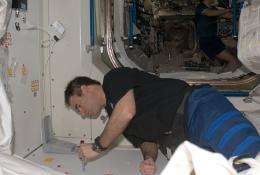
Astronaut Greg Chamitoff swabs for fungi on Aug. 20, 2008

Enlarge

Astronaut Greg Chamitoff swabs for fungi on Aug. 20, 2008

If you saw a mushroom growing in your bathroom, you'd probably bring out the heavy artillery. - Mr. Clean, astride a Howitzer

Even in space, someone has to clean the bathroom. Good housekeeping is essential when you're living in the close quarters of a tightly-sealed spaceship for months at a time. To make this possible, NASA scientists have developed a tricorder-like device called "LOCAD-PTS" that can track down microscopic bacteria and fungi. It helps astronauts do their chores--no Howitzer required.

"The crew of the space station works hard to keep things clean," says Norm Wainwright, principal investigator for LOCAD-PTS (Lab-On-A-Chip Application Development Portable Test System) at the Marshall Space Flight Center. "Our instrument tells them where to focus their efforts."

Strange, but true: LOCAD works using enzymes from the immune system of a horseshoe crab. Astronauts swab a surface with a high-tech Q-tip, insert a sample into the LOCAD device, and crab-chemistry does the rest. In less than 15 minutes, the LOCAD test system tells the crew if they've got some cleaning to do.

During March to May 2007, astronaut Sunita "Suni" Williams proved LOCAD's adeptness at detecting gram negative bacteria in the space station's Node 1 and US Lab.

In June and September 2008, a station crew tested a second type of LOCAD cartridge, designed to detect fungi. First, they tested Node 1 and found it virtually fungi-free.

That sounds like great news, but it didn't help the LOCAD scientists prove the abilities of the new cartridge.

So just a couple of weeks ago, astronaut Sandy Magnus decided to play hard ball. She thought of a place that would surely be a fungi factory - the spot where crewmembers put their feet to brace themselves while working on their laptops.

Wrong. Clean.

A determined fungi-finder, Magnus tried another location. She went to the "gym," where station astronauts ride a modified exercise bike and a treadmill to combat the muscle weakening effects of microgravity. To keep themselves from floating up off the bicycle seat while pedaling, the sweaty space cyclers hold onto hand brackets.

You guessed it -- fungi are thoroughly enamored with an oft-sweaty surface. LOCAD ratted out some hand bracket fungi.

"The fungi posed no immediate health concern to the crew," says Maule, LOCAD-PTS project scientist. "But Magnus called to Houston to say, 'Tomorrow I'm going to give those brackets a good cleaning.' That's just what we want -- the intuitive reaction 'I need to clean that.'"

In years to come, spacecraft cleanliness will be a critical issue for another reason: "One of the key scientific goals for NASA's future Constellation missions beyond low Earth orbit will be to prepare to search for life on Mars," says Maule.

All humans carry stowaway microbes around with them on their skin, microbes that shouldn't be allowed to contaminate Mars samples. On the other hand, they don't want to bring unwanted alien life forms back into the spacecraft.

"The crew will need a way to monitor themselves before and after EVA [extra-vehicular activity]," says Maule. "LOCAD is ideal for that purpose. We've used it successfully during EVA tests on the ground."

The LOCAD team has also conducted several tests in the US Quest airlock, the conduit from the interior cabin to the outside of the space station where the crew "camps out" overnight and depressurizes before venturing outside. LOCAD proved the airlock to be pretty clean in general, but showed that the handle to the airlock entrance harbored gram negative bacteria. Bacteria on a surface like the airlock handle would be a concern if crew members were about to embark on a sample collecting excursion on Mars.

It would seem that finding fungi onboard the ISS is just the beginning for LOCAD. There are chores to be done ... and the whole solar system awaits.

Source: by Dauna Coulter, Science@NASA


Rank not rated yet
Related Stories
Relevant PhysicsForums posts
  • Never ending outer space.....
    created13 hours ago
  • Neutron Star fragments?
    created15 hours ago
  • stationary or not?
    created19 hours ago
  • Scale of the Universe
    createdFeb 10, 2012
  • Titan's lack of impact craters
    createdFeb 09, 2012
  • Real pictures of black hole eating a star?
    createdFeb 08, 2012
  • More from Physics Forums - General Astronomy

More news stories

Latin America mining boom clashes with conservation

Latin America is experiencing a mining boom as prices rise fuelled by a hike in global demand, but the region is also being hit by a wave of violent protests, strikes and rallies by environmentalists.

Space & Earth / Environment

created 6 hours ago | popularity not rated yet | comments 0

Political leaders play key role in how worried Americans are by climate change: study

More than extreme weather events and the work of scientists, it is national political leaders who influence how much Americans worry about the threat of climate change, new research finds.

Space & Earth / Environment

created Feb 06, 2012 | popularity 5 / 5 (6) | comments 72

NASA budget will axe Mars deal with Europe: scientists

US President Barack Obama's budget proposal to be submitted next week for 2013 will cut NASA's budget by 20 percent and eliminate a major partnership with Europe on Mars exploration, scientists said Thursday.

Space & Earth / Space Exploration

created Feb 10, 2012 | popularity 5 / 5 (3) | comments 55

Humans may have helped the decline of African rainforests 3000 years ago

(PhysOrg.com) -- Large areas of rainforests in Central Africa mysteriously disappeared over three thousand years ago, to be replaced by savannas. The prevailing theory has been that the cause was a change ...

Space & Earth / Environment

created Feb 10, 2012 | popularity 4.1 / 5 (14) | comments 20 | with audio podcast report

Study shows global glaciers, ice caps, shedding billions of tons of mass annually

Earth's glaciers and ice caps outside of the regions of Greenland and Antarctica are shedding roughly 150 billion tons of ice annually, according to a new study led by the University of Colorado Boulder.

Space & Earth / Earth Sciences

created Feb 08, 2012 | popularity 4.4 / 5 (9) | comments 14 | with audio podcast


Google might launch Drive for cloud storage soon

(PhysOrg.com) -- Google's next big move, according to the Wall Street Journal, is a cloud storage service called Drive. Hardly first to the plate, Google is simply catching up to introducing its cloud reposi ...

Love a click away in Indonesia's Twitter Republic

He was a geeky kid from Yogyakarta, she a glamorous city girl in Jakarta. In a country with one of the world's most vibrant social networking scenes they fell in love on Twitter.

Europeans protest controversial Internet pact

Tens of thousands of people marched in protests in more than a dozen European cities Saturday against a controversial anti-online piracy pact that critics say could curtail Internet freedom.

Walney offshore wind farm is world's biggest (for now)

(PhysOrg.com) -- The Walney wind farm on the Irish Sea--characterized by high tides, waves and windy weather--officially opened this week. The farm is treated in the press as a very big deal as the Walney ...

Navy to begin tests on electromagnetic railgun prototype launcher

The Office of Naval Research (ONR)'s Electromagnetic (EM) Railgun program will take an important step forward in the coming weeks when the first industry railgun prototype launcher is tested at a facility ...

Explained: Sigma

It's a question that arises with virtually every major new finding in science or medicine: What makes a result reliable enough to be taken seriously? The answer has to do with statistical significance -- but ...