How gorilla gestures point to evolution of human language
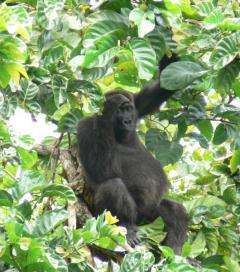
(PhysOrg.com) -- Scientists at the University of St Andrews have discovered that gorillas have a more extensive repertoire of gestures than any other mammal.
Researchers examined the communication signals of the gorilla, a great ape and one of our closest relatives. The study found that ape gestures are carried out with close attention to the potential audience: silent ones are only given when other apes can see them.
The new study was conducted by Professor Richard Byrne, Dr Emilie Genty and Ms. Cat Hobaiter at the School of Psychology and Dr Thomas Breuer at the Max Planck Institute for Evolutionary Anthropology, Leipzig. Their study catalogued gestures - some given exotic sounding labels, like 'disco arms shake' - amongst several different gorilla groups.
Professor Byrne explained, "There has always been speculation that the origins of human language might lie in gesture, an idea supported by the close proximity of the brain areas involved in language and gesture. Many researchers have therefore studied the gestural communication of the great apes for clues to the evolutionary origins of human gesture.
"But there is a persisting puzzle: each population seems to use a somewhat different repertoire of gestures, suggesting that individuals learn their gestures; yet there is no sign of local `dialects¿ of gesture, group-specific gesture traditions, as would be expected if they learnt the gestures from each other."
The researchers were able to study gorillas at more sites than before, and were also able to draw upon previous work to investigate the gorilla repertoire, which eventually totalled 102 gesture types.
Whilst some common gestures like 'arm swing with object' and 'tapping other' were shared by all groups they studied, others were found only at a few places; one, the 'disco arms shake', was unique to a single gorilla and performed only to a human, not to other gorillas.
The investigators found that juvenile and adolescent animals, aged between three and ten years, were responsible for using the highest number of gesture types compared to a smaller variety used by infants under three, or by adults of either sex.
Professor Byrne continued, "What we found was that, as we added more populations to the study, most gestures that had seemed specific to one individual or one site almost always turned up elsewhere.
"Any two populations are likely to differ a lot in the repertoire of gestures shown, but all are drawn from a very large, species-wide 'pool' of possible gestural signals."
Consequently, the team concluded that the gestures do not need to be learnt, because they are already part of the natural gorilla communicative repertoire.
"What is particularly notable about great ape gesture repertoires, then, is not that they are acquired by learning (like human language), but that they are so much larger than repertoires of other mammals," said Professor Byrne.
The new work throws light on another puzzle in the behaviour of great apes. Several studies have found that apes are capable of the "Do as I do" routine that children also enjoy, but their copies of human actions modelled for them are relatively inexact.
Professor Byrne explained, "Dr Joanne Tanner and I studied a female gorilla that was able to do this, and we found that all her 'copies' of apparently novel human actions were really actions she'd done herself, sometimes years before: they matched the demonstrated actions pretty well, but not exactly. It was only because of Tanner's long-term data on the gorillas that we could find out what was going on.
"So we think that, just as in the case of communicative gestures, the fact that apes have a huge repertoire of actions can explain how they imitate human demonstrations and why their copies are usually inexact: they are 're-using' actions from their own repertoire, not learning new ones."
Provided by University of St Andrews


